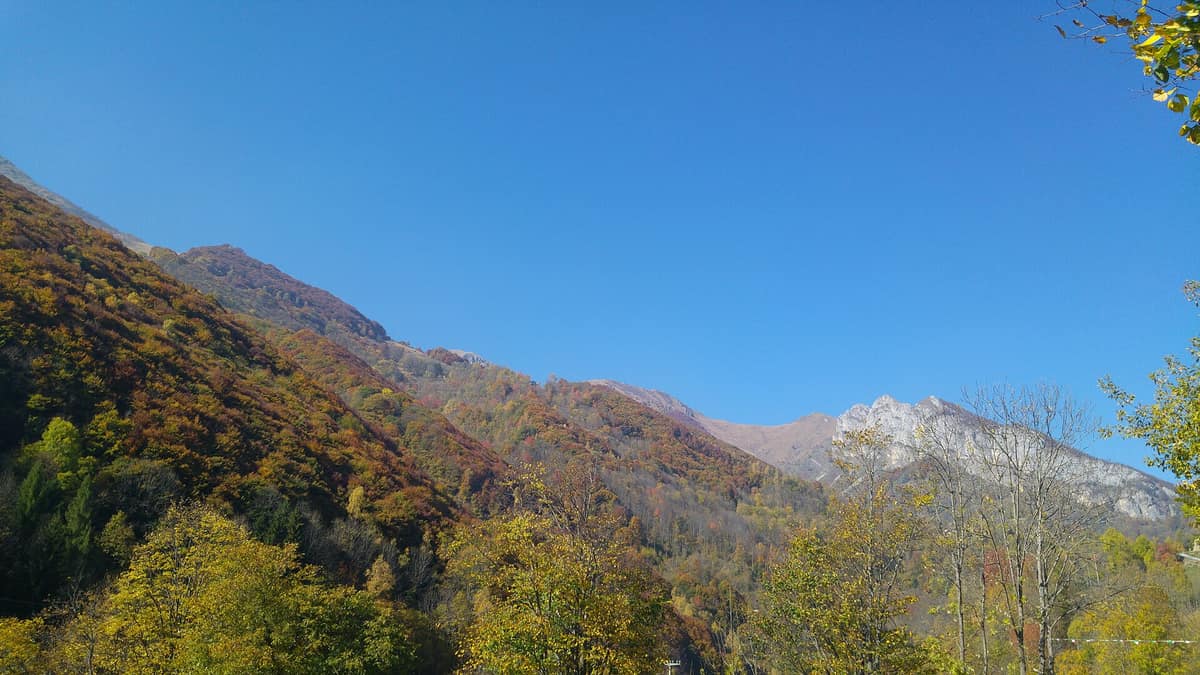
Maritime Alps Natural Park
Parco Naturale delle Alpi Marittime
Piedmont (Cuneo / Valdieri / Entracque) · Italy
Photo: IlariaBarison · CC BY-SA 4.0 · Wikimedia Commons
United with France's Mercantour National Park, it forms a massive cross-border Alpine-Mediterranean wilderness crowned by Mount Argentera (3.297 m).
The kings of Savoy once hunted across these crags. In 1857, Victor Emmanuel II created the Royal Hunting Reserve of Valdieri-Entracque, from which the present park emerged in 1980 as the largest protected natural area in Piedmont. What was once an exclusive royal estate is now a maze of narrow glens, summits rising to 3.297 m, and glacial tarns accessible on foot, with alpine ibex traversing high ledges and alpine marmots whistling at approaching walkers.
What makes it unique
Here lie the southernmost glaciers in the Alps just steps from the Mediterranean, sheltering an endemic flora that exists nowhere else.
The place
Nature
The landscape
The park encompasses the upper Gesso valley, the upper Grande di Palanfrè valley, and the rugged ravines of Valletta and Reduc. Nearly the entire territory drains into the Gesso torrent, which descends almost linearly for roughly 25 km toward the plains of Cuneo. The terrain climbs steeply from 750 m to 3.297 m between the Argentera and Gelàs massifs.
It is a forbidding, rocky landscape. Almost half the surface area, some 47 %, consists of bare rock faces and scree slopes. Because crystalline basement rocks strongly resist erosion, valleys remain narrow and deeply incised, slopes are precipitous, and forests are restricted. Quaternary glaciers shaped the rest: major valleys display classic U-shaped cross-sections, with each headwall cradling tarns within extinct glacial cirques. Perennial snowfields and pocket glaciers of Pyrenean character linger, with those on Monte Gelàs standing as the southernmost glaciers in the entire Alpine chain.
Vegetation ascends through distinct elevation zones. The montane belt is dominated by beech forests covering most woodland areas, accompanied by silver fir in the Pesio valley and mountain pine in the Carnino valley. Subalpine pastures are dotted with alpenrose, green alder, and dwarf juniper, while traditional summer livestock shelters (gias) foster organically enriched soils that support specialized nitrophilous plant communities. Higher still in the alpine belt, sheltered north-facing couloirs hold snow patches year-round.
Wildlife and seasons
The park is renowned as an Alpine glacial refuge: its southerly latitude and maritime proximity foster a rich flora of roughly 1.800 species, including thirteen endemics and two micro-endemics. Among alpine rocks bloom Saxifraga florulenta, Galium tendae, and Silene cordifolia, with Viola valderia and Viola argenteria colonizing scree slopes. Around Valdieri, an isolated relict population of Phoenicean juniper bears witness to prehistoric Mediterranean penetrations.
Among wildlife, the chamois is the park's emblem and its most widespread ungulate, numbering over 4.000 individuals. The alpine ibex returned through releases begun in 1920 using stock from Gran Paradiso, generally dwelling higher than chamois. The alpine marmot is gregarious and readily observed. With the return of the wolf to the Maritime Alps, non-native mouflon have become easy prey in heavy snow, curbing their presence.
For birds, scan cliffs and screes. Roughly eighty species inhabit the park, with 75 breeding locally: the golden eagle among raptors, rock ptarmigan and black grouse among mountain galliformes, and the wallcreeper on sheer walls. Since 1993, the park has partnered with Mercantour to reintroduce the bearded vulture, releasing eight pairs of juveniles in Piedmont up to 2006. Butterflies feature some fifty endemic forms native to the Maritime and Cottian Alps, including Parnassius apollo valderiensis at Terme di Valdieri.
Species
With a page in the atlas
Being mentioned in a source doesn't guarantee sightings: check with the people who manage the area.
Memory and protection
History and conservation
The park originated in 1980 as Parco Naturale dell'Argentera, receiving the European Diploma of Protected Areas in 1993. It shares more than one third of its boundary along its southern and southwestern perimeter with France's Mercantour National Park, with which it has been twinned for over thirty years.
Before you set off
Visiting
How to visit
The Centro Uomini e Lupi operates in two sections: the town visitor centre in Entracque and the wildlife enclosure at Casermette. At Terme di Valdieri, an additional centre features a permanent exhibit on protected areas of the Gesso valley, flanked by the Valderia Botanical Garden showcasing roughly 500 plant species across fourteen distinct Alpine habitats. In Entracque, the Ultimi ghiacci exhibit explores climate change across the Mediterranean Alps, while in Sant'Anna di Valdieri the Museo della Civiltà della Segale documents traditional rye farming.
For walking routes, the managing authority hosts the portal Trekking nelle Alpi del Mediterraneo, featuring filters by village, distance, duration, and difficulty with downloadable GPS tracks. The park's staffed mountain refuges enable multi-day traverses connecting directly with Mercantour across the international border.
If you spot an ibex or chamois with ear tags or a GPS collar, record the location, colours, and date, taking a photo if possible: the park collects these sightings for citizen-science monitoring.
Before you go
Dogs must always be kept on a leash and are restricted to designated trails. Model aircraft are forbidden, and drones require prior official authorisation for professional purposes. In the park bivouacking in lightweight tents is allowed from one hour before sunset until one hour after sunrise. Open campfires on the ground are prohibited year-round outside equipped barbecue sites, as is feeding or placing salt to lure wildlife. Check operating hours and trail conditions with park visitor centres before departing.
Check access, rules and visiting conditions in the official information from the managing body before you set off.
Location
Where it is and how far it reaches
Boundary of Parco naturale delle Alpi Marittime · IUCN IV · © EEA, CDDA (CC-BY) The coordinate is estimated; it isn't a verified access point.
Transparency
Sources
The research data with its sources, and the official links for this place, are in the Spanish version of this page. See the Spanish version
Around it
France's Parc National du Mercantour lies roughly 1 km across the frontier crest as the park's twin reserve. Further away, Parco Nazionale Gran Paradiso, Parco Nazionale dello Stelvio / Nationalpark Stilfserjoch, and Parc national de la Vanoise share ibex, chamois, bearded vultures, and high-alpine glaciated biomes.
What else to explore nearby
Approximate straight-line distance between the edges of each area. It doesn't indicate access, routes or driving times.
- Mercantour National Park
Alpes-Maritimes / Alpes-de-Haute-Provence (Saint-Martin-Vésubie / Barcelonnette)
About 1 km away
Historic site of the natural return of the wolf to France from Italy (1992), spanning from the Alps to the Mediterranean.
JFMAMJJASONDJune – October · Crowding low
If you like this place, elsewhere in Europe
Distant places with uncommon wildlife and habitats in common. The most widespread species don't count. Sharing species doesn't imply a corridor or guaranteed presence.
- Vanoise National Park
Auvergne-Rhône-Alpes (Savoie)
In common: Lagopus mutus · Black grouse · Wallcreeper — high mountain, glacial landscape
France's first national park (1963), created to save the Alpine ibex: glaciers, alpine grasslands, and one of the Alps' greatest ibex populations.
JFMAMJJASONDJune – September · Crowding moderate
- Aigüestortes and Lake Saint Maurici National Park
Catalonia (Lleida)
In common: Pyrrhocorax graculus · Alpine marmot · Bearded vulture — high mountain, glacial landscape, old-growth forest
The only National Park in Catalonia, a glacial circus wonderland harboring over 200 tarns (estanys) beneath the iconic twin summits of Els Encantats.
JFMAMJJASONDJune – October · Crowding moderate
- Gran Paradiso National Park
Aosta Valley / Piedmont (Cogne / Valsavarenche / Ceresole Reale)
In common: Alpine marmot · Alpine ibex · Bearded vulture — high mountain, glacial landscape, old-growth forest
Italy's oldest national park (1922): the last surviving Alpine ibex population held out here and repopulated the entire range.
JFMAMJJASONDJune – September · December – January · Crowding moderate
Entry #547 of the original atlas.