Mercantour National Park
Parc National du Mercantour
Alpes-Maritimes / Alpes-de-Haute-Provence (Saint-Martin-Vésubie / Barcelonnette) · France
Photo: Lulucmy · CC BY-SA 4.0 · Wikimedia Commons
Historic site of the natural return of the wolf to France from Italy (1992), spanning from the Alps to the Mediterranean.
On 5 November 1992, park rangers sighted two wolves. No one had released them: they had arrived on their own from Italy, and with them the wolf returned to France. The place where it happened is the Mercantour National Park, a massif between Alpes-Maritimes and Alpes-de-Haute-Provence stretching from alpine summits to the Mediterranean. Today it shares wildlife monitoring with Italy and preserves what was once a royal hunting preserve.
What makes it unique
Within a single massif coexist the wolf that returned on its own, some 36 000 Bronze Age rock engravings in the vallée des Merveilles, and over 2 300 plant species, more than one hundred of them endemic.
The place
Nature
The landscape
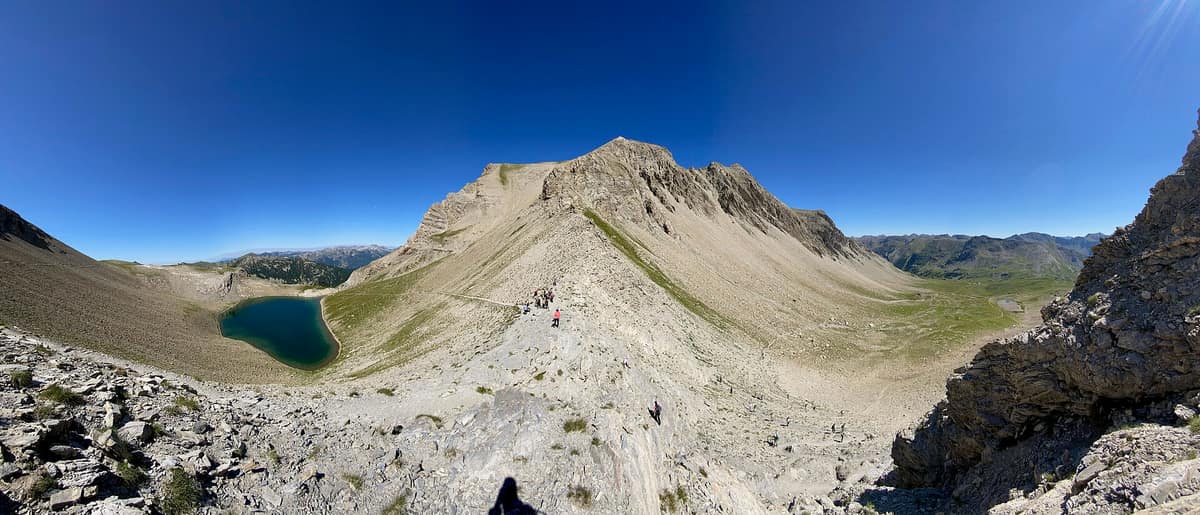
Everything you see was carved by ice and water. Until the beginning of the twentieth century, glaciers covered the heights of the massif, and together with rivers shaped the reliefs and valleys. Hence glacial lakes like Lake Allos, at 2 230 metres, the largest natural high-mountain lake in Europe: it occupies a cirque hollowed out by Quaternary glaciers of the upper Verdon, is dominated by Mount Pelat, and has no surface outlet. Its water escapes through an underground passage that emerges at the Chadoulin spring, flowing from there into the Verdon.
The rock tells the same story in two tones. The core of the massif along the border consists of crystalline rocks, surrounded by sedimentary strata. Six main valleys traverse it: Roya and Bévéra, Vésubie, Tinée, Haut-Var and Cians, Ubaye, and Verdon. The core zone covers 68 500 hectares, with its highest point at the summit of Gélas, at 3 143 metres.
This blend of rock types and elevations explains the flora. Deciduous trees—downy oak, Scots pine, holm oak—give way to conifers, including silver fir, Norway spruce, European larch, and Swiss stone pine up to 2 200 metres, above which alpine species begin. Plants with very restricted distributions include the many-flowered saxifrage, Moggridge fritillary, Allioni primrose, Ligurian gentian, and Reichenbach butterwort. The massif also served as a glacial refuge for alpine relics such as woolly berardia. Beside Lake Allos grow alpine meadows, alpine poppy, rusty-leaved alpenrose, and larches.
Wildlife and seasons
Walk with attentive ears: in summer, hikers readily spot chamois—several thousand live in the park—and often hear marmots whistling. With luck, alpine ibex and mouflon reveal themselves during the cooler hours of the day. There are more than 8 000 chamois and 1 100 ibex, alongside red deer, wild boar, roe deer, and abundant marmots.
Animals follow a calendar that knows no borders. Ibex spend the summer in the Mercantour after overwintering in the Argentera, while mouflon make the reverse journey. For this reason, the park and its Italian neighbour monitor wildlife together. Ibex fitted with ear tags or GPS collars help researchers understand these movements, and the park asks hikers to report every sighting: date, time, and exact location.
Up above, birds rule the skies. The park hosts 153 species, where you can watch the bearded vulture, reintroduced since 1993, the golden eagle, black grouse, ptarmigan, and at high altitudes, the yellow-billed chough and red-billed chough. The bearded vulture remains vulnerable due to its small population.
And then there is the wolf. Following that first sighting in 1992, the park supported shepherds with nocturnal corrals and Pyrenean Mountain Dogs (patous). In the most discreet corners of the massif lives the Lanza's alpine salamander, measuring 15 cm: its range is only partially documented, and the park asks hikers who spot one to record its position and take a photograph.
Species
With a page in the atlas
Being mentioned in a source doesn't guarantee sightings: check with the people who manage the area.
Memory and protection
History and conservation
Protection here has deep roots. The heart of the massif became a royal hunting reserve in 1859 under Victor Emmanuel II, an early safeguard that laid the groundwork for the national park created in 1979. Since 1987 it has been twinned with Italy's Alpi Marittime park, sharing 33 km of border.
Long before, human communities left their mark: around Mount Bégo, petroglyphs carved into slate and granite date from the Late Neolithic and Bronze Age, while most livestock grazing today are transhumant, spending only the summer pasture season high up. The Brigasque sheep is a traditional breed of this territory, now considered endangered. Closer to our era, military relics survive from the eighteenth and nineteenth centuries and World War II, particularly around the Authion massif and the upper Tinée.
Active conservation continues: in one translocation, 19 ibex were moved from Vanoise to Vésubie to strengthen the genetic diversity of the population.
Before you set off
Visiting
How to visit
The park has 600 km of marked trails, including the GR 5, the GR 52A—the panoramic Mercantour trail crossing the Valley of Wonders—and the GR 56.
For an easy start, Lake Allos: a one-hour return walk from the Laus plateau car park, plus another hour to circuit the lake. There are many more lakes to explore: Lauzanier, the Vens lakes, Morgon lakes, and those of the Valley of Wonders.
If history is your focus, the vallée des Merveilles holds some 36 000 prehistoric rock carvings dating from the Neolithic and Early Bronze Age. They are spread across seven high valleys above 2 000 m around Mount Bégo, at 2 872 m. The ideal approach begins at the Musée des Merveilles in Tende, followed by a guided tour. In Saint-Martin-Vésubie, a dedicated wolf centre also welcomes visitors.
Before you go
In the vallée des Merveilles, the GR 52 allows you to view rock carvings from the trail, but stepping off the marked path without an accredited guide is strictly prohibited. Making engravings in the area is treated as criminal damage to a historic monument and the national park core zone.
If you look up at night, don't miss this: in June 2026 the entire national park became part of the expanded Alpes Azur Mercantour International Dark Sky Reserve.
Check access, rules and visiting conditions in the official information from the managing body before you set off.
Location
Where it is and how far it reaches
Boundary of Mercantour · IUCN II · © EEA, CDDA (CC-BY) The coordinate is estimated; it isn't a verified access point.
Transparency
Sources
The research data with its sources, and the official links for this place, are in the Spanish version of this page. See the Spanish version
Around it
The Parco Naturale delle Alpi Marittime is just 1 km away: it is the Italian park with which Mercantour shares its border and wildlife tracking. About 20 km away lies the Parc Naturel Régional du Queyras, and 26 km away the Parco naturale del Monviso.
What else to explore nearby
Approximate straight-line distance between the edges of each area. It doesn't indicate access, routes or driving times.
- Maritime Alps Natural Park
Piedmont (Cuneo / Valdieri / Entracque)
About 1 km away
United with France's Mercantour National Park, it forms a massive cross-border Alpine-Mediterranean wilderness crowned by Mount Argentera (3.297 m).
JFMAMJJASONDJune – October · Crowding low
- Queyras Regional Natural Park
Hautes-Alpes (Guillestre / Saint-Véran)
About 20 km away
A high alpine larch valley dominated by Mount Viso and punctuated by Saint-Véran, the highest inhabited village in Europe.
JFMAMJJASONDJune – October · Crowding low
- Monviso Natural Park
Piedmont — Po and Varaita Valleys (Province of Cuneo)
About 26 km away
Alpine pastures and rocky crags between the Po and Varaita valleys, harbouring the ancient stone pine forest of Alevè.
JFMAMJJASONDJuly – September · Crowding high
Entry #329 of the original atlas.