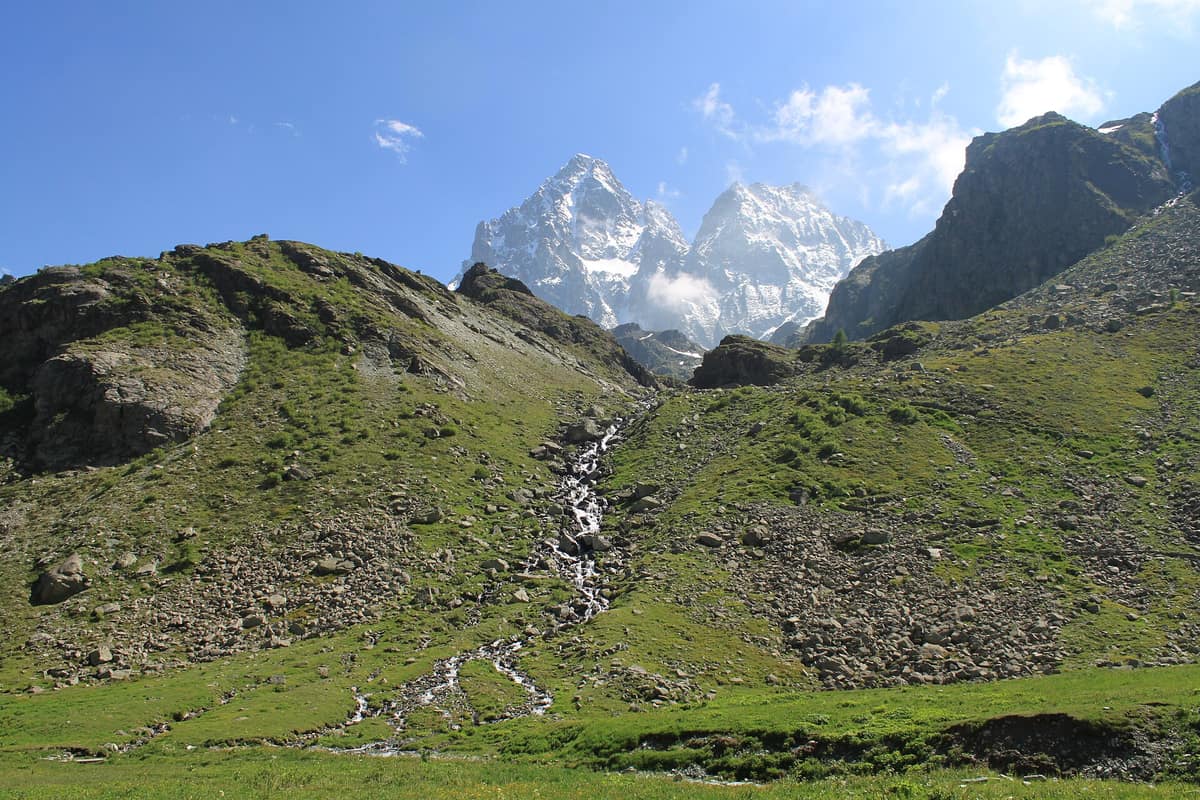
Monviso Natural Park
Parco naturale del Monviso
Piedmont — Po and Varaita Valleys (Province of Cuneo) · Italy
Photo: Yreen · CC BY-SA 4.0 · Wikimedia Commons
Alpine pastures and rocky crags between the Po and Varaita valleys, harbouring the ancient stone pine forest of Alevè.
The Po is born at the foot of a greenstone pyramid. At Pian del Re rises the River Po, beneath Monviso, which at 3841 metres stands as the highest summit of the Cottian Alps. Surrounding it spreads the Monviso Natural Park, established by regional law 19/2015 across the Po and Varaita valleys, extending from 1300 m up to the crest. It coincides largely with the special conservation area «Gruppo del Monviso e Bosco dell’Alevé», encompassed within the UNESCO MaB Biosphere Reserve of Monviso.
What makes it unique
A mountain of greenstone giving birth to the Po and cradling Europe’s southernmost pure Swiss pine forest.
The place
Nature
The landscape
Monviso belongs geologically to the greenstones group—oceanic volcanic rocks metamorphosed roughly 80 million years ago. This origin explains the turquoise hues of several high lakes: Lago Chiaretto owes its distinctive colour to smaragdite, a mineral derived from these local ophiolites.
The park encompasses two distinct worlds. In the upper Po valley, almost everything rises above the timberline among crags, scree slopes and boulder fields; in the Varaita valley, extensive woodlands unfold within the Bosco dell’Alevè. Overall, alpine environments predominate: high meadows, dwarf-shrub heathlands, rocks, scree and glacial relicts. Many upland pastures are still grazed seasonally by cattle and sheep.
The Alevè forest occupies some 825 hectares on the southern flank of the massif, between 1500 and 2500 m. It constitutes the largest pure Swiss stone pine forest (partly intermingled with larch) in the Western Alps and the southernmost pure stone pine stand in Europe. Beside Rifugio Bagnour stands the oldest pine in the woods, around 550 years old, listed since 2018 among the Monumental Trees of Italy. Stone pine was formerly far more widespread throughout the Alps before systematic clearance for pasture. Since 1949 the forest has been entered into the National Register of Seed Forests, harvested to re-establish new stone pine stands. Its name derives from the Occitan «èlvou», meaning Swiss stone pine.
Wildlife and seasons
Almost all wildlife here belongs to high-altitude zones. The Alpine ibex, Alpine marmot, chamois and red deer are the most conspicuous mammals, alongside the wolf and several bat species. Among birds, 117 species have been recorded, with 48 confirmed breeding. High ridges provide prime habitat for the ptarmigan and mountain hare, while black grouse and rock partridge inhabit lower slopes. In the Alevè woods, the spotted nutcracker caches seed reserves, actively regenerating the stone pine canopy.
Summer brings vultures. The griffon vulture is increasingly observed between July and September in the Po and Varaita valleys in scavenging groups. The bearded vulture is best seen in winter and early spring, particularly in the Varaita valley; it died out locally in the nineteenth century and returned following a reintroduction programme launched in 1986 in Austria's Hohe Tauern National Park. The cinereous vulture is a rare visitor; sightings can be logged on the park’s iNaturalist project.
The jewel among small fauna is Lanza's alpine salamander, an endemic amphibian of the Cottian Alps found nowhere else on Earth and the park’s most sensitive species. Pian del Re is where it is most reliably encountered, often spotted near the shores of Lago Fiorenza after rain. In damp conditions, take special care not to step on salamanders along trails or when parking at Pian del Re. Protected butterflies such as Parnassius apollo are also found.
Species
With a page in the atlas
Being mentioned in a source doesn't guarantee sightings: check with the people who manage the area.
Memory and protection
History and conservation
The first ascent of Monviso was achieved on 30 August 1861 by William Mathews, Frederick Jacomb and guides Jean-Baptiste and Michel Croz. The name derives from the Latin Mons Vesulus, signifying a «prominent, isolated mountain». Today park managers cite intensive tourism recreation as a key pressure on sensitive alpine birdlife.
Before you set off
Visiting
How to visit
Pian del Re is reached by car or via the shuttle bus from Pian della Regina or Crissolo—the recommended choice. There, a small visitor centre in the historic casermetta explains flora and fauna with displays, and an adjacent room provides information panels in four languages. In Casteldelfino, the Alevè centre interprets the stone pine forest with a life-size diorama.
Itinerary 1 of the Giro dei Laghi departs from Pian del Re, visiting lakes Fiorenza, Chiaretto, Lausetto and Superiore: 7.45 km, 390 m of elevation gain and about 3 hours. Sections of this lake circuit may remain snow-covered well into the summer season.
The premier long-distance route is the Giro del Monviso. The earliest documented circumnavigation was completed by the Englishman D. Forbes with a local guide on 1 July 1839. Today the loop covers 45 km with 2600 m of cumulative ascent, traversing between 1900 and 2950 m at the Colle delle Traversette; graded E with short technical passages for experienced walkers, it requires between two and five days depending on pace. It passes through the Buco di Viso, an ancient tunnel leading through into France, for which a torch is recommended.
Before you go
Dogs must be kept on a leash at all times. Tenting is permitted from one hour before sunset until two hours after sunrise, except within alpine peatlands. In areas designated as Natural Park, picking wild flowers and collecting fallen deer antlers are prohibited. Grazing is prohibited across alpine bogs. Always verify trail conditions and visitor centre opening hours before setting out; summer crowds are high at Pian del Re.
Check access, rules and visiting conditions in the official information from the managing body before you set off.
Location
Where it is and how far it reaches
Boundary of Parco naturale del Monviso · IUCN IV · © EEA, CDDA (CC-BY) The coordinate is estimated; it isn't a verified access point.
Transparency
Sources
The research data with its sources, and the official links for this place, are in the Spanish version of this page. See the Spanish version
Around it
Just 2 km away lies Parc Naturel Régional du Queyras. At twenty-two kilometres is Parco naturale della Val Troncea, and at twenty-six, Parc National du Mercantour.
What else to explore nearby
Approximate straight-line distance between the edges of each area. It doesn't indicate access, routes or driving times.
- Queyras Regional Natural Park
Hautes-Alpes (Guillestre / Saint-Véran)
About 2 km away
A high alpine larch valley dominated by Mount Viso and punctuated by Saint-Véran, the highest inhabited village in Europe.
JFMAMJJASONDJune – October · Crowding low
- Mercantour National Park
Alpes-Maritimes / Alpes-de-Haute-Provence (Saint-Martin-Vésubie / Barcelonnette)
About 26 km away
Historic site of the natural return of the wolf to France from Italy (1992), spanning from the Alps to the Mediterranean.
JFMAMJJASONDJune – October · Crowding low
If you like this place, elsewhere in Europe
Distant places with uncommon wildlife and habitats in common. The most widespread species don't count. Sharing species doesn't imply a corridor or guaranteed presence.
- Totes Gebirge - Karst Desert
Upper Austria / Styria (Hinterstoder / Bad Aussee)
In common: Lyrurus tetrix · Lepus timidus · Rock ptarmigan — high mountain
The 'Dead Mountains', Central Europe's largest high-alpine karst desert plateau (over 200 km² of exposed barren limestone void of surface water).
JFMAMJJASONDJune – October · Crowding low
- Dachstein Nature Reserve — Gosau, Hallstatt and Obertraun
Upper Austria — Gmunden; Gosau, Hallstatt and Obertraun
In common: Lyrurus tetrix · Rock ptarmigan — high mountain, old-growth forest
Karst topography, glaciers, alpine meadows and old-growth mountain forests above the Gosau lakes.
JFMAMJJASONDMarch – November · Crowding no data
- Vanoise National Park
Auvergne-Rhône-Alpes (Savoie)
In common: Pinus cembra · Rock ptarmigan — high mountain, glacial landscape
France's first national park (1963), created to save the Alpine ibex: glaciers, alpine grasslands, and one of the Alps' greatest ibex populations.
JFMAMJJASONDJune – September · Crowding moderate
Entry #1063 of the original atlas.