Vanoise National Park
Parc national de la Vanoise
Auvergne-Rhône-Alpes (Savoie) · France
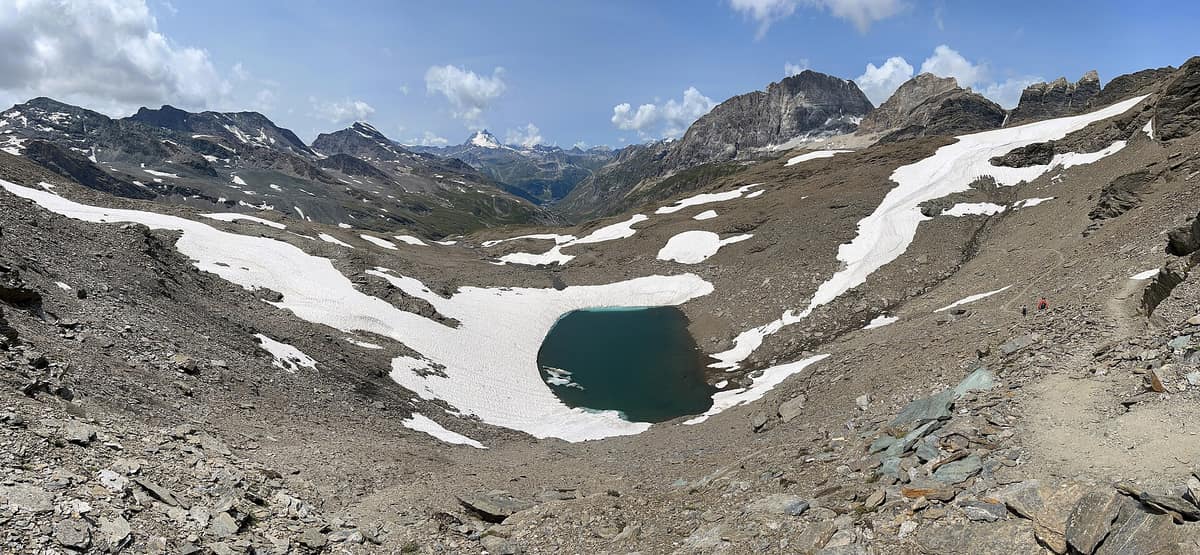
Photo: Tiia Monto · CC BY-SA 4.0 · Wikimedia Commons
France's first national park (1963), created to save the Alpine ibex: glaciers, alpine grasslands, and one of the Alps' greatest ibex populations.
It all began with a goat. The Alpine ibex had been systematically exterminated as soon as firearms appeared, and across the entire Vanoise massif only a tiny handful survived high on the southern slopes of the Maurienne—terrain so steep and inaccessible that it became their ultimate sanctuary. To save it, Vanoise National Park was created in 1963 as France's first national park. Today its 535 km² protected core, in Savoie, spans the valleys of the Tarentaise to the north and the Maurienne to the south, and the ibex remains its proud emblem.
What makes it unique
Created to save the Alpine ibex, it borders Italy's Gran Paradiso to form one of the largest continuous protected spaces in the Alps.
The place
Nature
The landscape
The Vanoise is a high-altitude world with welcoming manners. There are 107 peaks rising above 3.000 meters, including the Grande Casse (3.855 m), Mont Pourri (3.779 m), and Dent Parrachée (3.695 m), yet broad pastoral valleys separate them and provide gentle access to high mountain passes. That is why hiking is so beloved here: the terrain is towering, yet it leaves open doors.
Glaciers and high-altitude lakes grace the heights, while larches, mountain pine, and Swiss stone pine—known locally as arolle—dominate the timberline. Protected mountain blooms include the alpine androsace and edelweiss.
The landscape also preserves deep human roots. Prehistoric rock art is remarkably widespread across the park, with the most celebrated concentration found in the petroglyphs of Grand Roc Noir, shared among the communes of Termignon, Lanslebourg-Mont-Cenis, and Lanslevillard.
Wildlife and seasons
The ibex is king, numbering some 2.100 individuals in the park, but it is far from alone. The chamois numbers around 6.000, and the Alpine marmot is ubiquitous: no need to search for it, it finds you first. Completing the carnivore cast are wolves, lynx, mountain hares, badgers, and stoats.
Above, birds rule the skies. The bearded vulture and golden eagle soar along the cliffs; the rock ptarmigan, black grouse, and wallcreeper inhabit high crags, while the Eurasian eagle-owl represents nocturnal raptors.
Winter shifts the rules. Off-piste skiing is prohibited in designated black grouse wintering reserves to avoid fatal disturbance.
Species
With a page in the atlas
Being mentioned in a source doesn't guarantee sightings: check with the people who manage the area.
Memory and protection
History and conservation
The story of the Vanoise is that of a nature reserve that grew into a national park. In 1943 a natural reserve was established through the joint push of the French Alpine Club, the Touring Club de France, and hunting federations. In neighboring Gran Paradiso, barely a hundred ibex survived when hunting was banned in 1823, leading to a royal hunting reserve in 1856.
The park has repeatedly had to defend its core. Conservationists took the Val Thorens ski resort expansion to the Council of State over violations of the core park's inviolability; construction proceeded, but without expanding onto the glacier. Later came friction with local municipalities: twenty-six of twenty-nine communes rejected an initial park charter over bureaucracy and constraints on winter sports, leaving the surrounding transition zone sharply reduced when only two voted in favor of the revision.
Before you set off
Visiting
How to visit
The Vanoise is meant to be walked. An extensive network of nearly 400 km of marked trails radiates from the villages and ski resorts of the Maurienne and Tarentaise valleys, while the Rando Vanoise hiking portal offers some sixty circuits in the park's core and over 250 across the wider territory.
Two major trails cross the massif north to south: the Via Alpina and the GR 5. The GR 55 and the Tour of the Vanoise Glaciers also wind through the park, leading up to sparkling glaciers and hanging tarns. Multi-day traverses are facilitated by staffed mountain refuges, allowing you to string together consecutive days without descending to the valleys.
A classic moderate day hike is the ascent to Col de Plan Séry, which the park refuge estimates as a six-hour round trip.
Before you go
When planning a hike, assess elevation gain before distance: in the Vanoise, altitude gain is what counts. In July and August, visitor density is high around Pralognan and popular refuges. Respect designated black grouse wintering reserves if visiting on skis.
Check access, rules and visiting conditions in the official information from the managing body before you set off.
Location
Where it is and how far it reaches
Boundary of Vanoise · © EEA, CDDA (CC-BY) The coordinate is estimated; it isn't a verified access point.
Transparency
Sources
The research data with its sources, and the official links for this place, are in the Spanish version of this page. See the Spanish version
Around it
The Vanoise borders Italy's Gran Paradiso National Park just 1 km away: they share fourteen kilometers of frontier and have been officially twinned since 1972. Roughly twenty-two kilometers away lies the Gran Bosco di Salbertrand Natural Park, twenty-seven kilometers to the Belledonne Range, and thirty kilometers to the Écrins National Park.
Farther away, the Pyrénées National Park shares marmots, bearded vultures, and golden eagles, while Aigüestortes National Park shares ptarmigan, marmots, and bearded vultures.
What else to explore nearby
Approximate straight-line distance between the edges of each area. It doesn't indicate access, routes or driving times.
- Gran Paradiso National Park
Aosta Valley / Piedmont (Cogne / Valsavarenche / Ceresole Reale)
About 1 km away
Italy's oldest national park (1922): the last surviving Alpine ibex population held out here and repopulated the entire range.
JFMAMJJASONDJune – September · December – January · Crowding moderate
- Belledonne Mountain Range
Isère / Savoie (Grenoble / Chamrousse)
About 27 km away
Imposing crystalline rocky rampart without road passes soaring directly opposite the city of Grenoble.
JFMAMJJASONDJune – October · Crowding low
- Écrins National Park - Alpine Massif
Auvergne-Rhône-Alpes / Provence-Alpes-Côte d'Azur (Isère / Hautes-Alpes)
About 30 km away
The glaciated core of the French Alps (Barre des Écrins 4.102 m), with deep glacial valleys such as Valgaudemar and Vénéon.
JFMAMJJASONDJune – October · Crowding low
If you like this place, elsewhere in Europe
Distant places with uncommon wildlife and habitats in common. The most widespread species don't count. Sharing species doesn't imply a corridor or guaranteed presence.
- Maritime Alps Natural Park
Piedmont (Cuneo / Valdieri / Entracque)
In common: Lagopus mutus · Black grouse · Wallcreeper — high mountain, glacial landscape
United with France's Mercantour National Park, it forms a massive cross-border Alpine-Mediterranean wilderness crowned by Mount Argentera (3.297 m).
JFMAMJJASONDJune – October · Crowding low
- Retezat National Park
Hunedoara County (Hațeg)
In common: Pinus cembra · Leontopodium alpinum · Alpine marmot — high mountain, glacial landscape
The realm of the granitic and glacial Retezat, with over 80 crystal tarns and the Gemenele scientific reserve.
JFMAMJJASONDJune – October · Crowding low
- Dachstein Nature Reserve — Gosau, Hallstatt and Obertraun
Upper Austria — Gmunden; Gosau, Hallstatt and Obertraun
In common: Rock ptarmigan · Alpine marmot · Alpine ibex — high mountain
Karst topography, glaciers, alpine meadows and old-growth mountain forests above the Gosau lakes.
JFMAMJJASONDMarch – November · Crowding no data
- Rodna Mountains National Park
Bistrița-Năsăud and Maramureș Counties (Pietrosu Rodnei)
In common: Pinus cembra · Leontopodium alpinum · Alpine marmot — high mountain, glacial landscape
The highest glacial mountains in the Eastern Carpathians hosting the Pietrosu Rodnei scientific reserve.
JFMAMJJASONDJune – October · Crowding low
Entry #1015 of the original atlas.