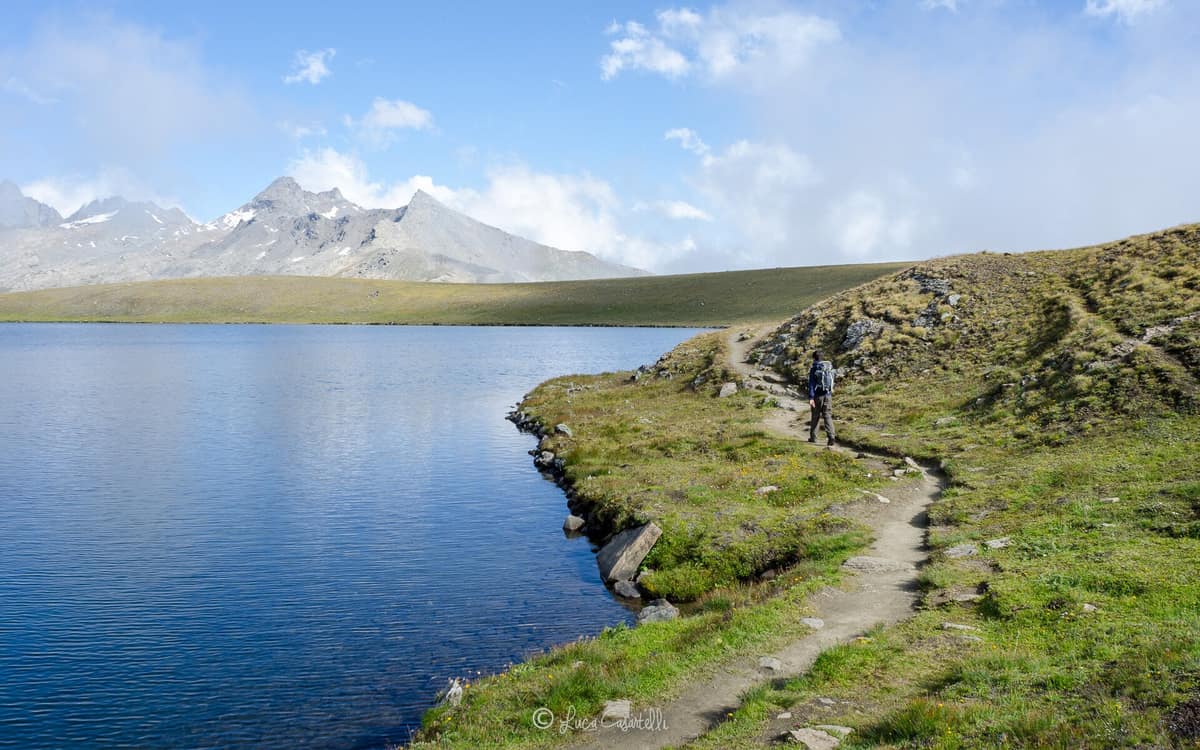
Gran Paradiso National Park
Parco Nazionale Gran Paradiso
Aosta Valley / Piedmont (Cogne / Valsavarenche / Ceresole Reale) · Italy
Photo: Luca Casartelli · CC BY-SA 3.0 · Wikimedia Commons
Italy's oldest national park (1922): the last surviving Alpine ibex population held out here and repopulated the entire range.
At the beginning of the nineteenth century, the ibex had almost vanished from the Alps: only about 60 individuals survived around Gran Paradiso and the Vanoise. Today, almost all modern Alpine ibex descend from that massif, which gives its name to Italy's oldest national park. Gran Paradiso National Park, established on 3 December 1922 between the Aosta Valley and Piedmont, is a history of hunting, royalty, and rescue written across five valleys of glaciers and high meadows.
What makes it unique
Here the protection of the ibex was born, and even today the animal that saved this massif presides over the park.
The place
Nature
The landscape
Gran Paradiso is the only massif over 4000 metres located entirely within Italy. The park encompasses five main valleys: Rhêmes, Cogne, Valsavarenche, Valle dell'Orco, and Val Soana. Between three thousand and 4000 metres there are 59 glaciers, more extensive on the Aosta Valley side. Glacial advance during Quaternary ice ages sculpted its geomorphology.
There are lakes to suit every taste. The largest and finest cluster around Colle del Nivolet, and the Savara torrent springs from the two Laghi del Nivolet. Water also thunders over drops: the Lillaz waterfalls near Cogne are the most spectacular, while on the Piedmontese side others cascade near Noasca.
Vegetation ascends with altitude. Beech woods appear only on the Piedmont slope between 800 and 1200 m, whereas larch and Swiss pine reach the highest subalpine level between 2,200 and 2,300 m. Above 2500 m, amid the crags, grow saxifrages, Alpine rock-jasmine, artemisia, and glacier buttercups.
Wildlife and seasons
The Alpine ibex is the park's flagship species: about 2700 in the September 2011 census, with adult males weighing 90 to 120 kg and boasting horns up to 100 cm. The chamois, counting over 8000 individuals, is no longer in danger because it lacks natural predators here. There are about 6000 Alpine marmots, the golden eagle has 27 pairs (2013 census), among the highest densities in the Alps, and the bearded vulture has nested again since 2011, though without success the first year.
Other birds include buzzards, woodpeckers, tits, rock ptarmigans, choughs, sparrowhawks, goshawks, tawny owls, and little owls. Native brown trout share torrents with brook trout introduced in the nineteen-sixties. In summer, ibex and chamois have few months to gain condition before the rutting season, so the park asks you to observe them from a distance.
Species
With a page in the atlas
Being mentioned in a source doesn't guarantee sightings: check with the people who manage the area.
Memory and protection
History and conservation
In 1821 King Charles Felix banned ibex hunting in his realms. In 1856 Victor Emmanuel II declared the Royal Hunting Reserve of Gran Paradiso, larger than the present park, ordering the construction of a network of more than 300 km of paved mule tracks linking villages and hunting lodges; the best-preserved section runs in the Valle dell'Orco from Colle del Nivolet. In 1922 the park was born from 21 km² donated by Victor Emmanuel III. After the war, ibex had dropped to about 400, and by 2005 numbered about 4,000.
Gran Paradiso was added to the IUCN Green List of Protected Areas in 2014. On the French side it borders Vanoise National Park.
Before you set off
Visiting
How to visit
Visitor centres are the best introduction. They are single-theme information points—the bearded vulture, the ibex, the chamois, geology, predators, traditional trades—with at least one in each main valley village; they usually open in summer, Christmas, Easter, and on holidays. In Degioz in Valsavarenche, «I preziosi predatori» is dedicated to the lynx and its return in the nineteen-seventies, with an area on the wolf; in Chanavey in Rhêmes-Notre-Dame, «Bentornato gipeto!» covers the bearded vulture and birdlife; in Ceresole Reale, «Homo et Ibex». The Paradisia Alpine Garden in Valnontey rounds off the visit.
The trail network exceeds 500 km across the five valleys. To reach Colle del Nivolet, the «A piedi tra le nuvole» initiative regulates private vehicle traffic in summer and promotes travel on foot, by bike, or by shuttle bus. Since 1992 there has also been an accessible trail for visually impaired visitors, covering one kilometre on gentle ground.
Before you go
Dogs are prohibited in the park, and camping is permitted only at established campsites. Collecting mushrooms, plants, or minerals is not allowed. You must stay on marked paths to avoid disturbing ground-nesting birds such as the rock partridge.
Check access, rules and visiting conditions in the official information from the managing body before you set off.
Location
Where it is and how far it reaches
Boundary of P N DEL GRAN PARADISO · © EEA, CDDA (CC-BY) The coordinate is estimated; it isn't a verified access point.
Transparency
Sources
The research data with its sources, and the official links for this place, are in the Spanish version of this page. See the Spanish version
Around it
Just 1 km away lie Parc national de la Vanoise and Parco Naturale Mont Avic. With glaciers, ibex, and bearded vultures, it resembles Stelvio and Alpi Marittime; and it shares marmots and bearded vultures with the Pyrenees in Parc national des Pyrénées and Aigüestortes.
What else to explore nearby
Approximate straight-line distance between the edges of each area. It doesn't indicate access, routes or driving times.
- Vanoise National Park
Auvergne-Rhône-Alpes (Savoie)
About 1 km away
France's first national park (1963), created to save the Alpine ibex: glaciers, alpine grasslands, and one of the Alps' greatest ibex populations.
JFMAMJJASONDJune – September · Crowding moderate
- Mont Avic Natural Park
Aosta Valley (Champdepraz / Champorcher)
About 1 km away
The first Natural Park in the Aosta Valley, featuring the region's largest continuous stand of mountain pine (Pinus uncinata) and over 30 glacial cirque tarns.
JFMAMJJASONDJune – October · Crowding very low
If you like this place, elsewhere in Europe
Distant places with uncommon wildlife and habitats in common. The most widespread species don't count. Sharing species doesn't imply a corridor or guaranteed presence.
- Aigüestortes and Lake Saint Maurici National Park
Catalonia (Lleida)
In common: Vipera aspis · Rock ptarmigan · Alpine marmot — high mountain, glacial landscape, old-growth forest
The only National Park in Catalonia, a glacial circus wonderland harboring over 200 tarns (estanys) beneath the iconic twin summits of Els Encantats.
JFMAMJJASONDJune – October · Crowding moderate
- Maritime Alps Natural Park
Piedmont (Cuneo / Valdieri / Entracque)
In common: Alpine marmot · Alpine ibex · Bearded vulture — high mountain, glacial landscape, old-growth forest
United with France's Mercantour National Park, it forms a massive cross-border Alpine-Mediterranean wilderness crowned by Mount Argentera (3.297 m).
JFMAMJJASONDJune – October · Crowding low
- Dachstein Nature Reserve — Gosau, Hallstatt and Obertraun
Upper Austria — Gmunden; Gosau, Hallstatt and Obertraun
In common: Rock ptarmigan · Alpine marmot · Alpine ibex — high mountain, old-growth forest
Karst topography, glaciers, alpine meadows and old-growth mountain forests above the Gosau lakes.
JFMAMJJASONDMarch – November · Crowding no data
- Pyrénées National Park
Occitanie / Nouvelle-Aquitaine (Hautes-Pyrénées / Pyrénées-Atlantiques)
In common: Alpine marmot · Bearded vulture · Golden eagle — high mountain, glacial landscape, alpine meadow, old-growth forest
The French slope of the central Pyrenees, twin to Ordesa: glacial cirques, bearded vultures, isards, and Pyrenean desmans.
JFMAMJJASONDJune – September · Crowding moderate
Entry #1019 of the original atlas.