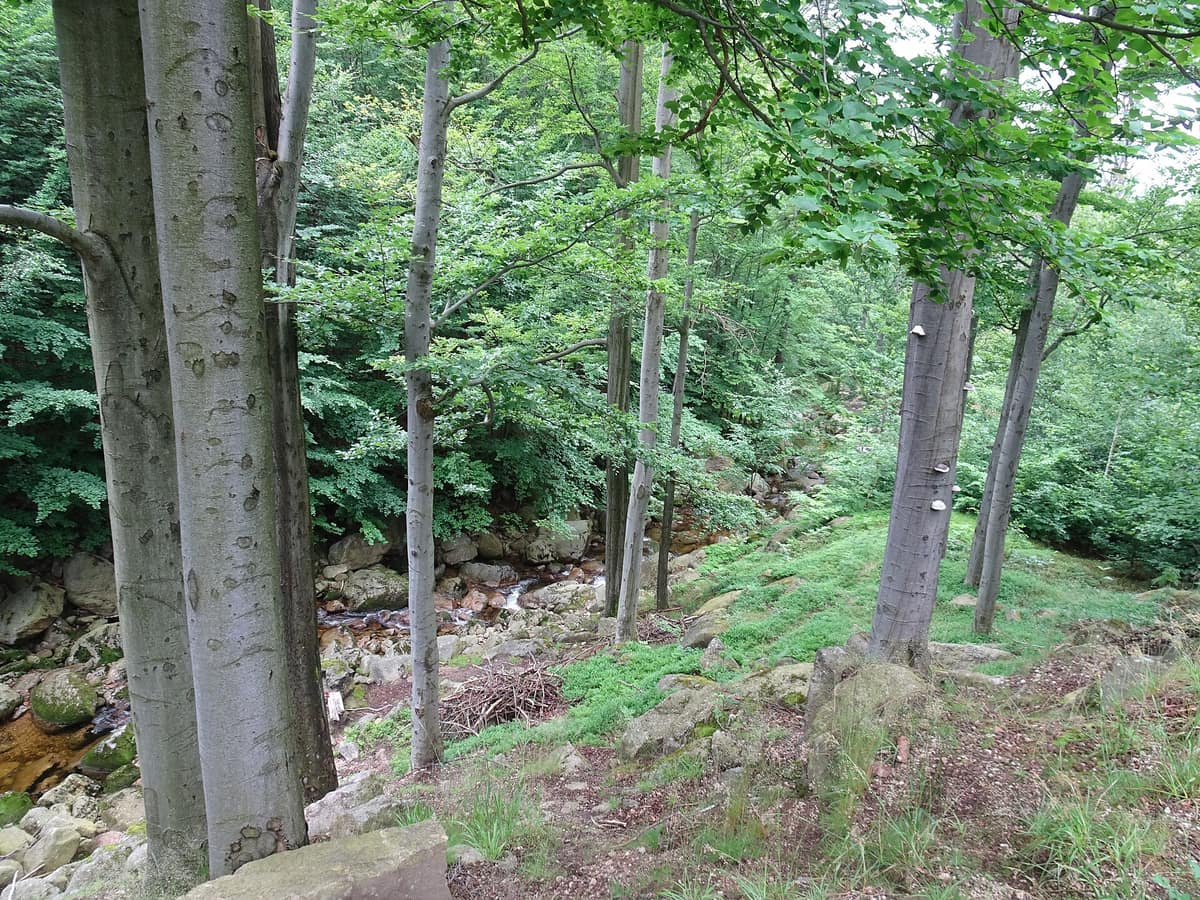
Jizera Mountains Beechwoods
Národní přírodní rezervace Jizerskohorské bučiny
Liberec Region (Jizera Mountains) · Czechia
Photo: Palickap · CC BY-SA 4.0 · Wikimedia Commons
Spectacular mountain slope clothed in ancient beechwoods with granite outcrops, inscribed by UNESCO.
There are forests that humankind left untouched simply because it was impossible to reach them. Across the northern flank of the Jizera Mountains, the slopes drop so steeply that the beechwoods of Jizerskohorské bučiny were spared from commercial felling, yielding a 27 km² nature reserve that in July 2021 became Czechia’s very first natural UNESCO World Heritage Site. You will not find easy park pathways here, but rather a wild mixed forest dominated by beech, punctuated by cataracts, granite towers, and craggy outlooks accessible solely via steep stone stairways and metal ladders.
What makes it unique
Beech forests on slopes so precipitous that loggers could not touch them, now protected under UNESCO European primeval beech forests.
The place
Nature
The landscape
The deep story began far beneath the surface. Roughly 325 million years ago, during the Variscan orogeny, molten granitic magma welled up from the depths. Much later, continental ice sheets from the Elsterian and Saalian glaciations advanced right up to these northern slopes. Between ice and frost, weathering has sculpted towers and ramparts of stone since late Tertiary times. That is why rocky crags and scenic lookouts abound: the entire reserve is an outdoor showcase of sculpted granite formations.
Water does the rest. Mean annual precipitation hovers around 1000 mm, draining northward toward the Baltic Sea basin. Along these steep gradients, waterfalls plunge: Velký Štolpich, dropping around 30 m, is the grandest waterfall in the Jizera Mountains; Černý potok falls 8 m, boasting the strongest flow and steepest gradient around a giant granite boulder split down its centre. The reserve spans an elevation from 360 m near the Dubina forestry lodge up to 1006 m atop Polední kameny. Only the historic 7 ha pond of Šolcův rybník, dating from the seventeenth century, opens up the continuous forest canopy with open water.
Wildlife and seasons
Historically, the most abundant canopy trees were Norway spruce, silver fir, and European beech, with spruce crowning the harsh montane crests. Botanical treasures include perennial honesty, martagon lily, and nine-leaved toothwort. Spruce-fern associations demand cold, wet microclimates, where mountain male fern carpets the forest floor.
Avian life in these mature beech forests includes the black stork, northern goshawk, European honey buzzard, red kite, black woodpecker, boreal owl, and red-breasted flycatcher. Granite tors and forest clearings provide nesting cliffs for the Eurasian eagle-owl and common raven, while rushing torrents harbour the white-throated dipper and grey wagtail. Both the fire salamander and slow worm are common, alongside mammals such as edible dormouse, Bechstein's bat, red fox, European pine marten, and red deer. Within Šolcův rybník, a viable population of native noble crayfish thrives.
Except for apex predators eradicated by human hunting, the present faunal assemblage has endured virtually unchanged for some seven thousand years.
Species
With a page in the atlas
Being mentioned in a source doesn't guarantee sightings: check with the people who manage the area.
Memory and protection
History and conservation
Humankind did not venture into these primeval beechwoods until the fourteenth century. In the sixteenth century glassmakers arrived, cutting timber for potash and fueling glassworks until the dawn of the twentieth century. The forest retains haunting traces of those logging eras: numerous wayside monuments commemorating fallen woodsmen. Searching for these pomníčky—modest stone monuments commemorating woodsmen killed on the job, fatal skirmishes between gamekeepers and poachers, or suicides—is a cherished local tradition. In the late thirties a chain of border fortifications was erected, entering the western fringe of the reserve.
The modern reserve was created on 16 August 1999 by consolidating seven older protected areas. Its strictly preserved cores at Poledník and Štolpichy, in natural succession since 1960, comprise the 634 ha UNESCO World Heritage site and its protective buffer. It is part of the trans-European network Ancient and Primeval Beech Forests of the Carpathians and Other Regions of Europe. Active management prioritizes non-intervention throughout the core, leaving standing deadwood for birds, wood-boring insects, and fungi. One major challenge persists: overabundant ungulates browse young saplings, and efforts continue to cull non-native mouflon released into these mountains.
Before you set off
Visiting
How to visit
Most highlights combine rock outcrops and rushing water. Krásná Máří is a panoramic vantage point offering vistas across the Štolpich valley down to the basilica of Hejnice; Ořešník reigns as the grandest rock overlook. Polední kameny forms the highest granite formation in the beechwoods, while Frýdlantské cimbuří owes its name to its resemblance to the battlements of Frýdlant Castle.
Two interpretive trails explore the reserve. The Přirozený les educational trail covers two kilometres exclusively on foot, featuring demanding sections with ladders and steep rock scrambles up to scenic lookouts that illuminate the wild western edge of the Jizera range. The Oldřichovské bučiny educational trail runs from the Oldřichov pass to Skalní hrad, passing Gorilla rock and Lysé skály across 18 interactive interpretation stations. A third trail traces the perimeter of the mid-nineteenth-century Clam-Gallas game enclosure, guiding hikers safely from Oldřichov v Hájích up to the pass.
Before you go
Throughout the nature reserve you may hike solely on marked trails; with the exception of the Viničná cesta, which accommodates bicycles, all paths are strictly pedestrian. Gradients are steep and weather changes within minutes; under snow and ice, trails become treacherous. Arriving by public transport is recommended, with railway stations in Oldřichov v Hájích, Hejnice, Bílý Potok pod Smrkem, and Raspenava.
Check access, rules and visiting conditions in the official information from the managing body before you set off.
Location
Where it is and how far it reaches
Boundary of Jizerskohorské bučiny · IUCN Ib · © EEA, CDDA (CC-BY) The coordinate is estimated; it isn't a verified access point.
Transparency
Sources
The research data with its sources, and the official links for this place, are in the Spanish version of this page. See the Spanish version
Around it
The Krkonoše / Karkonosze High Massif lies some 18 km away, and slightly farther spreads the Bóbr Valley Landscape Park. With the Boubín Primeval Forest, Jizerskohorské bučiny shares the Eurasian pygmy owl and primeval montane forest.
What else to explore nearby
Approximate straight-line distance between the edges of each area. It doesn't indicate access, routes or driving times.
- Krkonoše / Karkonosze High Massif
Northern Bohemia (CZ) / Silesia (PL) (Sněžka / Špindlerův Mlýn)
About 14 km away
The 'Giant Mountains', Central Europe's highest range north of the Alps with alpine tundra relict from the Ice Age.
JFMAMJJASONDJune – October · Crowding moderate
If you like this place, elsewhere in Europe
Distant places with uncommon wildlife and habitats in common. The most widespread species don't count. Sharing species doesn't imply a corridor or guaranteed presence.
- Strâmbu-Băiuț Primeval Forest
Maramureș County
In common: European honey buzzard · Silver fir · European pine marten — primary forest
Continuous virgin beech forest of the Northern Carpathians designated as a UNESCO World Heritage site.
JFMAMJJASONDMay – October · Crowding very low
- Pelister National Park
Pelagonia (Bitola / Resen)
In common: Silver fir · Fagus sylvatica · Eurasian eagle-owl — primary forest, high mountain
The oldest national park in North Macedonia (1948), established to preserve primeval Macedonian pine (molika) forests.
JFMAMJJASONDJune – October · Crowding very low
Entry #53 of the original atlas.