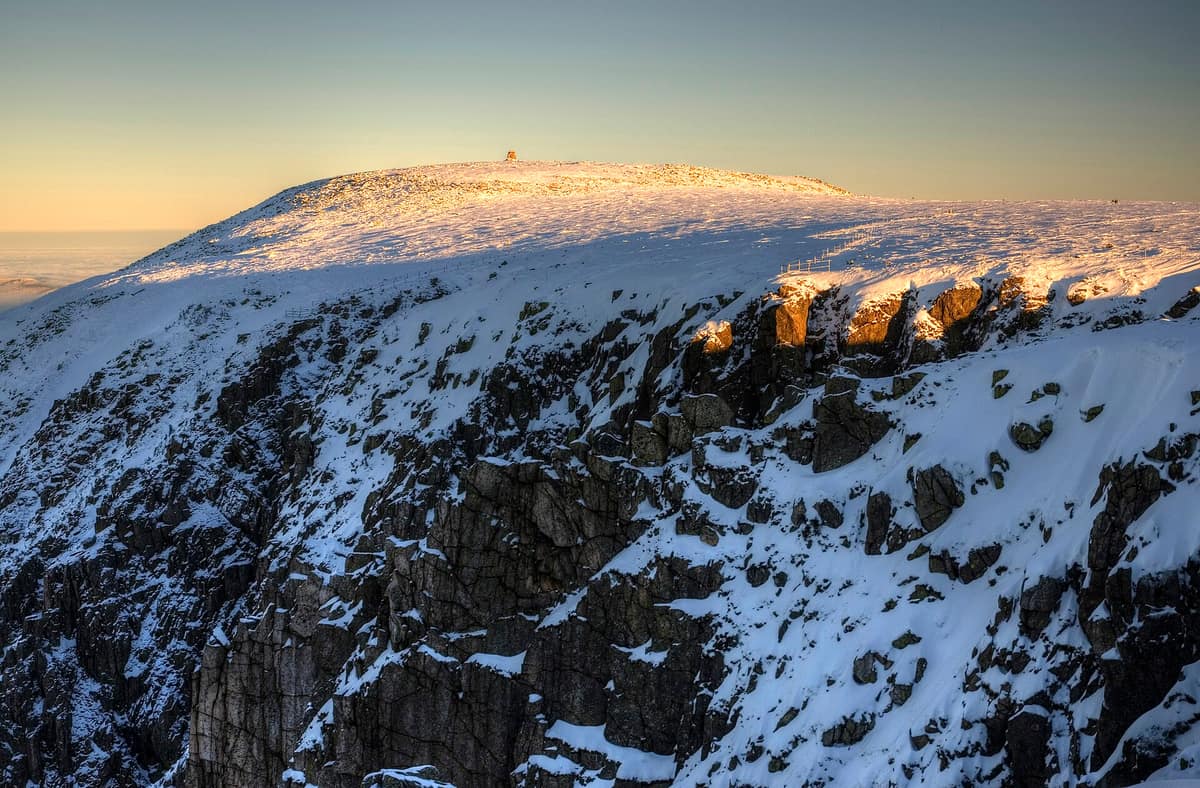
Krkonoše / Karkonosze High Massif
Northern Bohemia (CZ) / Silesia (PL) (Sněžka / Špindlerův Mlýn) · Czechia / Poland
Photo: Petr Vodička · CC BY-SA 4.0 · Wikimedia Commons
The 'Giant Mountains', Central Europe's highest range north of the Alps with alpine tundra relict from the Ice Age.
An invisible line cuts this mountain in two, and the clouds cross it without asking permission. Krkonoše, or Karkonosze in Polish, is the highest mountain range in Czechia and also the border with its neighbour. On each side lies a national park: the Polish park was established on 16 January 1959 and the Czech park on 17 May 1963. In 1992 both joined UNESCO's network of biosphere reserves, and at its summit, Sněžka, at 1,603 m, lies the highest point in Czechia.
What makes it unique
A mid-altitude mountain with tundra features, where plants and animals that are glacial relicts survive.
The place
Nature
The landscape
To understand Krkonoše one must imagine the ice. The last glaciation left cirques, glacial valleys, moraines, tors and blockfields across the range, all still clearly legible in the terrain. The main crest is formed by a granitoid pluton, the Krkonoše-Jizera pluton, and in the east, near Albeřice, karst phenomena even appear.
Altitude organizes the vegetation into distinct belts. Beech and maple once dominated the lower slopes, but native woodlands were largely cleared and replaced by spruce monocultures. In the montane belt, from the eighteenth century onward, tree-free meadows emerged with Bohemian bellflower, Sudetic yellow violet, arnica and orchids. The alpine timberline lies between 1,250 and 1,350 m, and above it, in the subalpine belt, appear mountain avens grasslands, boreal bogs and dwarf-shrub heaths with glacial relict flora. At the very top only stunted woody plants survive, such as Silesian willow, Carpathian birch and mountain pine.
The climate matches. On Sněžka the mean annual temperature is 0.2 °C and snow cover on the summits can persist for up to 180 days. In autumn and winter thermal inversions are common, sometimes lasting for weeks. Furthermore, the massif lies right on the main European watershed between the Elbe and Oder basins, that is, between the North Sea and the Baltic.
Wildlife and seasons
The rocky slopes and high glacial cirques, often termed the botanical gardens of Krkonoše, concentrate the highest plant diversity. Among the glacial relicts are the Bohemian lousewort, snow saxifrage, cloudberry and Lindberg's bogmoss. The park is home to around 300 vertebrates and more than 1200 vascular plants.
Notable vertebrates include the ring ouzel, the Bluethroat, inhabiting tundra-like open expanses, and the White-throated dipper, adapted to swift mountain streams. Several invertebrates are also glacial relicts, such as the alpine emerald dragonfly and the azure hawker, while Krkonoše has its own endemics, such as the mayfly Rhithrogena corcontica.
On the Polish side about 40 mammals live, including beaver, roe deer and red fox, along with 16 species of bats. The Eurasian lynx returned in 2006, though none have been confirmed since March 2018, while wolves have appeared since 2014 and are once again breeding. The mouflon was introduced at the start of the twentieth century from Corsica.
Species
With a page in the atlas
Being mentioned in a source doesn't guarantee sightings: check with the people who manage the area.
Memory and protection
History and conservation
The earliest reserves in Karkonosze, created to safeguard glacial cirques and natural monuments, date from 1933. The Czech national park was created in 1963 and reorganized in 1991. The peatlands on the Czech side are recognized among Ramsar wetlands.
The mountain pays for its popularity. In 2022 the park recorded over 12.1 million visits, an absolute record. Many visitors stray from paths in quiet zones, prompting additional protective fences on the Sněžka summit. Meanwhile, in March 2025 the park launched an initiative to restore the Silver fir, currently reduced to just 0.46 % of the forest.
Before you set off
Visiting
How to visit
Classic excursions include Sněžka summit, the source of the Elbe, the waterfalls of Pančava, the Elbe and Mumlava, the Černohorské rašeliniště peat bog trail, the Obří důl valley and the old-growth Dvorský les forest. On the Polish side there are 112 km of hiking trails, with portions open to mountain biking. On the Czech side there are some 700 km of marked trails. In winter, hikers must walk strictly outside groomed cross-country ski tracks.
Sněžka was one of the earliest European mountains frequented by tourists. The first recorded ascent, in 1456, was logged by a Venetian merchant prospecting for precious stones, and mining settlements extracting copper, iron and arsenic soon sprang up around the mountain.
Before you go
In the quiet zones, which are eight in number and cover 22.2 % of the park, you can only travel on marked trails. In winter, hikers must stay off prepared cross-country tracks. The park advises that wolves may occasionally be encountered in Krkonoše, recommending that you stay on marked paths and never approach wildlife.
Check access, rules and visiting conditions in the official information from the managing body before you set off.
Location
Where it is and how far it reaches
Boundary of Krkonošský národní park · © EEA, CDDA (CC-BY) The coordinate is estimated; it isn't a verified access point.
Transparency
Sources
The research data with its sources, and the official links for this place, are in the Spanish version of this page. See the Spanish version
Around it
The Parque Paisajístico del Valle del Bóbr lies just 1 km away, and the Hayedos de las Montañas de Jizera about 18 km distant.
What else to explore nearby
Approximate straight-line distance between the edges of each area. It doesn't indicate access, routes or driving times.
- Jizera Mountains Beechwoods
Liberec Region (Jizera Mountains)
About 14 km away
Spectacular mountain slope clothed in ancient beechwoods with granite outcrops, inscribed by UNESCO.
JFMAMJJASONDMay – October · Crowding low
If you like this place, elsewhere in Europe
Distant places with uncommon wildlife and habitats in common. The most widespread species don't count. Sharing species doesn't imply a corridor or guaranteed presence.
- Vindelfjällen Nature Reserve
Västerbotten (Ammarnäs / Tärnaby)
In common: Bluethroat · Charadrius morinellus — high mountain, old-growth forest
One of the largest nature reserves in Europe: high-alpine massifs, birch valleys, and the free-flowing Vindel River running wild to the Baltic.
JFMAMJJASONDMarch – April · June – September · Crowding very low
- Aigüestortes and Lake Saint Maurici National Park
Catalonia (Lleida)
In common: Alpine accentor · Silver fir — high mountain, glacial landscape, old-growth forest
The only National Park in Catalonia, a glacial circus wonderland harboring over 200 tarns (estanys) beneath the iconic twin summits of Els Encantats.
JFMAMJJASONDJune – October · Crowding moderate
- Dachstein Nature Reserve — Gosau, Hallstatt and Obertraun
Upper Austria — Gmunden; Gosau, Hallstatt and Obertraun
In common: Alpine accentor · Chamois — high mountain, old-growth forest
Karst topography, glaciers, alpine meadows and old-growth mountain forests above the Gosau lakes.
JFMAMJJASONDMarch – November · Crowding no data
Entry #355 of the original atlas.