Neusiedler See - Seewinkel National Park
Nationalpark Neusiedler See-Seewinkel
Burgenland (Neusiedl am See / Illmitz) · Austria
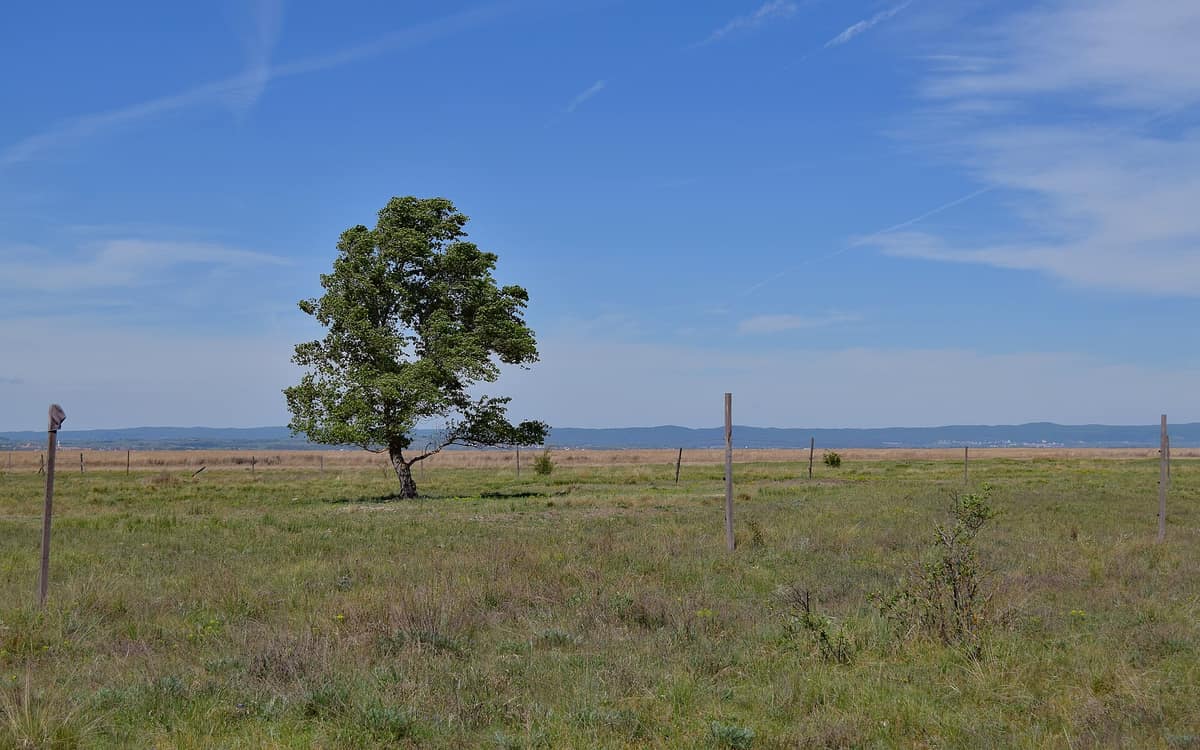
Photo: Haeferl · CC BY-SA 4.0 · Wikimedia Commons
Central Europe’s only endorheic steppe lake and its belt of saline shallow soda pans in Seewinkel.
A steppe lake fringed by reedbeds spanning 180 km², and to its east a lowland plain studded with saline pans that dry out in summer beneath a white crust of crystallized salts. This is Neusiedler See–Seewinkel: where the easternmost foothills of the Alps subside and the Little Hungarian Plain begins. A biogeographical frontier convergence displaying Alpine, Pannonian, Asian, Mediterranean and boreal elements, supporting some 350 verified bird species.
What makes it unique
A steppe lake and some 45 saline pans within a single national park, at the crossroads of five biogeographical zones and an international border.
The place
Nature
The landscape
Nearly one third of the park’s surface is water, and this dynamic mosaic of wetlands and meadows provides habitat for countless specialized species. Between Lake Neusiedl and the Hanság region lie roughly 45 shallow soda pans, each with distinct aquatic ecology. During dry summer spells, stark white salt efflorescences form on their dry lake beds, creating the trademark scenery of Seewinkel. Across adjacent grasslands, the continental Pannonian climate compels steppe flora to endure prolonged drought, sweeping winds and intense solar radiation.
In spring, orchids flank the verges and tracks, most notably the early spider orchid, which bursts into mass bloom by early May.
At Sandeck, herds of white baroque donkeys keep the open grassland cropped through intensive grazing and trampling, halting the spread of scrub, while their dust-bathing hollows create essential exposed sandy spots for ground-dwelling insects. From the Sandeck observation tower you look out over the boundless Seewinkel panorama, where Austrian and Hungarian borders meet, where open water meets steppe earth, and where meadow blends into vast reed marshes.
Wildlife and seasons
Spring is the undisputed highlight of the biological cycle. The Seewinkel serves as a crucial inland staging and refuelling station for waders across Central Europe, with northward spring migration peaking throughout May; select species linger well into June. Between mid-April and mid-May, hoopoes, spotted flycatchers, icterine warblers and nightingales sing loudly along the northwestern margin of the Oberer Stinkersee.
Across the saline pans near Illmitz, around 15 duck species and 30 wader species breed or stage. Wet meadows host breeding lapwings displaying aerial courtship flights; nearby you can spot redshanks and black-tailed godwit. At Geiselsteller, nesting close to the paved track, are kentish plover, black-tailed godwit, northern lapwing and common redshank. During the peak migratory passage in May, as well as July and August, diverse calidrid sandpipers assemble. The bounty of prey regularly attracts hunting marsh harrier.
To the south around Wasserstätten, black-winged stilts, pied avocet, ruff and eurasian spoonbill forage in dense flocks. The extensive reed belt forms occasional hunting grounds for white-tailed eagle and peregrine falcon. With ample water levels you encounter abundant greylag goose. Mid-May offers the optimal window to observe barred warblers along the lake dam.
Species
With a page in the atlas
Being mentioned in a source doesn't guarantee sightings: check with the people who manage the area.
Memory and protection
History and conservation
The national park was officially established in 1993. Decades earlier, the Lange Lacke—the largest and most renowned soda lake—faced imminent drainage for agriculture, and that conservation crisis catalyzed the founding of WWF Austria in 1963. Today four national park rangers patrol the extensive path network throughout the nature reserves.
Before you set off
Visiting
How to visit
The national park visitor centre stands on the northern edge of Illmitz, at the core of the Austrian park territory. It functions as the central orientation hub and departure point for guided nature excursions and self-guided discovery walks. Its permanent exhibition features 10 reed islands with mounted wildlife specimens and educational displays.
Adjacent to the visitor centre, a viewing tower provides panoramas over the Illmitzer Zicksee, especially radiant in early morning light. The comprehensive circular trail encircling Illmitzer Zicksee and Geiselsteller extends beyond 8 km and is best tackled by bicycle. The Sandeck–Wasserstätten route traverses meadows, lakeside dykes and multiple vantage points; two 16 m southern viewing towers were originally Hungarian frontier watchtowers. To survey birdlife across this flat topography, you have 13 observation platforms and hides, elevated lookouts, a tower and two former border watchtowers. An elevated accessible bird hide enables barrier-free birdwatching across Oberer Stinkersee and Lettengrube.
Given the immense open distances, carry high-magnification binoculars or a spotting scope, and arrive before sunrise.
Before you go
The national park remains open year-round. Across all sectors visitors are legally required to stay strictly on marked paths: stepping off trails flushes resting waterfowl, rendering them elusive for hours. Wild camping and open fires are strictly forbidden throughout the open countryside. Dogs must be kept on short leashes, and picking flora or taking specimens alive or dead is strictly outlawed. The agricultural tracks through Sandeck are unpaved gravel and reserved exclusively for farm management.
Check access, rules and visiting conditions in the official information from the managing body before you set off.
Location
Where it is and how far it reaches
Boundary of Neusiedler See - Seewinkel · IUCN II · © EEA, CDDA (CC-BY) The coordinate is estimated; it isn't a verified access point.
Transparency
Sources
The research data with its sources, and the official links for this place, are in the Spanish version of this page. See the Spanish version
Around it
Just 3 km away lies Fertő-Hanság National Park across the Hungarian border. Farther afield along the Danube, Donau-Auen National Park preserves riverine wetland wilderness. Among distant European wetlands that share wintering greylag goose populations and related steppe-marsh habitats with Seewinkel are Lagunas de Villafáfila Natural Reserve, Doñana National Park, Evros Delta National Park and Teiči Strict Nature Reserve. Farther afield, sharing wetland habitat and greylag geese with Seewinkel are Lagunas de Villafáfila Natural Reserve, Doñana National Park, Evros Delta National Park and Teiči Strict Nature Reserve.
What else to explore nearby
Approximate straight-line distance between the edges of each area. It doesn't indicate access, routes or driving times.
- Donau-Auen National Park
Vienna / Lower Austria (Orth an der Donau)
About 25 km away
Central Europe's last major free-flowing lowland river landscape between Vienna and Bratislava.
JFMAMJJASONDApril – October · Crowding low
If you like this place, elsewhere in Europe
Distant places with uncommon wildlife and habitats in common. The most widespread species don't count. Sharing species doesn't imply a corridor or guaranteed presence.
- Evros Delta National Park
Thrace (Alexandroupoli / Feres)
In common: Greylag goose · Eurasian spoonbill — wetland
The great delta on the Greek-Turkish border, one of Greece's foremost wetlands for wintering and migratory birds.
JFMAMJJASONDNovember – May · Crowding none
Entry #159 of the original atlas.