Heilige Hallen Nature Reserve
Naturschutzgebiet Heilige Hallen
Mecklenburg-Western Pomerania — Lüttenhagen, Feldberger Seenlandschaft · Germany
Photo: Michael Fiegle · CC BY-SA 3.0 · Wikimedia Commons
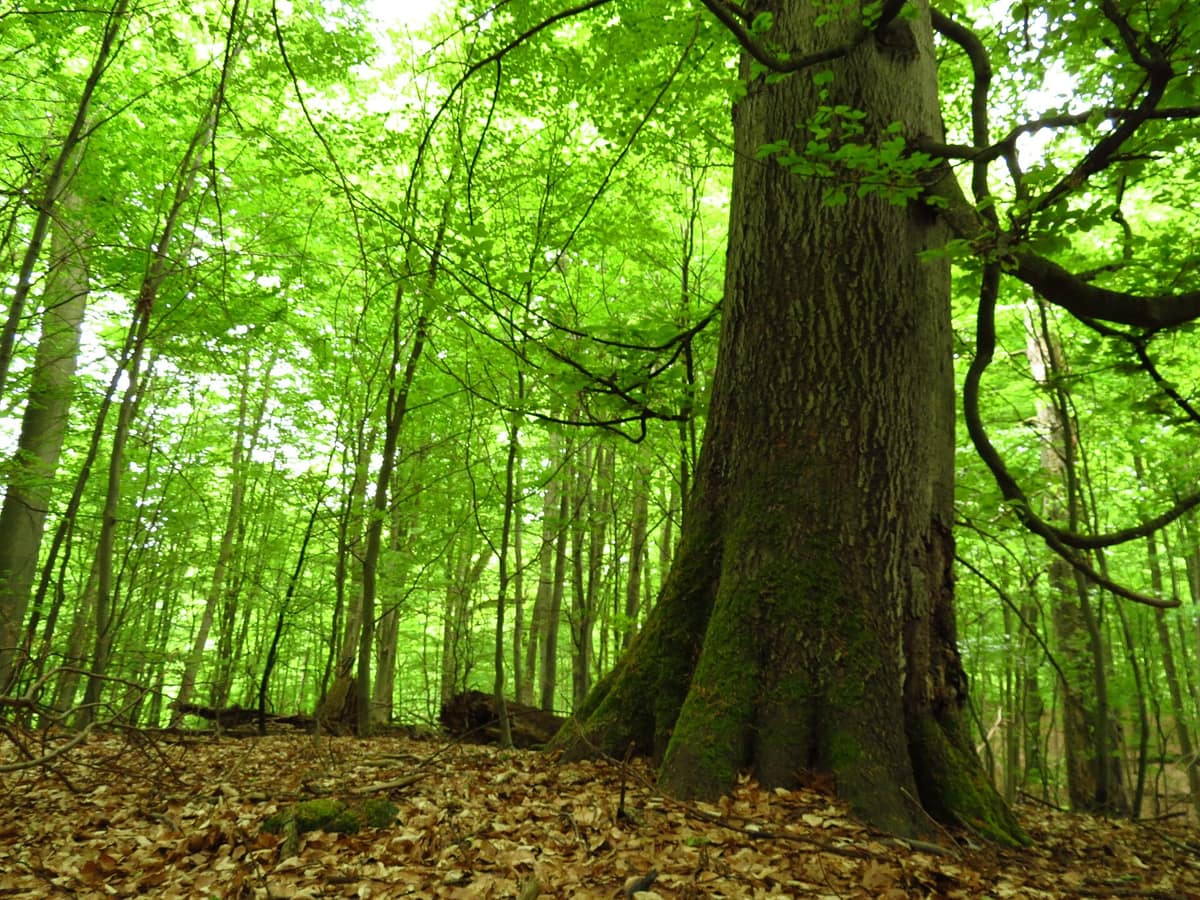
Naturally regenerating old-growth beech forest rich in coarse woody debris and structural diversity in Lüttenhagen reserve.
By the mid-nineteenth century, this ancient woodland resembled the majestic nave of a Gothic cathedral: colossal, pillar-straight trunks rising beneath a soaring vaulted canopy of boughs. Hence its name, Heilige Hallen, the "Sacred Halls". Today it remains a venerable old-growth beech forest nestled in the Feldberger Seenlandschaft, some 3,5 km west of Feldberg and southwest of Lüttenhagen, though it no longer resembles a solemn hall: younger cohorts have surged between the ancient giants, and many veteran trees are slowly dying. Protected as a nature reserve within the Feldberger Seenlandschaft Nature Park, it is best experienced on foot.
What makes it unique
A primeval beech grove renewing itself unaided: you witness old trees senescing, falling and starting life anew along the same walk.
The place
Nature
The landscape
The woodland does not occupy an ordinary plain. It is anchored upon the principal end moraine of the Weichselian glaciation, where melting ice sheets sculpted undulating hills of glacial till, leaving numerous kettle holes preserved to this day. In these waterlogged depressions, termed Sölle, vernal ponds, kettle bogs and birch carr mires formed. Alongside majestic beech stands, the nature reserve thus protects fine-grained, water-filled micro-landscapes.
The oldest beeches span from 300 to over 350 years of age, with several canopy veterans soaring beyond 50 metres in height and exceeding a metre in trunk diameter. Beneath these ancient "Methuselahs", younger generations have taken root. Having attained biological senescence, numerous giants die naturally, and natural canopy gaps are rapidly colonized by vigorous beech saplings. The forest is actively transitioning from late break-up into dynamic natural regeneration, displaying high structural richness.
Wildlife and seasons
Biological diversity here converges upon deadwood. The profusion of standing and fallen coarse woody debris underpins extraordinary fungal diversity, xylobiontic saproxylic beetles and cavity-nesting birds.
To observe resident wildlife across the nature park, moving in quiet reverence substantially improves your chances of unhurried encounters.
Memory and protection
History and conservation
In the mid-nineteenth century, Grand Duke Georg of Mecklenburg-Strelitz, spellbound by the soaring, pillar-like beeches, issued orders to preserve the grove from felling. Park managers view it as the oldest dedicated woodland nature reserve in Germany, protected continuously since roughly 1850. The core area of 25 hectares was inscribed onto the Mecklenburg natural monuments registry in 1908 and formally designated a nature reserve on 24 February 1938.
Since roughly 1950 commercial logging ceased completely and coarse woody debris is never extracted: rangers merely clear blocked footpaths when a fallen trunk obstructs passage. In 1998 the reserve was incorporated into the state forest administration’s strict natural forest research programme, expanding its non-intervention core.
Before you set off
Visiting
How to visit
Access is via the road from Feldberg to Lychen, continuing past Lüttenhagen to the designated woodland car park. From there commences the 6 km Heilige Hallen circular trail, for which municipal guides recommend allocating between two and three hours. The pathways are readily walkable on foot; the narrow footpath cutting through the old-growth interior is unsuitable for bicycles.
Before or after your walk, a stop at the Lütt Holthus forestry museum in the courtyard of the Lüttenhagen forestry office is well worthwhile. Featuring preserved wildlife specimens, it interprets local fauna alongside dedicated exhibits on European beech and Scots pine. It boasts an olfactory scent organ, an interactive sound installation and a walk-through artificial fox den. Outdoors stand a traditional woodcutter’s timber wagon, a historic pitch-burner’s hut and a tree nursery.
During summer, the forestry commission and park authority organize scheduled guided walks, with custom group tours available upon prior request.
Before you go
Visitors to nature reserves within the park are legally required to keep to waymarked trails. Dead limbs and aged trees may fall unexpectedly; entering is entirely at your own risk. Dogs must be kept on leashes; open fires and camping are prohibited. Gathering wild mushrooms and berries is restricted to personal consumption outside nature reserves, meaning it is strictly prohibited here. Flying civilian drones within the reserve requires formal permit approval.
Check access, rules and visiting conditions in the official information from the managing body before you set off.
Location
Where it is and how far it reaches
Boundary of Naturschutzgebiet Heilige Hallen · IUCN IV · © EEA, CDDA (CC-BY) The coordinate is estimated; it isn't a verified access point.
Transparency
Sources
The research data with its sources, and the official links for this place, are in the Spanish version of this page. See the Spanish version
Around it
Three significant forested destinations in the atlas lie close by. The Müritz National Park Forest Areas lie roughly 4 km away. The Uckermark Lakes Nature Park Woodlands sit some 6 km away. And the primeval Serrahn Ancient Beech Forest within Müritz National Park is located about eleven kilometres distant.
What else to explore nearby
Approximate straight-line distance between the edges of each area. It doesn't indicate access, routes or driving times.
- Müritz National Park - Serrahn Ancient Beech Forest
Mecklenburg-Western Pomerania (Neustrelitz)
About 3 km away
Sector of Müritz National Park protected as a World Heritage site for its lowland primeval beech forests.
JFMAMJJASONDMay – October · Crowding low
- Müritz National Park Forests
Mecklenburg-Western Pomerania
About 4 km away
Extensive continental forests and glacial lakes where the white-tailed eagle and osprey nest.
JFMAMJJASONDMay – June · September · Crowding low
Entry #1072 of the original atlas.