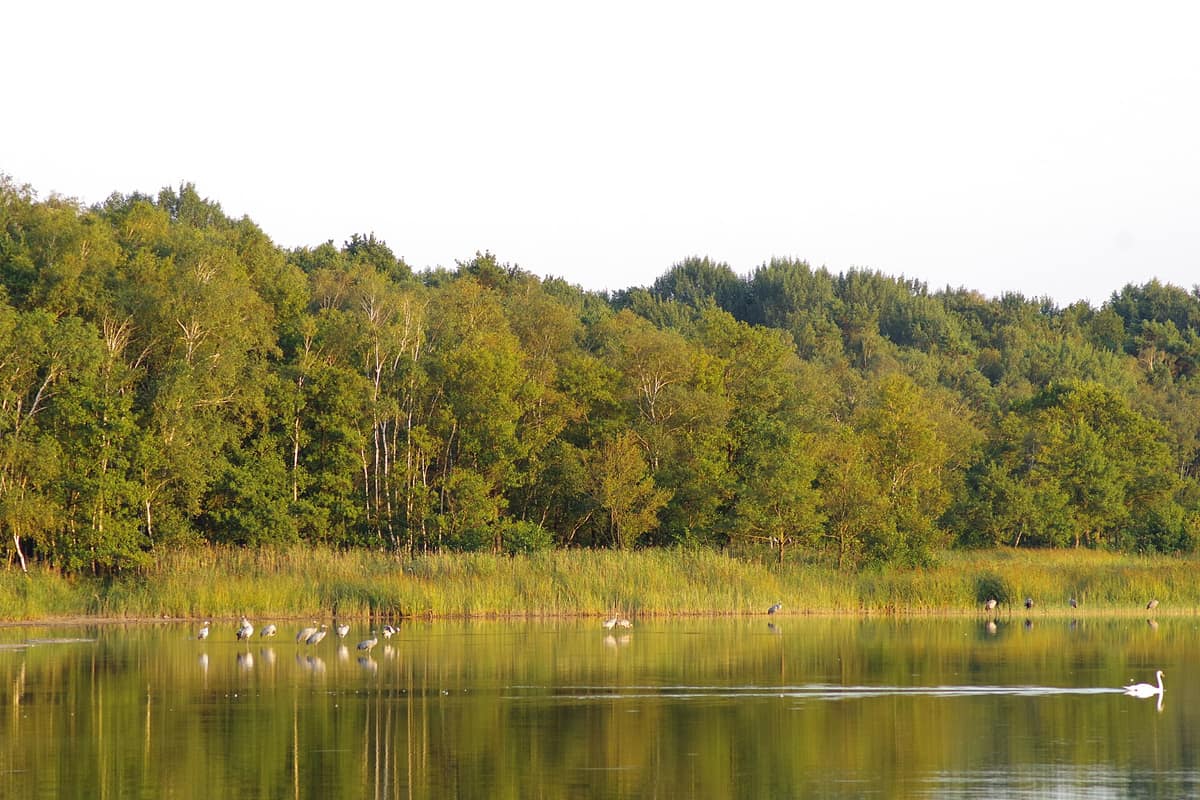
Müritz National Park - Serrahn Ancient Beech Forest
Nationalpark Müritz - Serrahner Buchenurwald
Mecklenburg-Western Pomerania (Neustrelitz) · Germany
Photo: Lotte76 · CC BY-SA 4.0 · Wikimedia Commons
Sector of Müritz National Park protected as a World Heritage site for its lowland primeval beech forests.
For a long time, the woodlands of Serrahn were fortunate that someone was excessively fond of hunting. The hunting passion of the Grand Dukes of Mecklenburg-Strelitz left the local forests virtually untouched, sparing the area's oldest beech trees, which later became a nature reserve and, since 1990, part of the national park. Today they constitute the eastern sector of Müritz National Park; its ancient beech core has been a UNESCO World Heritage site since 2011.
What makes it unique
The ancient beeches of Serrahn show the dynamics of a near-natural forest amid hills, lakes and mires.
The place
Nature
The landscape
The Serrahn sector forms the eastern part of the park, between the Mecklenburg Lake Plateau and the Feldberg Lake District. It is a land of wooded hills: here rise the highest points in the entire national park, the Hirschberg at 143,7 m and the Warsberg at 143,2 m. Prominent large lakes include the Große Fürstenseer See, the Schweingartensee and the Zwirnsee.
Beech reigns supreme. Had humans not cleared the woods, this entire landscape would today be shrouded in beech forest; only on waterlogged ground would alder and ash carrs prevail. Across the rolling ridges of Serrahn, a wide stand of ancient beeches preserves structures closely resembling those of a primeval forest. The approach tells that story: the trail traverses open pine woods before plunging beneath towering old beeches. Hollows nestled among dense beech stands often trap pools of cold air.
Wildlife and seasons
The fauna of Serrahn reflects this union of forest and water. The red deer is the largest mammal in the protected area. In the air, common cranes and Eurasian bitterns are signature birds of this forest-and-wetland mosaic, and across the park you can spot white-tailed eagles, ospreys and cranes on their seasonal movements. The park maintains 25 observation platforms, towers and hides for watching waterbirds and raptors.
The forest trail can be enjoyed at any time of year, offering a front-row view of wild nature taking shape.
Species
With a page in the atlas
Being mentioned in a source doesn't guarantee sightings: check with the people who manage the area.
Memory and protection
History and conservation
Saved from the axe by the ducal hunts, Serrahn's forests became a nature reserve and then, in 1990, a national park. On 25 June 2011, part of these beechwoods was inscribed onto the World Heritage list.
Before you set off
Visiting
How to visit
The multimedia exhibition Im Reich der Buchen sits in the heart of the beechwoods, in the hamlet of Serrahn. It is barrier-free; confirm opening times with the information office before setting out. There you will also find a photography exhibition by nature photographer Roman Vitt, while another display charts the history of the landscape and the ecological value of ancient beechwoods.
The Grünes Buchenblatt nature experience trail is the classic route in. The traverse from Zinow to Dianenhof, passing through Serrahn and along the Schweingartensee, measures 6,5 km and includes a boardwalk across the mire. If you loop back from Serrahn to Zinow along the forest track, the circuit comes to 8 km. The longer variant returning from Dianenhof via the roadside cycle path is listed as 11 km in official park guides. From Dianenhof, the out-and-back walk to Serrahn measures 5 km and is graded as having limited accessibility for wheelchairs and prams due to steep gradients.
If you prefer cycling, the Grüner Radfahrer circular route links Zinow, Serrahn, Grünow and Carpin over 24 km. From Neustrelitz, green cycle signage guides you toward Zinow along some ten kilometres.
Before you go
Zinow is reached on bus 619 running between Neustrelitz and Feldberg; for the return journey you can cycle or catch the same bus. The approach from Neustrelitz to Zinow is signposted at 10 km. In core and management zones you must not leave marked roads and trails, and mushroom picking is prohibited in the core zone. Lighting fires is forbidden in the forest and within 50 m of it.
Check access, rules and visiting conditions in the official information from the managing body before you set off.
Location
Where it is and how far it reaches
Boundary of Serrahn · © EEA, CDDA (CC-BY) The coordinate is estimated; it isn't a verified access point.
Transparency
Sources
The research data with its sources, and the official links for this place, are in the Spanish version of this page. See the Spanish version
How it fits into the territory
Calculated from the Atlas boundaries. «Part of» is only stated with an official boundary; an estimated area only means that they overlap.
Part of Müritz National Park Forests
Around it
Serrahn forms part of the Müritz National Park Forests. Around 4 km away lie the Uckermark Lakes Nature Park Forests, and about 11 km away is the Heilige Hallen Nature Reserve.
Further afield, Orient Forest - Forest Sectors, Ķemeri National Park, Lake Der-Chantecoq and Store Mosse National Park share the common crane with Serrahn.
What else to explore nearby
Approximate straight-line distance between the edges of each area. It doesn't indicate access, routes or driving times.
- Heilige Hallen Nature Reserve
Mecklenburg-Western Pomerania — Lüttenhagen, Feldberger Seenlandschaft
About 3 km away
Naturally regenerating old-growth beech forest rich in coarse woody debris and structural diversity in Lüttenhagen reserve.
JFMAMJJASONDNo recommended season · Crowding no data
If you like this place, elsewhere in Europe
Distant places with uncommon wildlife and habitats in common. The most widespread species don't count. Sharing species doesn't imply a corridor or guaranteed presence.
- Orient Forest - Woodland Sectors
Grand Est (Aube / Troyes)
In common: Common crane · White-tailed eagle — old-growth forest, lake
Lush deciduous forests encircling artificial reservoir lakes that have become a crucial migration stopover for waterfowl.
JFMAMJJASONDMarch – May · October – November · Crowding low
- Ķemeri National Park
Latvia (Jūrmala / Tukums)
In common: Common crane · White-tailed eagle — old-growth forest, lake
Raised bogs, swamp forests and coastal lagoons half an hour from Riga, featuring the Great Ķemeri Bog boardwalk.
JFMAMJJASONDApril – June · September – October · Crowding low
Entry #124 of the original atlas.