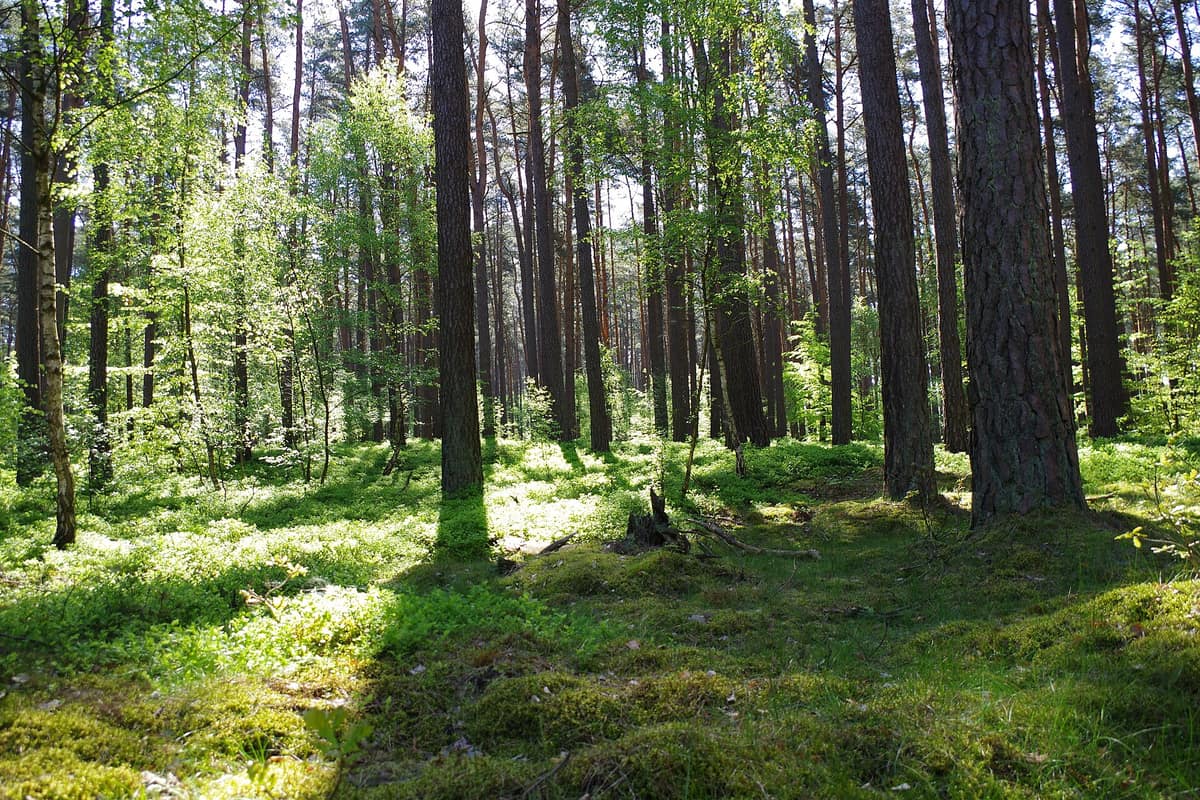
Müritz National Park Forests
Nationalpark Müritz - Waldgebiete
Mecklenburg-Western Pomerania · Germany
Photo: Lotte76 · CC BY-SA 4.0 · Wikimedia Commons
Extensive continental forests and glacial lakes where the white-tailed eagle and osprey nest.
Among the park's iconic inhabitants are the white-tailed eagle and the osprey; in spring and autumn, common cranes echo across the land on their seasonal journeys. Müritz National Park lies in southern Mecklenburg-Western Pomerania. Spanning 322 km², it is Germany's largest terrestrial forested national park, distinguished above all by water: a mosaic of pine woods, more than four hundred mires and 107 lakes larger than one hectare, along with a 10 km stretch of the eastern shoreline of Lake Müritz, northern Germany's largest lake.
What makes it unique
A mosaic of forest, lakes and mires where cranes and large fish-eating raptors share territory with wolves.
The place
Nature
The landscape
Almost everything you see was sculpted by ice. The Mecklenburg Lake Plateau emerged following the last glaciation, around 12.000 years ago, as glaciers pushed debris, boulders, sand and clay into moraines. The eastern shore of the Müritz forms a vast, flat sandur plain, where hollows left by buried dead ice and ancient meltwater channels became lakes. The northern moraine ridge forms the drainage divide between the North Sea and the Baltic, and from a spring fen near Ankershagen rises the river Havel, winding through lakes and bogs before continuing southward.
The forest arrived later. Pine woods occupy much of the wooded area today. The park management plan records a landscape breakdown of 71% forest, 14% lakes and 8% natural mires. Where original woodland was cleared, Scots pine and birch colonised first, while foresters subsequently planted extensive pine plantations on sandy soils; jays cache and disperse acorns, accelerating the natural return of pedunculate oak within an ongoing transition toward broadleaf and beech cover. The oldest and most precious beech stands thrive in the Serrahn sector. Each lake displays a distinct personality: groundwater-fed spring lakes tend to be nutrient-poor, base-rich and exceptionally clear, whereas peat bogs feed tea-coloured, dystrophic waters.
Along Lake Müritz grow saw-sedge beds and sprawling juniper heaths. The Käflingsberg observation tower provides panoramic vistas across the Müritz sector.
Wildlife and seasons
Birdlife provides the grand spectacle. The park hosts more than 100 breeding crane pairs, while the osprey and white-tailed eagle hold established territories here: with a little luck, you can watch ospreys hunting and tending nests from an observation tower. Shoreline wetlands shelter the secretive Eurasian bittern and reed warblers, while garganey and common teal nest in reedbeds.
Wolves have also returned. In May 2012, the first dispersing wolf was confirmed in the park. Ongoing monitoring with trail cameras and genetic tracking subsequently documented a resident pack establishing territory here. Ungulates include wild boar, roe deer, red deer, fallow deer and mouflon. In total, researchers have documented 54 mammal species, 214 bird species, 859 beetle species and 26 fish species.
To view them, the park offers 25 platforms, towers and observation hides. Warnker See is renowned for waterfowl; Federow provides an osprey observation camera feed, and Zootzen-See north of Babke overlooks white-tailed eagles and cranes. Success requires patience and quality binoculars or a spotting scope, especially around dawn and dusk.
Species
With a page in the atlas
Being mentioned in a source doesn't guarantee sightings: check with the people who manage the area.
Memory and protection
History and conservation
The park was created during the closing days of East Germany through the efforts of deputy environment minister Michael Succow and dedicated conservationists. The Soviet army previously occupied some 3.500 ha of the Müritz sector as a tank gunnery and maneuver ground. Commercial timber harvesting ceased entirely in 2018, though uniform pine plantations still shape parts of the landscape. Drainage ditches and canals have been plugged to restore natural groundwater tables: across re-wetted areas, drowning birch gave way to rebounding mire and fen flora.
Before you set off
Visiting
How to visit
Visitors enjoy 450 km of marked walking trails and 270 km of cycling routes: 47 hiking trails, 12 cycle paths and 2 canoe itineraries. Among the easiest options is the family-friendly eight-kilometre circuit from Zinow to Serrahn returning via the forest road, following the Grünes Buchenblatt nature trail with its boardwalk over the mire. The Blauer Radfahrer cycle tour between Boek and Schwarzenhof reveals the tranquil landscapes of the eastern shore.
To get your bearings, start at the visitor centres. The Federow centre lies seven kilometres southeast of Waren and is barrier-free; Schwarzenhof hosts a small display focused on birds and feathers; at Serrahn, the Im Reich der Buchen exhibition explores the World Heritage beech woodland, and the Müritzeum in Waren, opened in 2007, is the region's premier natural history discovery centre. For children, a two-kilometre wolf discovery trail provides interactive learning.
If you prefer the water, selected lakes and rivers can be explored by canoe along strictly designated routes. Motorboats, sailing, windsurfing and scuba diving are prohibited across park waters.
Before you go
In core and management zones you must remain on designated roads and paths. Gathering berries and mushrooms for personal consumption is allowed in development zones, but strictly prohibited in the core zone. Lighting fires is forbidden throughout the forest and within 50 m of woodland margins, and flying drones is prohibited throughout the entire park. Consult seasonal timetables for the national park bus and bike shuttles. Kratzeburg is served by regional trains on the Rostock-Berlin railway line.
Check access, rules and visiting conditions in the official information from the managing body before you set off.
Location
Where it is and how far it reaches
Boundary of Müritz-Nationalpark · IUCN II · © EEA, CDDA (CC-BY) The coordinate is estimated; it isn't a verified access point.
Transparency
Sources
The research data with its sources, and the official links for this place, are in the Spanish version of this page. See the Spanish version
How it fits into the territory
Calculated from the Atlas boundaries. «Part of» is only stated with an official boundary; an estimated area only means that they overlap.
Within this area · 1
- Müritz National Park - Serrahn Ancient Beech Forest
Mecklenburg-Western Pomerania (Neustrelitz)
Inside its official boundary
Sector of Müritz National Park protected as a World Heritage site for its lowland primeval beech forests.
JFMAMJJASONDMay – October · Crowding low
Around it
Its eastern sector is the Serrahn Ancient Beech Forest, preserving World Heritage beech stands. Locally, the Uckermark Lakes Nature Park Forests offer another prime expanse of woodland; the Heilige Hallen Nature Reserve lies roughly 4 km away.
Further away, Orient Forest - Forest Sectors, Ķemeri National Park and Lake Der-Chantecoq share the common crane and white-tailed eagle with Müritz.
What else to explore nearby
Approximate straight-line distance between the edges of each area. It doesn't indicate access, routes or driving times.
- Heilige Hallen Nature Reserve
Mecklenburg-Western Pomerania — Lüttenhagen, Feldberger Seenlandschaft
About 4 km away
Naturally regenerating old-growth beech forest rich in coarse woody debris and structural diversity in Lüttenhagen reserve.
JFMAMJJASONDNo recommended season · Crowding no data
If you like this place, elsewhere in Europe
Distant places with uncommon wildlife and habitats in common. The most widespread species don't count. Sharing species doesn't imply a corridor or guaranteed presence.
- S'Albufera de Mallorca Natural Park
Balearic Islands (Mallorca / Muro / Alcúdia / Sa Pobla)
In common: Cladium mariscus · Osprey
The largest wetland in the Balearic Islands (1,700 ha), a lagoon of brackish reedbeds with outstanding bird observation hides in the Bay of Alcúdia.
JFMAMJJASONDMarch – May · September – November · Crowding low
- Orient Forest - Woodland Sectors
Grand Est (Aube / Troyes)
In common: Common crane · White-tailed eagle — old-growth forest, lake
Lush deciduous forests encircling artificial reservoir lakes that have become a crucial migration stopover for waterfowl.
JFMAMJJASONDMarch – May · October – November · Crowding low
- Ķemeri National Park
Latvia (Jūrmala / Tukums)
In common: Common crane · White-tailed eagle — old-growth forest, lake
Raised bogs, swamp forests and coastal lagoons half an hour from Riga, featuring the Great Ķemeri Bog boardwalk.
JFMAMJJASONDApril – June · September – October · Crowding low
Entry #121 of the original atlas.