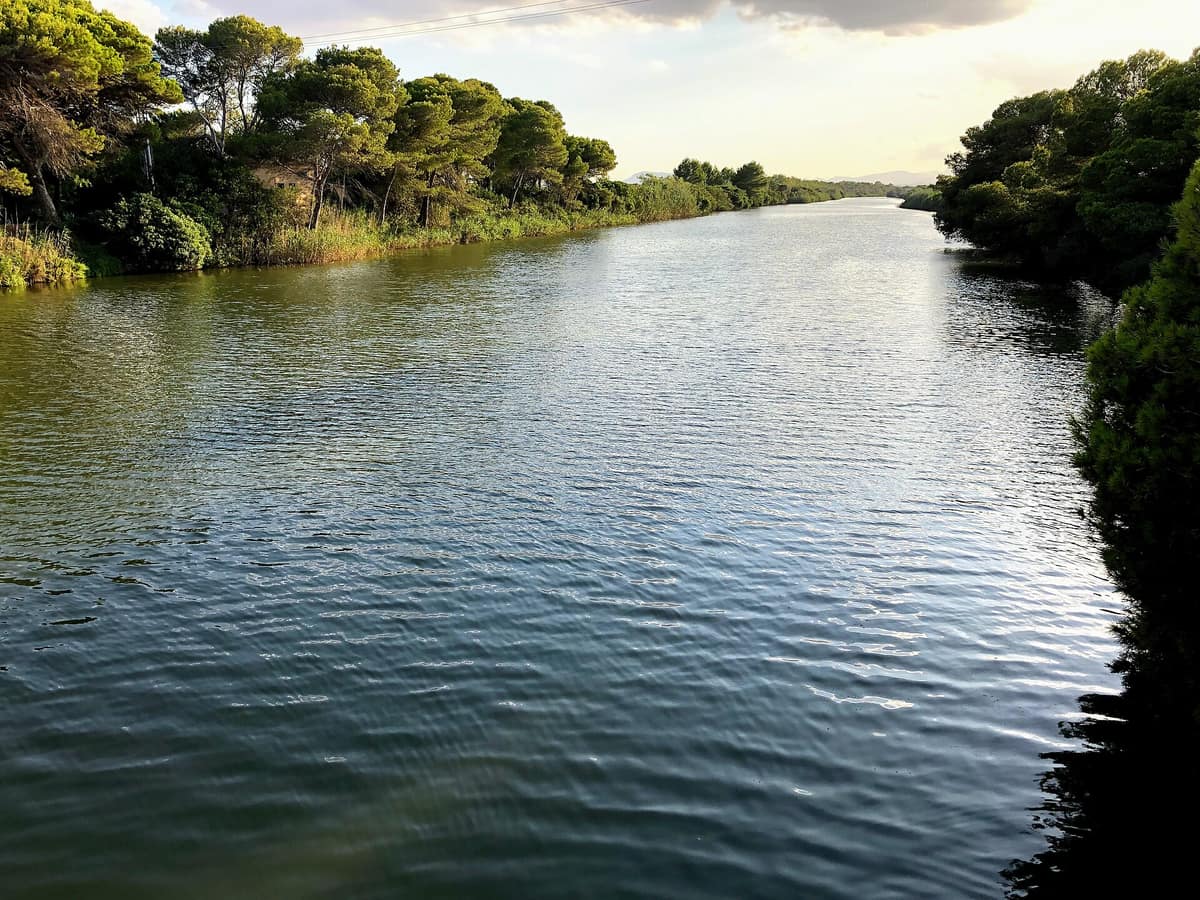
S'Albufera de Mallorca Natural Park
Parc Natural de s'Albufera de Mallorca
Balearic Islands (Mallorca / Muro / Alcúdia / Sa Pobla) · Spain
Photo: Wasquewhat · CC BY-SA 4.0 · Wikimedia Commons
The largest wetland in the Balearic Islands (1,700 ha), a lagoon of brackish reedbeds with outstanding bird observation hides in the Bay of Alcúdia.
On a dry island, a landscape of bridges and canals. S'Albufera does not offer summits or large zoo animals: it offers the agile flight of the marsh harrier, the splashing of mallards, the wind moving the reeds and the shy glance of a tortoise, for those who have time to see them. It is the largest and most important wetland in the Balearics, a wetland of very ancient origin, in the Bay of Alcúdia. Those who cross its barriers on foot or by bicycle enter a quiet world that asks you to leave haste behind.
What makes it unique
A wetland with 303 bird species and a network of canals built by a British company, on a dry island.
The place
Nature
The landscape
Water explains everything. Rainfall reaches the park through torrents and through ullals, springs of groundwater, and in summer some seawater enters, affecting vegetation and fauna. Soil moisture keeps vegetation alive all year, and it changes with depth, proximity to the sea and terrain type. Part of the meadow originated in the Tertiary, but the current wetland formed less than 100,000 years ago; the coastal dunes are more recent, about 10,000 years old.
Reed, bulrush and cattail dominate. In the canals there are submerged plants such as water hornwort and water horsetail; in the brackish zones, rushes and halophyte plants; and among the trees white poplar, elm and tamarisk stand out. On the dunes, the sea iris and other species live adapted to the harsh conditions of the sandy terrain. Fungi number 205 species, and one of them, Psathyrella halofila, new to science, was discovered here in 1992.
Wildlife and seasons
Up to 303 bird species have been observed and 64 breed in the park, including resident and summer species. In winter there are more than 10,000 birds, including mallards and large starling flocks; during migration, birds that stop for a few days, and occasionally vagrant visitors such as cranes. Spring and autumn, especially April and October, coincide with the peak of migration.
In the water the eel and mullets stand out; the marsh frog is abundant and there are the viperine snake and the European pond turtle. There are 22 mammal species, such as bats, mice and rats, and among the invertebrates dragonflies, beetles and more than 450 moth species.
Species
With a page in the atlas
Being mentioned in a source doesn't guarantee sightings: check with the people who manage the area.
Memory and protection
History and conservation
Albufera comes from the Arabic al-Buhayra, the small sea. The first references date from Roman times, when the wetland almost reached the gates of Pollentia. Its current appearance is due above all to the drainage works carried out between 1863 and 1871 by the New Majorca Land Company, a British company with more than 1,500 workers. From that time the network of canals and ditches remains, such as the Gran Canal, and roads and bridges, including the Pont dels Anglesos. It was declared a natural park on 28 January 1988 and is also a Ramsar wetland and part of the Natura 2000 network.
Before you set off
Visiting
How to visit
The main entrance is on the Ma-12 road, at the level of the Pont dels Anglesos in Platja de Muro, and is crossed on foot or by bicycle; there are two more entrances only for those going on foot or by bicycle: s'Amarador from Muro, and the Pont de Can Blau bridge from sa Pobla. The four colour-coded and numbered routes are: Sa Roca, Es Colombars, Camí d'Enmig-ses Puntes and Es Cibollar. The Sa Roca route reaches the Sa Roca hillock after crossing a small wooden bridge. The Es Colombars route turns left after one kilometre, beside the Ferragut canal. The Camí d'Enmig-ses Puntes reaches the Pont de sa Font bridge, under which flows the cleanest water in the park, and is recommended by bicycle. The perimeter circuit, route three, is 12 km long. The whole park is very flat: the elevation change is virtually nil.
At Can Bateman, once a pumping station and later a paper factory, the park interpretation centre now stands, with interactive displays on its environmental, historical and cultural heritage. The park also runs guided visits and educational activities.
Before you go
A free permit is needed, obtainable at the Information Centre, which includes a map and rules for public use. Plants, animals and fungi may not be collected, nor remains of them taken away. Only guide dogs for blind people are admitted. Camping is prohibited in the protected natural spaces of the Balearics, and sports activities such as running, equestrian circuits or mountain biking are not permitted either. The perimeter circuit is not recommended in months of intense heat, and the quieter months are better for enjoying the park's peace. Check that the park is open and its opening hours before visiting.
Check access, rules and visiting conditions in the official information from the managing body before you set off.
Location
Where it is and how far it reaches
Boundary of S'Albufera de Mallorca · IUCN II · © EEA, CDDA (CC-BY) The coordinate is estimated; it isn't a verified access point.
Transparency
Sources
The research data with its sources, and the official links for this place, are in the Spanish version of this page. See the Spanish version
Around it
The Serra de Tramuntana, about thirteen kilometres away, offers the contrast of mountain against flat wetland. Further afield, the Venice Lagoon shares with s'Albufera the European pond turtle and its character as a coastal wetland.
What else to explore nearby
Approximate straight-line distance between the edges of each area. It doesn't indicate access, routes or driving times.
- Serra de Tramuntana (UNESCO World Heritage)
Balearic Islands (Mallorca / Sóller / Valldemossa / Pollença / Deià)
About 7 km away
Mallorca's limestone backbone (Puig Major 1.445 m), deep gorges like Torrent de Pareis, and the world's only island redoubt for black vultures and the Majorcan midwife toad (Alytes muletensis).
JFMAMJJASONDApril – June · September – November · Crowding moderate
If you like this place, elsewhere in Europe
Distant places with uncommon wildlife and habitats in common. The most widespread species don't count. Sharing species doesn't imply a corridor or guaranteed presence.
- Aiguamolls de l'Empordà Natural Park
Catalonia (Girona / Castelló d'Empúries / Sant Pere Pescador)
In common: Western swamphen · Western marsh harrier · Osprey — wetland, wild coast
Coastal wetland and fluvial marsh reserve at the mouths of the Muga and Fluvià rivers on the Costa Brava.
JFMAMJJASONDMarch – May · September – November · Crowding low
- Müritz National Park Forests
Mecklenburg-Western Pomerania
In common: Cladium mariscus · Osprey
Extensive continental forests and glacial lakes where the white-tailed eagle and osprey nest.
JFMAMJJASONDMay – June · September · Crowding low
Entry #634 of the original atlas.