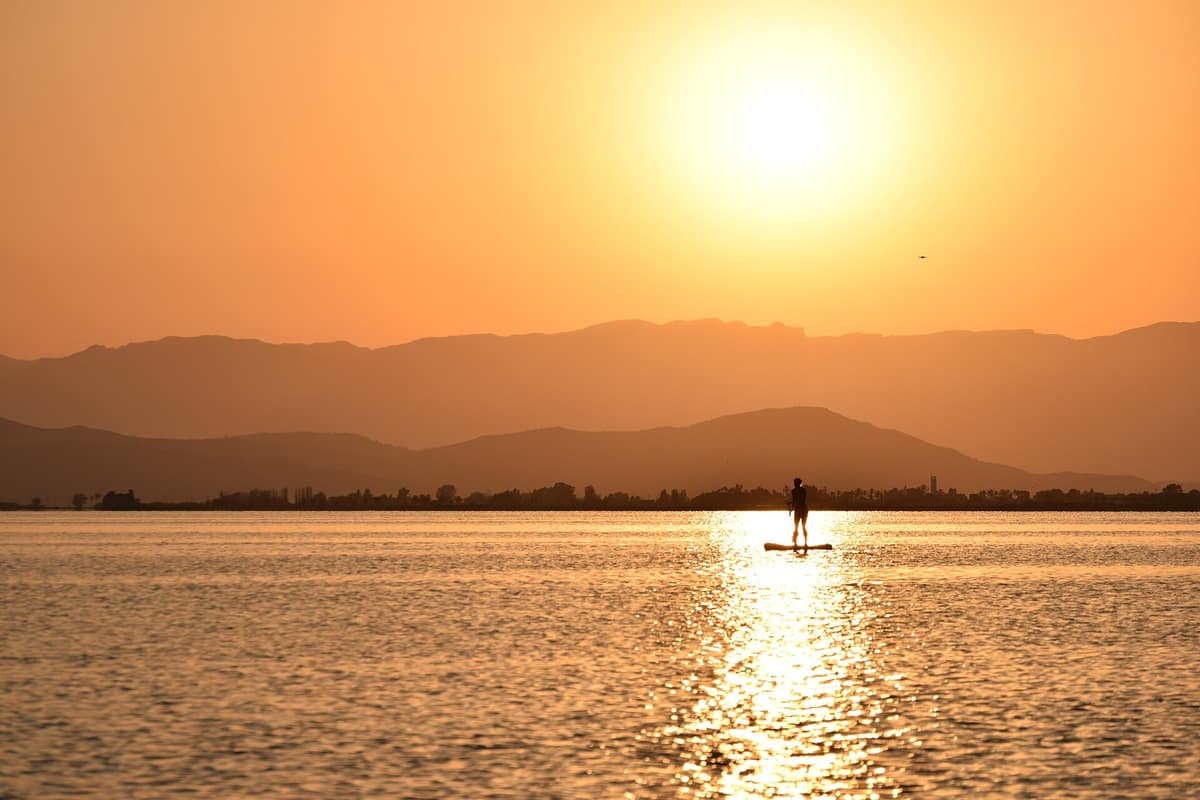
Ebro Delta Natural Park
Parc Natural del Delta de l'Ebre
Catalonia (Tarragona / Deltebre / Sant Jaume d'Enveitja / Amposta) · Spain
Photo: L. Vadillo - MaLéPhotoSpain · CC BY-SA 4.0 · Wikimedia Commons
The most important wetland in the Iberian Mediterranean after Doñana (320 km²), featuring reed-fringed lagoons, the Trabucador sandbar, and thousands of flamingos.
In autumn, once the rice harvest is complete, the Ebro Delta teems with birds. Between October and November the paddies remain flooded, and thousands of waterbirds arrive, either resting on migration or settling for the winter. This is the fastest way to grasp this environment: a landscape sculpted by a river, shaped by human labour, and transformed by abundant water into one of Catalonia's richest wetlands. The natural park spans 7.805 hectares, with all towns and settlements remaining outside its boundaries.
What makes it unique
A spit of sediment extending some 22 km into the sea, where rice paddies function as seasonal wetlands and lagoons are saltier in winter than in summer.
The place
Nature
The landscape
The Ebro, Spain's mightiest river by discharge, deposited here sediments washed down from its upper catchment, gradually building a delta of more than 320 km². Its present shape forms a clearly delineated arrow projecting about 22 km into the sea. Since the second half of the twentieth century, upstream reservoirs have trapped the river sediments that once fed the delta, causing marine erosion to push the coastline backwards.
Within this spit diverse habitats coexist: coastal dunes harbouring plants like Zygophyllum album and Kostelezkya pentacarpos, coastal lagoons, salt marshes, open beaches, and rice fields. The area shelters 764 vascular plant taxa and 23 habitats listed under the European Habitats Directive, two of them priority habitats. Rice cultivation covers roughly 20 000 ha, and its agricultural rhythm dictates the hydrology: in December sluice gates close, leaving water stagnant; in March fields are tilled for seeding; in April they are reflooded. Consequently, lagoon salinity is higher in winter than in summer, contrary to typical expectations, because summer brings a steady inflow of fresh water from the paddy drainage canals.
Between Amposta and La Ràpita lie the Ullals de Baltasar, natural freshwater upwellings fed by rain falling on the Montsià and Els Ports massifs. Only those within the public recreational area can be visited. Meanwhile, the Bassa de l'Encanyissada, spanning 1.192 ha, is the largest lagoon in the delta.
Wildlife and seasons
The inventory lists 343 bird species, 101 fish species, and twenty-one mammal species. Birds dominate the landscape entirely.
In spring and summer, the reedbeds of L'Encanyissada host major breeding colonies of herons: little egret, cattle egret, little bittern, purple heron, and squacco heron. At La Tancada, the most saline lagoon, greater flamingos, ducks, coots, and grebes gather in numbers. From the observation tower at El Través bridge overlooking L'Encanyissada, you can watch little bittern, purple swamphen, red-crested pochard, black-winged stilt, the western marsh harrier, and great reed warbler. At Canal Vell, the tower offers sightings of the black-crowned night heron, flamingos, and during migration, the elusive Eurasian bittern.
Along the coast, the Sant Antoni saltpans are prime terrain for gulls, terns, and waders; during breeding season, sandwich terns, common terns, and little terns nest in abundance. Beyond the dunes of El Fangar, flat sandy expanses provide critical nesting grounds for terns and Kentish plovers. The beach of Buda Island offers the finest vantage point in the delta for northern gannets, skuas, the razorbill, and both Mediterranean and Balearic shearwaters.
Winter brings impressive numbers: the delta's wintering ducks account for more than 90 % of Catalonia's wintering total and 10 % of the entire Iberian Peninsula's.
Species
With a page in the atlas
Being mentioned in a source doesn't guarantee sightings: check with the people who manage the area.
Memory and protection
History and conservation
Before rice farming arrived in the late nineteenth century, the delta economy depended on salt harvesting (since the tenth century), livestock grazing (since the fourteenth century), and fishing. In 1926 the Casa de Fusta was erected using Canadian timber for a Barcelona hunting club; the park has managed it since 1986.
The natural park emerged from a grassroots protest in Deltebre on 26 June 1983 against the planned drainage of the Canal Vell lagoons for rice cultivation. The park expanded in 1986, joined the Ramsar convention in 1993, became part of the Natura 2000 Network in 2006, received the European Charter for Sustainable Tourism in 2007, and was designated a UNESCO Biosphere Reserve in 2013. Historic fish like sturgeon, lamprey, and allis shad have dwindled dramatically, while introduced species such as largemouth bass, northern pike, black bullhead, and wels catfish have proliferated.
Before you set off
Visiting
How to visit
Begin at the Ecomuseu in Deltebre, inaugurated in October 1988: it introduces newcomers to the delta's heritage through an outdoor circuit showcasing the river, lagoon, riparian woodland, freshwater upwelling, irrigation canals, vegetable gardens, and rice fields, complete with a traditional hut hide for birdwatching. The Casa de Fusta beside L'Encanyissada serves as an information centre and lagoon museum. At the Riet Vell reserve, an organic rice estate, a traditional barraca functions as a visitor centre with two bird hides beside the lagoon.
For walkers, routes suit every pace. Three easy and flat circuits include: Bassa de les Olles (3,3 km, one hour), Ullals de Baltasar (0,9 km, 30 minutes), and Bosc de Ribera (1,2 km, 30 minutes). The Desembocadura-Garxal-Riumar route covers 6,9 km, taking 1 h 45 min. The Deltebre riverside trail is an out-and-back of 12,6 km taking about 3 h, while Punta del Fangar is walked out-and-back over 8,4 km in 2 h 15 min. By bicycle, the route from Ecomuseu to the river mouth measures 31,4 km taking around 5 h at an easy grade.
For birdwatchers, two full-day circuits are recommended: one covering the south and one the north, starting from Deltebre. At El Fangar, be mindful of rising tides, which displace birds—especially feeding waders.
Before you go
The delta is accessed through the towns of L'Ampolla and Deltebre in Baix Ebre, and Amposta, La Ràpita, and Sant Jaume d'Enveja in Montsià. For birdwatching, the park especially recommends spring and autumn. Punta del Fangar must be explored on foot, with areas roped off during bird nesting seasons.
Check access, rules and visiting conditions in the official information from the managing body before you set off.
Location
Where it is and how far it reaches
Boundary of Delta de l`Ebre · IUCN V · © EEA, CDDA (CC-BY) The coordinate is estimated; it isn't a verified access point.
Transparency
Sources
The research data with its sources, and the official links for this place, are in the Spanish version of this page. See the Spanish version
Around it
About twenty-four kilometres away lies the Parc Natural dels Ports. Farther afield, other Mediterranean wetlands share species with the delta: Parc Natural dels Aiguamolls de l'Empordà, Parque Natural de Ses Salines, and the flamingo colonies of Reserva Natural do Estuário do Sado.
What else to explore nearby
Approximate straight-line distance between the edges of each area. It doesn't indicate access, routes or driving times.
- Els Ports Natural Park
Catalonia / Aragon / Valencian Community (Tarragona / Teruel / Castellón / Roquetes / Tortosa)
About 24 km away
A rugged karst massif between Catalonia, Aragon, and the Valencian Community featuring limestone cliffs, southern beech groves, and the Iberian ibex.
JFMAMJJASONDApril – June · September – November · Crowding low
If you like this place, elsewhere in Europe
Distant places with uncommon wildlife and habitats in common. The most widespread species don't count. Sharing species doesn't imply a corridor or guaranteed presence.
- Aiguamolls de l'Empordà Natural Park
Catalonia (Girona / Castelló d'Empúries / Sant Pere Pescador)
In common: Glossy ibis · Purple heron · Eurasian bittern — wetland, wild coast, river corridor
Coastal wetland and fluvial marsh reserve at the mouths of the Muga and Fluvià rivers on the Costa Brava.
JFMAMJJASONDMarch – May · September – November · Crowding low
Entry #490 of the original atlas.