Els Ports Natural Park
Parc Natural dels Ports
Catalonia / Aragon / Valencian Community (Tarragona / Teruel / Castellón / Roquetes / Tortosa) · Spain
Photo: Espencat · Public domain · Wikimedia Commons
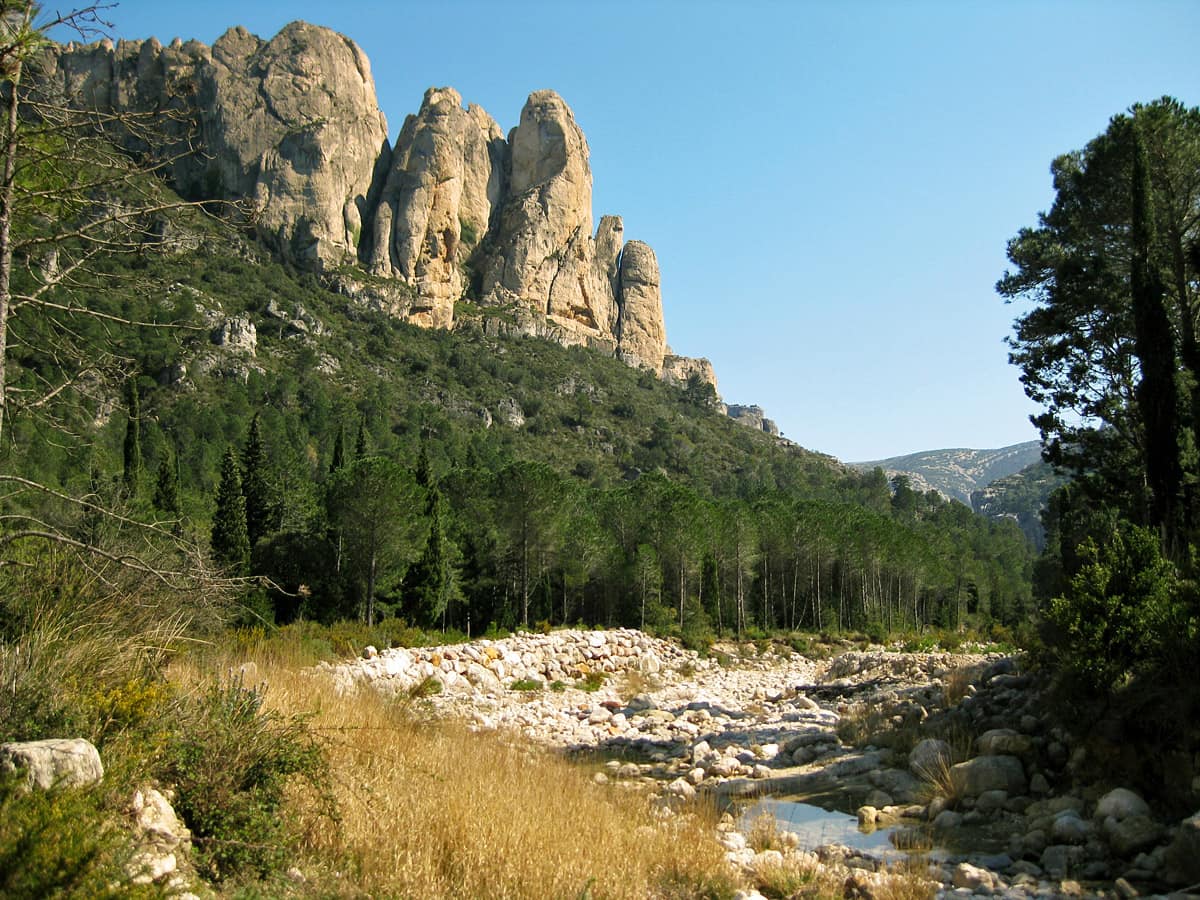
A rugged karst massif between Catalonia, Aragon, and the Valencian Community featuring limestone cliffs, southern beech groves, and the Iberian ibex.
Els Ports rises dramatically above the surrounding agricultural plains; on clear days, you can gaze out over the Ebro Delta and even glimpse the island of Mallorca. It is a Mesozoic limestone massif fractured by fault lines between the Catalan Pre-Coastal Range and the Iberian System, with rugged relief that makes it wild, untamed, and occasionally inaccessible. Els Ports Natural Park spans 35.050 hectares—one of the largest protected areas in Catalonia—harbouring over 1.300 plant species, readily spotted Iberian ibex, and skies dominated by birds of prey.
What makes it unique
Certain plants exist nowhere else on Earth, such as Aquilegia paui, known from only two localities worldwide.
The place
Nature
The landscape
Limestones and dolomites erode easily, and flowing water dissolves them into a karst landscape of canyons, caves, chasms, resurgence pools, natural springs, and sinkholes. About 28 % of the surface rises above 1.000 m, with Mont Caro at 1.441 m standing as the highest peak. Across the terrain, towering cliffs, scree slopes, and limestone pavements alternate with extensive woodlands, Mediterranean scrub, and montane pastures.
Water, though scarce at the surface, defines the geography. In the Els Estrets river, which flows perpetually through a massif where surface water is typically ephemeral, biodiversity concentrates; the La Franqueta area ranks among the park's most valuable yet fragile ecosystems. Els Estrets d'Arnes, La Gronsa, and the Roques de Benet are designated Sites of Geological Interest in Catalonia and vital refuges for wildlife.
Forests blanket much of the park and preserve some of the most significant mature woodland stands in the country, featuring black pine forests prioritised at European scale. The beech forests of Els Ports, the southernmost in the Iberian Peninsula, are protected as a Nature Reserve for their exceptional botanical value.
Wildlife and seasons
Look upward to the crags. Sedentary raptors include the griffon vulture, golden eagle, Bonelli's eagle, northern goshawk, peregrine falcon, and Eurasian eagle-owl. In summer, short-toed snake eagles, booted eagles, and the Egyptian vulture arrive to breed. Bearded vultures from a Valencian reintroduction initiative are also observed, alongside sporadic yet regular sightings of the cinereous vulture.
Among mammals, the Iberian ibex thrives throughout every habitat, coexisting with the Eurasian otter, wildcat, and a bat fauna that, with some 20 species, forms one of the richest assemblages on the Iberian Peninsula.
More than 50 % of Catalonia's reptile and amphibian species occur here, including sharp-ribbed newt, marbled newt, and parsley frog. The dragonfly Macromia splendens faces critical endangerment in Catalonia.
The flora yields remarkable surprises. The willow Salix tarraconensis, discovered by Font i Quer in 1915, is strictly confined to the Tarragona ranges and neighbouring Castellón and Teruel provinces. The rare mullein Verbascum boerhavii maintains thirteen colonies—the only ones in Catalonia—monitored annually by park staff. Spring and autumn are the optimal times to visit.
Species
With a page in the atlas
Being mentioned in a source doesn't guarantee sightings: check with the people who manage the area.
Memory and protection
History and conservation
Lime kilns, charcoal hearths, pitch furnaces, stone sheepfolds, animal pens, and cisterns bear witness to traditional livelihoods around the historical masías of Els Ports.
The park is designated as a Special Protection Area (SPA) and Special Area of Conservation (SAC) within the European Natura network, safeguarding over 30 habitats of community interest. Its forests actively contribute to European climate change adaptation initiatives, including the Life Pinassa and Life RedBosques programmes.
Before you set off
Visiting
How to visit
The park's nine municipalities have their town centres outside its borders, each providing an access gateway equipped with visitor centres and information desks. The Roquetes Visitor Centre in Baix Ebre presents the GeoPorts exhibition on the geological evolution of the massif, featuring water-cycle models and fossils. The La Sénia centre in Montsià displays La Vida als Ports, an audiovisual journey through local flora, fauna, and ecosystems. In Prat de Comte (Terra Alta), the centre explores the natural landscapes of Els Ports, with interpretive panels detailing open habitats, fire ecology, and ancient woodlands.
There are 35 waymarked walking itineraries, including long-distance paths and the Vía Verde, totalling over 200 km. From El Molí in Prat de Comte begins the La Mola trail, ascending from historical terraced farmland into deep woodland. Mont Caro can be reached by road or on foot from the El Esquirol car park, where its panoramic mirador looks over the Ebro Delta. To spot ibex, vultures, and falcons, the Vall ravine is prime ground, while the Vía Verde—a converted disused railway closed to motor vehicles—stretches 110 km from Tortosa to Alcañiz in Aragon.
Before you go
Wild camping is strictly prohibited across the park. Always stay on waymarked paths and trails, as navigation can prove difficult across the rugged karst topography of Els Ports. Before setting out, stop by one of the visitor centres in the gateway villages.
Check access, rules and visiting conditions in the official information from the managing body before you set off.
Location
Where it is and how far it reaches
Boundary of Ports, els · IUCN V · © EEA, CDDA (CC-BY) The coordinate is estimated; it isn't a verified access point.
Transparency
Sources
The research data with its sources, and the official links for this place, are in the Spanish version of this page. See the Spanish version
Around it
About twenty-four kilometres away lies the Parc Natural del Delta de l'Ebre. Farther afield, the Iberian ibex and soaring raptors like the griffon vulture and golden eagle are shared with Parque Natural Sierras de Cazorla, Segura y Las Villas and Parque Nacional Sierra de las Nieves.
What else to explore nearby
Approximate straight-line distance between the edges of each area. It doesn't indicate access, routes or driving times.
- Ebro Delta Natural Park
Catalonia (Tarragona / Deltebre / Sant Jaume d'Enveitja / Amposta)
About 24 km away
The most important wetland in the Iberian Mediterranean after Doñana (320 km²), featuring reed-fringed lagoons, the Trabucador sandbar, and thousands of flamingos.
JFMAMJJASONDApril – June · September – November · Crowding low
If you like this place, elsewhere in Europe
Distant places with uncommon wildlife and habitats in common. The most widespread species don't count. Sharing species doesn't imply a corridor or guaranteed presence.
- Sierra de las Nieves National Park
Andalusia (Málaga — Ronda / Tolox / Yunquera)
In common: Bonelli's eagle · Spanish ibex · Circaetus gallicus — high mountain, karst and caves
Spanish fir forests (pinsapares), a relict conifer growing only in these ranges, over deep karst harboring some of the deepest chasms in Spain.
JFMAMJJASONDMarch – May · October – December · Crowding low
- Verdon Regional Natural Park - Grand Canyon
Alpes-de-Haute-Provence / Var (Castellane / Moustiers-Sainte-Marie)
In common: Circaetus gallicus · Bearded vulture · Cinereous vulture — karst and caves, gorge and canyon
The 'Grand Canyon of Europe', sheer limestone cliffs plunging 700 m carved out by the turquoise waters of the Verdon River.
JFMAMJJASONDApril – June · September – October · Crowding moderate
- Domogled - Cerna Valley National Park
Caraș-Severin, Mehedinți, and Gorj Counties
In common: Circaetus gallicus · Hermann's tortoise · Eurasian eagle-owl — high mountain, karst and caves, gorge and canyon
Deep tectonic canyon flanked by Banat black pine and catchments with virgin montane beech woods.
JFMAMJJASONDMay – October · Crowding very low
Entry #503 of the original atlas.