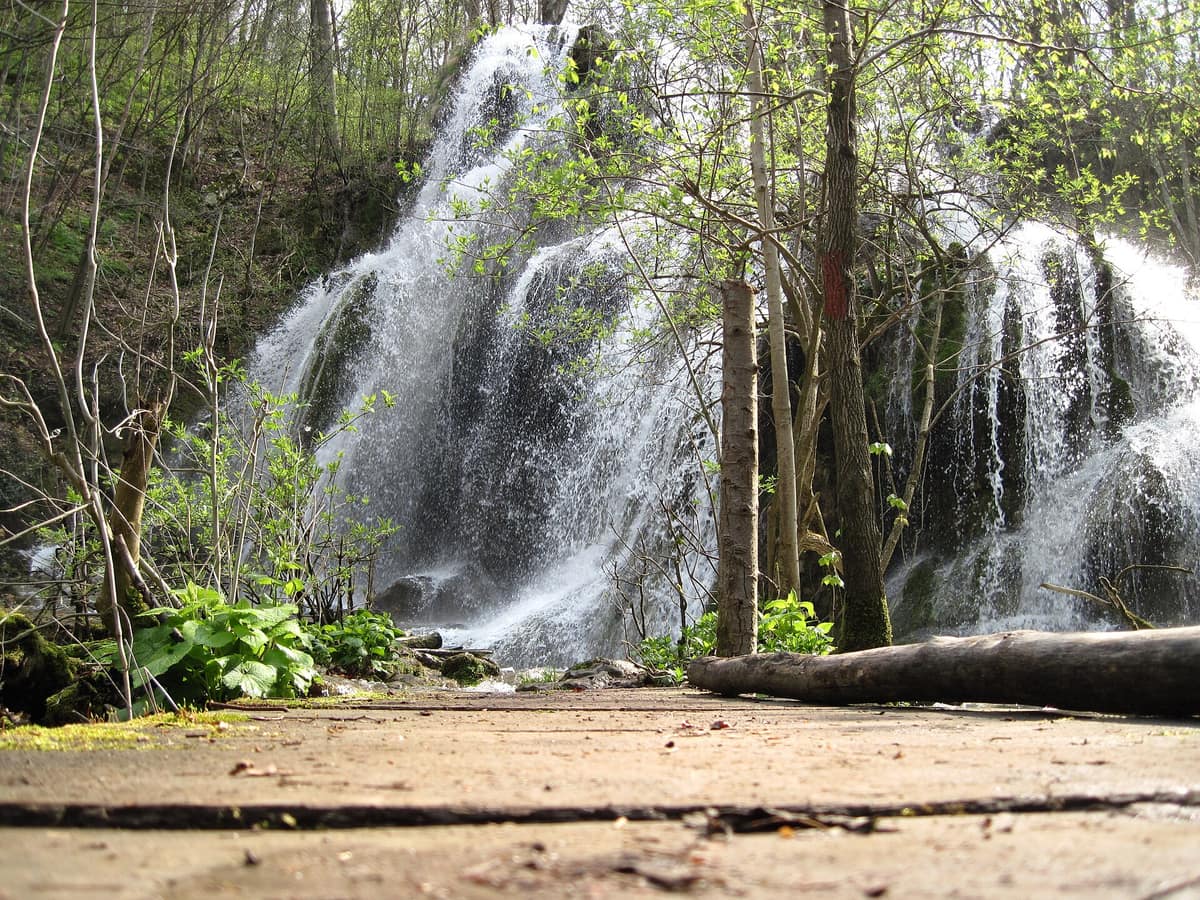
Nera Gorge - Beușnița National Park
Parcul Național Cheile Nerei - Beușnița
Caraș-Severin County · Romania
Photo: Mary03101983 · CC BY-SA 3.0 · Wikimedia Commons
Romania's longest limestone gorges with turquoise karst lakes and virgin sub-Mediterranean woodlands.
Nearly twenty-three kilometres of sheer canyon carved by a single river. Through the Jurassic limestones of the southern Anina Mountains, the Nera has hollowed a defile so narrow that the trail hugs the riverbed between vertical cliffs, at times traversing ledges hewn into the bedrock. Cheile Nerei-Beușnița National Park encompasses 36.758 hectares in Caraș-Severin County in southwestern Romania, protecting rich karst ecosystems under IUCN category II.
What makes it unique
A wild gorge with travertine-forming springs, cascades, and karst tarns, alongside ancient beech woods listed as World Heritage since 2017.
The place
Nature
The landscape
Water shapes everything here. The Nera, the park's ecological spine, slices between precipitous slopes, joined by descending tributaries including the Beu and Șușara. Along their course, petrifying springs deposit travertine, giving rise to cascades and natural tarns: Lacul Dracului, the celebrated Beușnița waterfalls, Ochiul Beului, and the Bigăr, Șușara, and Moceriș waterfalls.
All around lies classic karst: limestone crags, sinkholes, caves including Peștera Lenuța, Peștera de sub Padina Popii, and Peștera Bijuteria, and rocky pastures. The park shelters protected reserves like Cheile Nerei-Beușnița, Izvorul Bigăr, Cheile Șușarei, Ducin, Valea Ciclovei-Ilidia, Dealul Cărăula, and Poiana Lisovacea.
Wildlife and seasons
Ancient beech forests studded with scattered Turkish hazelnuts alternate with thermophilic scrub of lilac, flowering ash, and smoke bush, as well as limestone cliff pastures. This rich mosaic hosts more than half of Romania's wild orchid species, including the European priority species Himantoglossum caprinum.
The woodlands and open habitats support 9 of the 10 woodpecker species present in Romania. Caverns and sinkholes shelter more than two-thirds of the country's bat species, notably Myotis myotis and Rhinolophus ferrumequinum. Cliff faces harbour some of Romania's premier nesting peregrine falcons, while rugged, untamed sectors provide hunting grounds for the Eurasian lynx. Further European protected mammals include the grey wolf and several families of Eurasian otters along fish-rich streams.
The park also protects two Tertiary relict species: the snail Amphimelania holandri and the loach Cobitis elongata. The sub-Mediterranean microclimate and karst relief foster species such as the Carpathian scorpion and the nose-horned viper. Notable invertebrates feature the stag beetle and the dragonfly Cordulegaster heros.
Species
With a page in the atlas
Being mentioned in a source doesn't guarantee sightings: check with the people who manage the area.
Memory and protection
History and conservation
Since 2017, more than 4000 hectares of the park's primeval beech forests, recognized as continentally significant, have been inscribed as part of the UNESCO World Heritage serial site.
Before you set off
Visiting
How to visit
Three primary hiking routes span the park. The main traverse, Șopotu Nou–Cheile Nerei–Podul Bei–Sasca Română, extends 24 kilometres and takes nine hours. It follows the river with minimal major elevation changes, where sections are carved as narrow rock terraces secured by safety cables. It crosses the Nera via a ford impassable in flood conditions. It can be walked in a single day, though tent camping at Damian ranger post or hiking it in sections is recommended.
A second trail, Sasca Română–Sasca Montană–Șușara Waterfall–Cărbunari, covers eight kilometres and lasts three hours. Leaving Sasca Montană, it penetrates the shaded Șușara gorge before climbing steeply to the Cărbunari karst plateau.
A third option, Podul Bei–Ochiul Beiului–Crivina–Cheile Minișului–Cabana Buhui, entails a twelve-hour hike following an old logging railway with several vintage tunnels, made demanding by degraded trail stretches.
Before you go
Vehicles and hikers must remain on designated, marked paths; camping outside authorized campsites is strictly banned. Do not feed or disturb wildlife. On the main gorge path watch for vipers, and note that the river ford becomes impassable during high waters; consult park staff beforehand.
Check access, rules and visiting conditions in the official information from the managing body before you set off.
Location
Where it is and how far it reaches
Boundary of Rezervația Cheile Nerei - Beușnița · IUCN IV · © EEA, CDDA (CC-BY) The coordinate is estimated; it isn't a verified access point.
Transparency
Sources
The research data with its sources, and the official links for this place, are in the Spanish version of this page. See the Spanish version
Around it
Eleven kilometres away lies Semenic - Caraș Gorge National Park and, at the same distance, Valea Mare Primeval Forest Nature Reserve. At 21 km is Đerdap National Park - Iron Gate. With Jiu Gorge National Park - Primeval Forest it shares the nose-horned viper, brown bear, gorges, and ancient forest; with Sohodol Gorge, the nose-horned viper and karst terrain.
What else to explore nearby
Approximate straight-line distance between the edges of each area. It doesn't indicate access, routes or driving times.
- Semenic - Caraș Gorges National Park
Caraș-Severin County (Anina / Carașova)
About 11 km away
One of Romania's longest and wildest limestone gorges alongside relict virgin beech forests (Izvoarele Nerei).
JFMAMJJASONDMay – October · Crowding very low
If you like this place, elsewhere in Europe
Distant places with uncommon wildlife and habitats in common. The most widespread species don't count. Sharing species doesn't imply a corridor or guaranteed presence.
- Vârghiș Gorge
Harghita and Covasna Counties (Baraolt / Vârghiș)
In common: Rhinolophus hipposideros · Greater mouse-eared bat · Greater horseshoe bat — gorge and canyon, karst and caves
Limestone gorge reserve with over 120 caves of major chiropterological importance (Peștera Merești).
JFMAMJJASONDMay – October · Crowding low
Entry #62 of the original atlas.