Semenic - Caraș Gorges National Park
Parcul Național Semenic - Cheile Carașului
Caraș-Severin County (Anina / Carașova) · Romania
Photo: Petr Vodička · CC BY-SA 4.0 · Wikimedia Commons
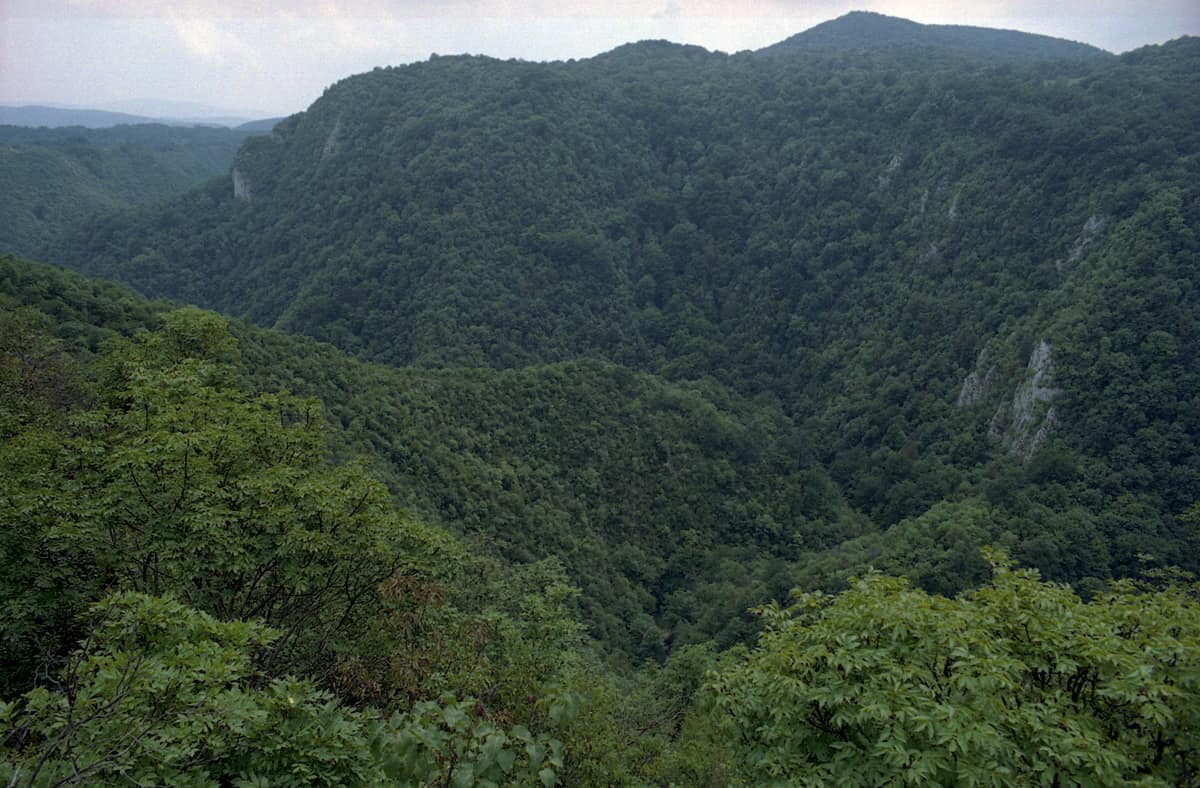
One of Romania's longest and wildest limestone gorges alongside relict virgin beech forests (Izvoarele Nerei).
Two contrasting mountain realms share a single protected territory. On one side rise the Semenic Mountains, composed of metamorphic and magmatic rocks, gently undulating and draped in dense forest; on the other stand the Anina Mountains, heavily karstified sedimentary rock cleaved by deep ravines and harbouring more than 800 caves and sinkholes. Located in south-western Romania in the heart of Caraș-Severin County, Semenic-Cheile Carașului National Park covers some 36,051 hectares.
It is a landscape of stark contrasts: the dense air of near-virgin beech woods, the damp stillness of a cave at 10 degrees, and the thrilling vertiginous drop into one of Romania's longest and wildest limestone gorges.
What makes it unique
Its beech stands at Izvoarele Nerei are part of the UNESCO World Heritage primeval and ancient beech forests network, accessible only on foot with a ranger.
The place
Nature
The landscape
The Semenic Mountains, making up 55 % of the park, feature rolling slopes cloaked in forest that give birth to most of the Banat's major rivers; their highest summit is Gozna at 1446.9 m. The Anina Mountains, accounting for the other 45 %, belong to an entirely different world: intensely karstified sedimentary rock, gorges, and dry valleys with sinkholes separated by limestone pavement plateaus. Here lie the Cheile Carașului, one of Romania's longest and wildest canyon complexes with exceptionally rich flora and fauna, topped on its right flank by the thirteenth-century ruins of Grat Castle.
Beech forests cover over 80 % of the park. At Izvoarele Nerei, on the southern flank of Semenic within the upper Nera basin, survive some of the most extensive tracts of primary forest remaining in temperate Europe: an immaculate beech ecosystem shielded by extreme isolation and rugged terrain. The oldest trees here reach 534 years of age, with the forest stretching between 620 and 1400 m in altitude.
Wildlife and seasons
The park shelters 1277 vascular plant species, including delicate orchids, Martagon lily, and fritillary. In terms of wildlife, 672 species have been documented, more than 80 of which are strictly protected under international conventions and European directives.
Among large mammals roam brown bear, red deer, roe deer, wolf, and Eurasian lynx. Reptiles include the venomous nose-horned viper, while protected avian species feature the golden eagle and hazel grouse. In the pristine waters of the Nera and Miniș rivers thrive the Carpathian lamprey (Eudontomyzon danfordi) alongside Kessler's gudgeon (Romanogobio kesslerii) and Danubian longbarbel gudgeon (Romanogobio uranoscopus), their river corridors shaded by woodruff-beech woodlands of the Asperulo-Fagetum type.
Species
With a page in the atlas
Being mentioned in a source doesn't guarantee sightings: check with the people who manage the area.
Memory and protection
History and conservation
Formal protection began early: in 1955, the mixed reserve of Cheile Carașului was first established across 800 hectares, with the national park officially designated in 1982; that same year saw the creation of the Izvoarele Nerei strict nature reserve to safeguard these pristine old-growth stands. The ancient beech forests of Izvoarele Nerei were incorporated into the transnational UNESCO network in 2017.
Today the national park encompasses ten strictly protected nature reserves, including Cheile Carașului, Cheile Gârliștei, Izvoarele Carașului, Izvoarele Nerei, and several notable cavern systems. Human visitation pressure remains high due to heavy tourist flows throughout much of the year.
Before you set off
Visiting
How to visit
The park is traversed by 10 waymarked trails totalling 130 km. The longest route, running from Lake Secu up to Semenic, spans 30.8 km and takes about nine hours. For a shorter outing, the Red Cross route connects Comarnic to Semenic over 13.9 km in about three and a half hours, while the Yellow Cross path links Carașova to Gârliște across 3.7 km. In addition, there is a themed trail focused on the history and cultural traditions of the Caraș Valley Croatian community, and another dedicated to the park's wildlife.
Underground, the jewel of the park is Comarnic Cave, widely regarded as the most beautiful and wild subterranean chamber system in the Banat and across Romania; measuring 6,201 m in total passages, it is the Banat's second-longest cave after Buhui. Visitors explore only the dry upper level across 1750 metres, while the lower level is carved out by the subterranean Ponicova stream. Protected as a speleological reserve since 1947, it lies in the heart of the Banat Mountains midway between Reșița and Anina. From the end of the unpaved track, you can reach the entrance on foot in roughly 45 minutes, or drive. Inside, temperatures linger around 10 degrees with high humidity, so sturdy mountain footwear and warm layers are essential; helmets and headlamps are provided by the park service.
Before you go
Izvoarele Nerei, part of the UNESCO site, can only be entered on foot accompanied by an official park ranger. The park charges an admission fee, payable via SMS. Comarnic Cave is open from April to October, with guided visits on weekends for groups of at least five people and during weekdays only by prior arrangement.
Check access, rules and visiting conditions in the official information from the managing body before you set off.
Location
Where it is and how far it reaches
Boundary of Parcul Național Semenic - Cheile Carașului · IUCN II · © EEA, CDDA (CC-BY) The coordinate is estimated; it isn't a verified access point.
Transparency
Sources
The research data with its sources, and the official links for this place, are in the Spanish version of this page. See the Spanish version
Around it
The closest neighbouring natural sites, by distance, are Nera Gorges - Beușnița National Park, the Godeanu Mountains, and Domogled - Valea Cernei National Park. Further afield, Jiu Gorge National Park - Ancient Beech Forest shares the nose-horned viper, lynx, and bear amidst rugged gorges and ancient woodland; Yantra River Gorge shares a gudgeon species and limestone karst ravine, while Sohodol Gorge also harbours nose-horned vipers in a dramatic karst canyon.
What else to explore nearby
Approximate straight-line distance between the edges of each area. It doesn't indicate access, routes or driving times.
- Nera Gorge - Beușnița National Park
Caraș-Severin County
About 11 km away
Romania's longest limestone gorges with turquoise karst lakes and virgin sub-Mediterranean woodlands.
JFMAMJJASONDMay – October · Crowding low
- Domogled - Cerna Valley National Park
Caraș-Severin, Mehedinți, and Gorj Counties
About 29 km away
Deep tectonic canyon flanked by Banat black pine and catchments with virgin montane beech woods.
JFMAMJJASONDMay – October · Crowding very low
If you like this place, elsewhere in Europe
Distant places with uncommon wildlife and habitats in common. The most widespread species don't count. Sharing species doesn't imply a corridor or guaranteed presence.
- Northern Velebit National Park
Lika-Senj (Croatia)
In common: Nose-horned viper · Eurasian lynx · Golden eagle — karst and caves
Karst relief, ancient beech forests and mountain pastures in Northern Velebit.
JFMAMJJASONDMay – November · Crowding low
Entry #215 of the original atlas.