Cozia National Park - Primeval Woodlands
Parcul Național Cozia - Codrii seculari
Vâlcea County · Romania
Photo: Petr Vodička · CC BY-SA 4.0 · Wikimedia Commons
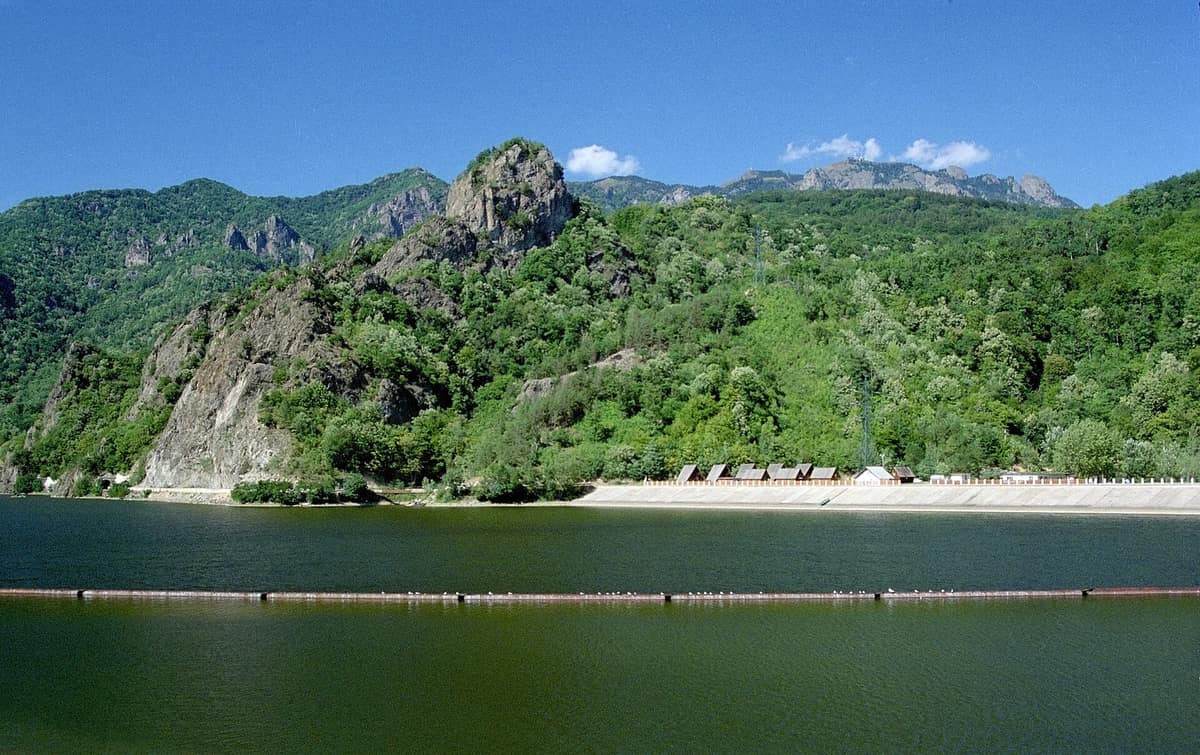
Limestone crags and the Olt River gorge cloaked in virgin beech forests and high-altitude oak groves.
A river slicing straight through a mountain range, leaving almost vertical gneiss walls on either bank. The Olt severs the Southern Carpathians through the defile bearing its name, and towering above its banks rises Mount Cozia: gneiss slopes so steep that soil scarcely clings, cloaked almost entirely in forest. Cozia National Park preserves this blend of rock, river, and ancient beech in Vâlcea County, and since 2017 two of its primeval forests have formed part of the UNESCO World Heritage serial site for primeval beech forests.
What makes it unique
A gneiss massif 93 % covered in forest, a gorge functioning as a flyway for migratory birds, and Gallium baillonii, an endemic plant unique to these crags.
The place
Nature
The landscape
Gneiss reigns supreme. The massif's central core consists of granitic gneiss studded with large microcline eyes—known as Cozia gneiss—carved out by the Olt and its feeder streams. Slopes rise steeply; on the eastern face above Stănişoara Monastery, woodland gives way to sheer towers, ledges, and barren cliffs. This rock architecture, combined with a horst structure and varied slope aspects, fosters remarkably diverse local microclimates.
Woodlands cover 93 % of the Cozia, Narăţu, and Doabra-Călineşti massifs, stratified by altitude. Dominant species are beech (57 %), Norway spruce (18 %), and sessile oak (14 %); the remainder comprises hornbeam, wild cherry, lime, and flowering ash. Mount Cozia reaches an elevation of 1668 m.
Wildlife and seasons
The bloom that brought scientific renown to the massif is Gallium baillonii, discovered in 1862 by Ulrich Hoffmann, the first botanist to systematically investigate this flora, and today regarded as a local endemic. Over 402 species of fungi have been catalogued.
Large carnivores include the brown bear, grey wolf, Eurasian lynx, and European wildcat. Key herbivores encompass the roe deer, red deer, and chamois; European pine marten, stone marten, badger, red squirrel, and edible dormouse also reside here.
Birds offer unexpected richness, with more than 120 species documented. The Olt defile serves as a vital migration flyway between Central Europe and the Aegean Sea, while the Turnu and Gura Lotrului reservoirs offer stopover and overwintering havens for waterfowl. Forest species include the western capercaillie and hazel grouse, while mountain watercourses host the grey wagtail, white wagtail, and white-throated dipper.
The nose-horned viper, strictly protected by law, and the fire salamander feature among herpetofauna. Mountain streams support over 30 fish species. Seven priority invertebrates include the stag beetle, the great capricorn beetle Cerambyx cerdo, and the alpine longhorn beetle Rosalia alpina.
Species
With a page in the atlas
Being mentioned in a source doesn't guarantee sightings: check with the people who manage the area.
Memory and protection
History and conservation
The Cozia massif was declared a nature reserve in 1966 through a decision of the Argeş Regional Council. Subsequent national park legislation established a protected territory of 17.100 ha entirely within Vâlcea County. Monasteries in the valley date back centuries and represent historic foundations by Wallachian voivodes.
Before you set off
Visiting
How to visit
Mountain excursions along waymarked trails with sweeping viewpoints define the visitor experience, with itineraries ranging from one to three days. Prominent scenic attractions include the Olt defile, Lotrişor gorge, Gardului waterfall, and Bulzul rock. The park has erected educational biodiversity panels along the path toward Stănişoara waterfall, and wild blooms provide botanical interest throughout the growing season.
Key trails depart from Turnu railway station, ascending via Curmătura la Troiță and Mount Scorțaru to Cabana Cozia at 1573 m. Another begins at Gara Lotru, climbing via Vărateca, Muchia Urzicii, and Stâna din Rotunda to Cozia peak. A third route climbs from Stănişoara Monastery (720 m) via Muchia Vlădesei and Durduc to the summit, while a descent leads from the crest via Curmătura Mocirle and Vf. Omul down to Pripoare. The historical path connecting Arutela Roman fort with Stănișoara Monastery concludes at 720 m elevation.
Before you go
Hiking is restricted strictly to marked footpaths. Open fires, motor vehicles, snowmobiles, and motorbikes are prohibited, and pitch-camping outside designated campsites constitutes an offence.
Check access, rules and visiting conditions in the official information from the managing body before you set off.
Location
Where it is and how far it reaches
Boundary of Parcul Național Cozia · IUCN II · © EEA, CDDA (CC-BY) The coordinate is estimated; it isn't a verified access point.
Transparency
Sources
The research data with its sources, and the official links for this place, are in the Spanish version of this page. See the Spanish version
Around it
Around 4 km away lies Buila-Vânturarița National Park - Bistrița Gorge. Twenty-seven kilometres distant stand the Iezer-Păpușa Mountains and the Parâng Mountains, and twenty-eight kilometres away are the Latorița Primeval Forest and the Vâlsan River Nature Reserve. The Olt River Defile overlaps with the park.
If you like this place, elsewhere in Europe
Distant places with uncommon wildlife and habitats in common. The most widespread species don't count. Sharing species doesn't imply a corridor or guaranteed presence.
- Retezat National Park
Hunedoara County (Hațeg)
In common: Rosalia longicorn · European pine marten · Western capercaillie — high mountain
The realm of the granitic and glacial Retezat, with over 80 crystal tarns and the Gemenele scientific reserve.
JFMAMJJASONDJune – October · Crowding low
- Domogled - Cerna Valley National Park
Caraș-Severin, Mehedinți, and Gorj Counties
In common: Nose-horned viper · European pine marten · European wildcat — primary forest, high mountain, gorge and canyon
Deep tectonic canyon flanked by Banat black pine and catchments with virgin montane beech woods.
JFMAMJJASONDMay – October · Crowding very low
Entry #63 of the original atlas.