Măcin Mountains National Park
Parcul Național Munții Măcinului
Tulcea County (Greci / Măcin) · Romania
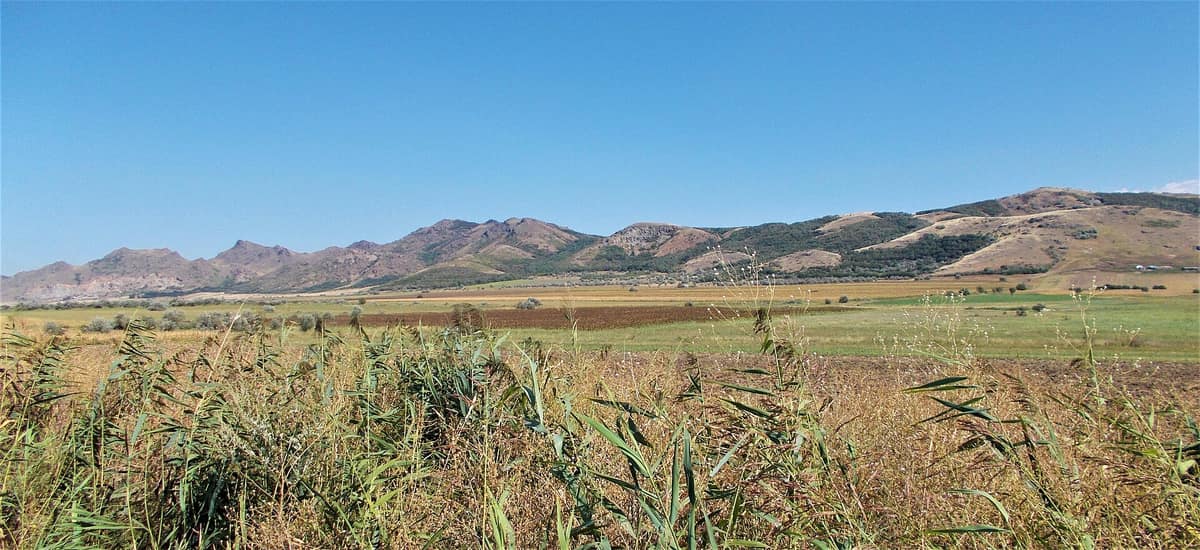
Photo: Nicu Farcaș · CC BY-SA 4.0 · Wikimedia Commons
Europe's oldest mountains (over 300 million years old), with Pontic-Sarmatic steppe, sub-Mediterranean forests, and raptor migration flyways.
From a distance they barely resemble mountains: rounded granite hills that once formed an entire continental range. The Măcin Mountains are the oldest mountains in Romania, the relic of the Hercynian orogeny that closed the Paleozoic era, rising today as an inselberg—an isolated mountain island—in northwestern Dobrogea beside the Danube. The national park protects 11.151,82 hectares of this massif, whose highest summit near Greci reaches 467 m.
What makes it unique
Granite inselbergs older than the dinosaurs, with rock formations shaped like eggs and human profiles, meeting Dobrogea steppes and Balkan woodlands.
The place
Nature
The landscape
Here rest rocks dating back 650 million years, encapsulating the grand geological epochs of Romania. The stone continues weathering into ruined, archaic vistas: eroded tor monoliths whose silhouettes shift with the viewer's angle. A Romanian geographer famously portrayed the Pricopan ridge as an avalanche of immense granite boulders fallen from the sky and piled precariously atop one another.
Vegetation provides startling contrast: arid steppe across the windswept crests, dense woodland at the base. Habitats range from Dobrogea beech woods and hornbeam oak groves to Pontic-Sarmatic steppes. The climate is temperate continental, tinged by aridity carried on eastern continental airflows.
Wildlife and seasons
More than 3400 species of flora and fauna inhabit the park. Vascular plants approach 1900 species—nearly half of Romania's entire flora—and researchers have identified 24 priority habitats, including one found nowhere else globally: the Dobrogea beech wood. Crags foster the endemic Dobrogea bellflower (Campanula romanica), Dianthus nardiformis, Moehringia grisebachii, and M. jankae, while crest footpaths are fringed by hawthorn, wild rose, and willow-leaved spiraea.
Rocky ridges shelter the spur-thighed tortoise, European green lizard, Caspian whipsnake, marbled polecat, stone marten, and steppe polecat. Mammals include the golden jackal, red deer, roe deer, red fox, and Eurasian lynx, beside European pine marten, Romanian hamster, and European ground squirrel. The spur-thighed tortoise, Testudo graeca, shares the terrain with the yellow-bellied toad, while insects include the stag beetle, hermit beetle Osmoderma eremita, and predatory bush-cricket Saga pedo.
Birdlife creates an extraordinary spectacle: the Culmea Pricopanului ridge serves as Romania's premier migration watchpoint for raptors transiting the country. Migrants and breeders include the golden eagle, lesser spotted eagle, Eurasian stone-curlew, Eurasian eagle-owl, short-toed snake eagle, and black stork.
Species
With a page in the atlas
Being mentioned in a source doesn't guarantee sightings: check with the people who manage the area.
Memory and protection
History and conservation
The mountains were designated a biosphere reserve in 1998. The initial proposal for national park establishment emerged that same year, and statutory protection was enacted by law on 6 March 2000. Today it forms an essential component of the Natura 2000 network created to safeguard the biodiversity of the Steppic bioregion.
Illegal poaching of the tortoise Testudo graeca remains a documented conservation threat.
Before you set off
Visiting
How to visit
The park offers eleven waymarked hiking trails, seven thematic paths, one equestrian trail, and ten cycling itineraries. A modern visitor and information centre operates in Greci, Tulcea County.
The flagship route is Culmea Pricopanului: a 14-kilometre ridge walk from Măcin via Sulucu Mare, Caramalău, and Fântâna de Leac, traversing spectacular granite landforms shaped some 255 million years ago. Among interpretive trails, the geological Poteca Priopcei spans 7 km marked with a yellow dot over the northern promontories of Vf. Priopcea and Vf. Boldea. The Dinogeția trail covers 4 km with red dots from Dinogeția fortress. The Niculițel trail extends 9 km with blue circles, taking three to four hours.
Road access is via the DN 22D between Măcin and Horia, the E87 connecting Măcin, Jijila, and Luncavița, or the local Horia–Luncavița road.
The park remains relatively undiscovered by mass tourism, despite the neighbouring Danube Delta attracting tens of thousands annually. Note that the Chediu sector is an intact strict scientific reserve off-limits to tourism.
Before you go
Consult the park map and respect all park regulations. Stick strictly to marked trails and never trespass into the Chediu strict reserve.
Check access, rules and visiting conditions in the official information from the managing body before you set off.
Location
Where it is and how far it reaches
Boundary of Parcul Național Munții Macinului · IUCN II · © EEA, CDDA (CC-BY) The coordinate is estimated; it isn't a verified access point.
Transparency
Sources
The research data with its sources, and the official links for this place, are in the Spanish version of this page. See the Spanish version
Around it
At 9 km lies the Babadag Plateau - Steppe Reserve. With Bükk National Park and Körös-Maros National Park it shares the eastern imperial eagle, saker falcon, and open steppe; with Hagieni Forest-Steppe Nature Reserve, the spur-thighed tortoise and steppe habitat.
If you like this place, elsewhere in Europe
Distant places with uncommon wildlife and habitats in common. The most widespread species don't count. Sharing species doesn't imply a corridor or guaranteed presence.
- Retezat National Park
Hunedoara County (Hațeg)
In common: Martes foina · Bombina variegata · Circaetus gallicus — high mountain, old-growth forest
The realm of the granitic and glacial Retezat, with over 80 crystal tarns and the Gemenele scientific reserve.
JFMAMJJASONDJune – October · Crowding low
- Körös-Maros National Park
Southeastern Great Hungarian Plain (Békés / Csongrád-Csanád)
In common: Eastern imperial eagle · European ground squirrel · Saker falcon — steppe and grassland
Mosaic of saline puszta grasslands, loess steppes, and riparian gallery forests harbouring Central Europe's premier great bustard stronghold.
JFMAMJJASONDApril – June · Crowding very low
- Bükk National Park
Heves / Borsod-Abaúj-Zemplén (Eger / Miskolc / Szilvásvárad)
In common: Eastern imperial eagle · Saker falcon · Circaetus gallicus — steppe and grassland, old-growth forest
Hungary's most extensive karst plateau, clothed in beech forests, featuring prehistoric caves and imperial eagles soaring along its cliff edges.
JFMAMJJASONDApril – June · September – October · Crowding low
Entry #261 of the original atlas.