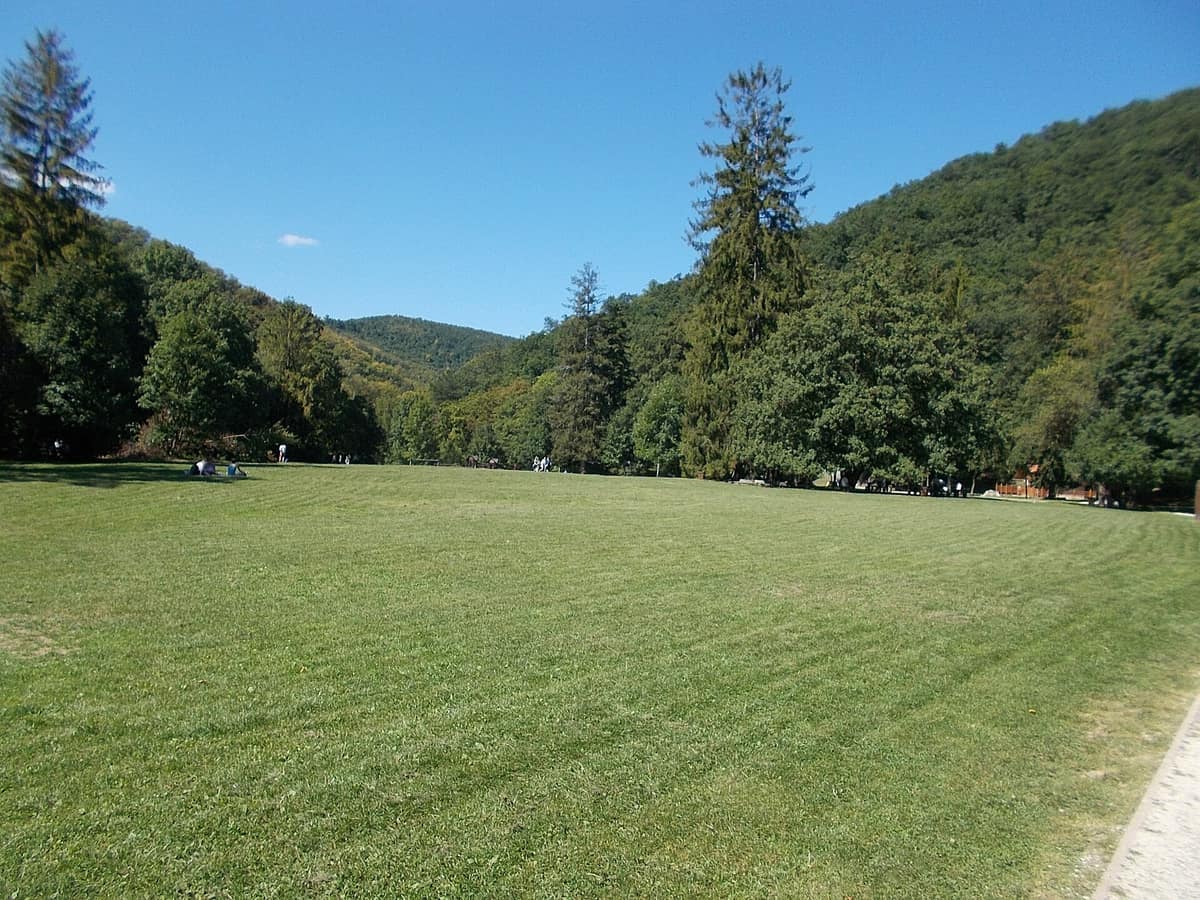
Bükk National Park
Bükki Nemzeti Park
Heves / Borsod-Abaúj-Zemplén (Eger / Miskolc / Szilvásvárad) · Hungary
Photo: Globetrotter19 · CC BY-SA 3.0 · Wikimedia Commons
Hungary's most extensive karst plateau, clothed in beech forests, featuring prehistoric caves and imperial eagles soaring along its cliff edges.
Almost all the mountain ranges of northern Hungary owe their origin to volcanic fires. The Bükk does not: it was built entirely from marine sedimentary rocks, giving it a unique morphology of limestone and dolomite plateaus girdled by dramatic crags locally known as kő (stones), and a labyrinthine subterranean realm of more than 1100 caves. Bükk National Park safeguards this massif between Szilvásvárad and Lillafüred near Miskolc, encompassing a virtually unbroken forested expanse where 94 % of the terrain is tree-covered.
What makes it unique
A mountain massif born of marine sedimentary rocks, crowned by a limestone plateau riddled with Neanderthal caves and an old-growth beechwood unmanaged for over 150 years.
The place
Nature
The landscape
The Bükk plateau exposes Mesozoic limestones and dolomites bounded by sheer scarps. The Garadna brook cleaves the upland into the Great and Little Plateaus. Rain dissolves the calcareous bedrock from within, carving sinkholes, swallets, and blind dolines that funnel groundwater into copious karst springs. The Szalajka Valley offers an exquisite textbook example: its resurgence springs burst where plateau limestone meets impermeable shale clays; rainfall on the plateau takes one to two days to reappear at the springs, and the discharge of the Szikla spring fluctuates between 0 and 10 000 litres per minute, even drying up during prolonged droughts. At its foot the mineral-rich water precipitates freshwater limestone, and Fátyol Waterfall cascades 17 metres over terraced travertine dams.
Istállós-kő (959 m) forms the second-highest peak of the Bükk, sheltering underneath the famous Istállós-kő cave celebrated for Paleolithic archaeological discoveries. Among the park's caves, 45 are strictly protected; visitors can explore illuminated showcaves like Anna and Szent István in Lillafüred, alongside the lake cave Tavasbarlang in Miskolctapolca, while Szeleta and Balla caves remain open for self-guided exploration.
Dense woodland blankets every contour. Turkey oak and sessile oak dominate lower slopes, yielding to hornbeam-oak and, above 400 metres, lush montane beech forests. Within the Őserdő primeval forest reserve, veteran beeches exceed 200 years of age.
Wildlife and seasons
October brings peak autumn foliage across the beech canopy. Botanically, 53 orchid species grace the park, headed by the critically endangered lady's slipper orchid (Cypripedium calceolus). Upland pastures feature stemless carline thistle (Carlina acaulis), commemorated in the park's official emblem.
Faunal numbers are staggering: at least 22 thousand animal species are recorded. The Eurasian lynx maintains a permanent resident population in the Bükk forests, while the European wildcat is widespread. Large herbivores include red deer, European mouflon, and wild boar, alongside a celebrated herd of Lipizzaner horses grazing the highland plateau. Early in the twenty-first century the grey wolf recolonised the massif and resumed breeding.
The Saker falcon represents a conservation triumph, recovered through nearly two decades of intensive nest safeguarding. Escarpments and abandoned quarries host common rock thrush and nesting Eurasian eagle-owls. Outstanding raptors include the Eastern imperial eagle, lesser spotted eagle, and short-toed snake eagle. Deep montane stands harbor the white-backed woodpecker. Nearly all of Hungary's bat species inhabit the Bükk. Szalajka brook supports the endemic relic snail Sadleriana pannonica; streamside alder carrs shelter the fire salamander and European common frog, attracting large wintering flocks of Eurasian siskins feeding on alder catkins.
Species
With a page in the atlas
Being mentioned in a source doesn't guarantee sightings: check with the people who manage the area.
Memory and protection
History and conservation
Mousterian stone tools and Neanderthal remains have been excavated across several caves. Over the centuries, hunting gave way to limestone quarrying and lime kilns; dense forests supplied timber for charcoal burning and potash for regional glassworks.
Szalajka Valley was declared a protected area in 1957, integrated into strictly protected nature reserves on 1 January 1977.
Before you set off
Visiting
How to visit
Szalajka Valley at Szilvásvárad is the primary gateway: an accessible riverside path lined with educational panels detailing the park's establishment, karst hydrology, stream ecology, the Szikla spring, Fátyol Waterfall's travertine terraces, and the prehistoric finds of Istállós-kő cave. From the car park onward only foot traffic is allowed; five minutes away stands the Park Information House featuring conservation displays. Since 1974 an Open-Air Forestry Museum has operated at the mouth of Horotna Valley, showcasing historic huts of woodcutters, lime-burners, and charcoal-makers with an authentic lime kiln.
Up on the plateau, the Jávorkút educational trail provides a 3 km loop open year-round. Waypoints lead to the Kis-Csipkés scarp, the boundary between the North and South Bükk, and a chain of dolines. Here lies the Ősfenyves, an 8-hectare relict stand of Norway spruce (78 %) and European beech (22 %); as ancient spruces die and fall, sunlight penetrating the gaps fosters vigorous young beech regeneration.
The National Blue Trail traverses most of the principal crests.
Before you go
In strictly protected core areas such as Három-kő, Tar-kő, and Dédesi Kisvár, leaving marked paths is prohibited. Off-trail entry across core zones requires written permission, with transit permitted only along designated blazed paths. Horse riding is restricted to marked bridleways, and grazing requires special permits. Szalajka Valley sees heavy weekend traffic; choose weekdays for tranquility.
Check access, rules and visiting conditions in the official information from the managing body before you set off.
Location
Where it is and how far it reaches
Boundary of Bükki Nemzeti Park · © EEA, CDDA (CC-BY) The coordinate is estimated; it isn't a verified access point.
Transparency
Sources
The research data with its sources, and the official links for this place, are in the Spanish version of this page. See the Spanish version
Around it
Distant reserves share species and habitats with the Bükk: Bosque Primario de Krokar shares Ural owls, white-backed woodpeckers, and Rosalia longicorns; Körös-Maros National Park shares imperial eagles and Saker falcons.
If you like this place, elsewhere in Europe
Distant places with uncommon wildlife and habitats in common. The most widespread species don't count. Sharing species doesn't imply a corridor or guaranteed presence.
- Măcin Mountains National Park
Tulcea County (Greci / Măcin)
In common: Eastern imperial eagle · Saker falcon · Circaetus gallicus — old-growth forest, steppe and grassland
Europe's oldest mountains (over 300 million years old), with Pontic-Sarmatic steppe, sub-Mediterranean forests, and raptor migration flyways.
JFMAMJJASONDApril – June · September – October · Crowding very low
- Retezat National Park
Hunedoara County (Hațeg)
In common: Cypripedium calceolus · Circaetus gallicus · Rosalia longicorn — old-growth forest
The realm of the granitic and glacial Retezat, with over 80 crystal tarns and the Gemenele scientific reserve.
JFMAMJJASONDJune – October · Crowding low
- Körös-Maros National Park
Southeastern Great Hungarian Plain (Békés / Csongrád-Csanád)
In common: Eastern imperial eagle · Saker falcon · Circaetus gallicus — steppe and grassland
Mosaic of saline puszta grasslands, loess steppes, and riparian gallery forests harbouring Central Europe's premier great bustard stronghold.
JFMAMJJASONDApril – June · Crowding very low
- Sierra de las Nieves National Park
Andalusia (Málaga — Ronda / Tolox / Yunquera)
In common: Monticola saxatilis · Circaetus gallicus · Eurasian eagle-owl — karst and caves
Spanish fir forests (pinsapares), a relict conifer growing only in these ranges, over deep karst harboring some of the deepest chasms in Spain.
JFMAMJJASONDMarch – May · October – December · Crowding low
Entry #1030 of the original atlas.