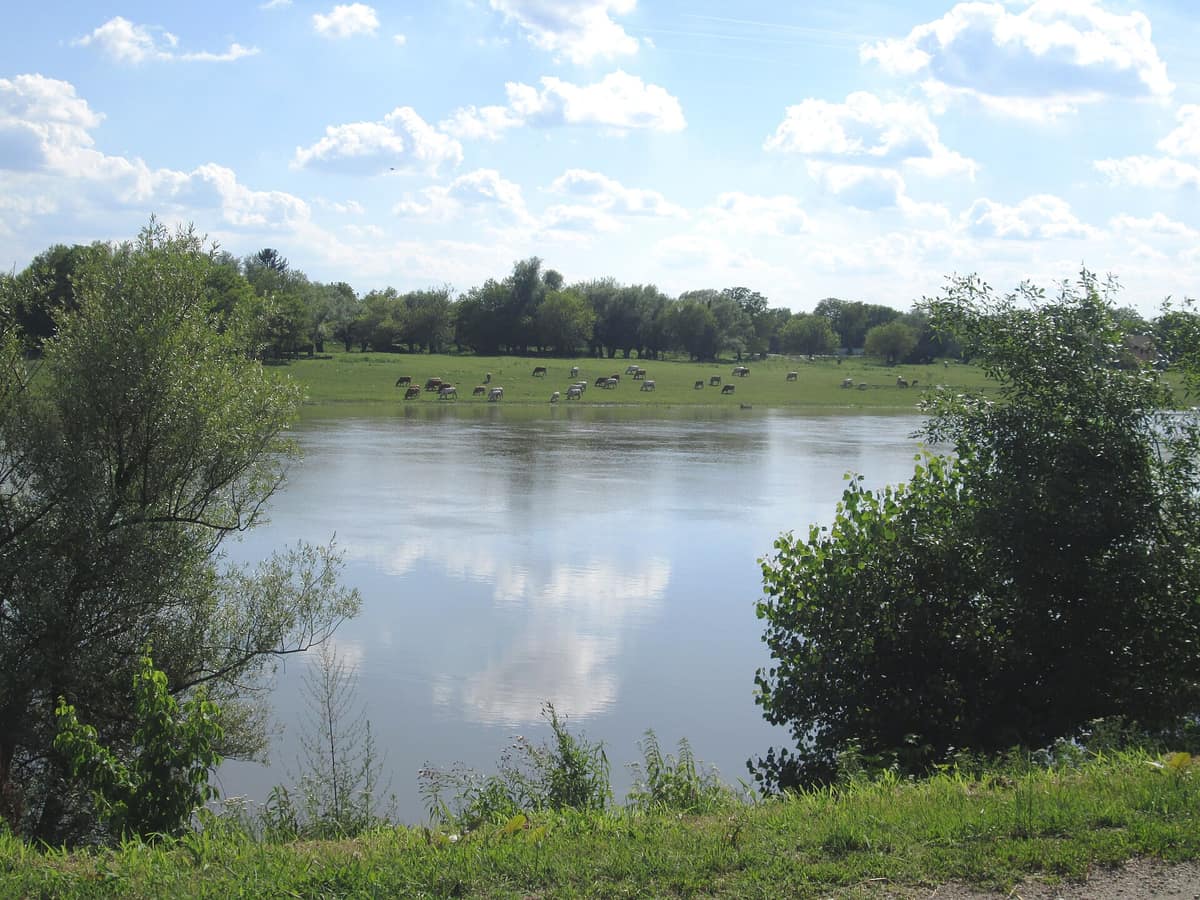
Lonjsko Polje Nature Park
Park prirode Lonjsko polje
Sisak-Moslavina County (Sava River Basin) · Croatia
Photo: Fraxinus · CC BY-SA 4.0 · Wikimedia Commons
Vast flood-retention wetland along the Sava River preserved through traditional livestock grazing.
When the river rises here, nobody panics: room was made for it. Lonjsko polje is an expansive floodplain of the Sava in Croatia, where for centuries people have lived alongside the water rather than fighting it. It spans 50,650 hectares, ranking among the largest protected wetlands in the entire Danube basin. When the floodwaters recede, pigs, cattle, and horses return to the communal pastures and linger until the first snow; overhead, storks nest on wooden rooftops.
What makes it unique
Here the river and rural communities share space: nearly 70 % of the park is alluvial forest, ancient heritage livestock breeds graze freely, and one village has more storks than human residents.
The place
Nature
The landscape
Water governs everything. Nearly 70 % of the park is cloaked in riparian forests of pedunculate oak and narrow-leaved ash. The alluvial wet meadows cover about 30 % of the area and flood completely or partially for 30 to 100 days in almost every year.
One humble plant encapsulates the system. The four-leaf water clover, nearly extinct across Europe due to wetland drainage, remains abundant throughout the flooded pastures of the Sava.
Wildlife and seasons
Lonjsko polje is a premier birdwatching destination: 250 bird species have been recorded in the park, 134 of which nest here. Since 1989 it has been included on the list of Important Bird Areas.
The ornithological reserve of Krapje Đol was the first established in Croatia. Here the Eurasian spoonbill gathers with several herons: grey heron, purple heron, little egret, great egret, black-crowned night heron, and squacco heron. Nearly 10 % of the European spoonbill population breeds here. At one time the reserve nearly dried up when surrounding lands were drained; with external support a canal was dug from the Sava, and in 1991 the birds resumed nesting.
The second reserve, Rakita, offers a different focus: large flocks of wild ducks assemble during winter migration. In the retention pasture of Mužilovčica, native horses and pigs graze freely, while white stork, black stork, grey herons, and night herons forage. The white storks have their own sanctuary: in 1994, Čigoč was declared the first European Stork Village, with almost a hundred storks in about thirty active nests atop houses and barns.
Above, the white-tailed eagle nests in forests close to open water: 36 pairs, representing about 15 % of the Croatian population. In hay meadows and natural wet grasslands with tall sedges, the corn crake breeds. Below, in pools and channels, live the Eurasian otter, Bechstein's bat, European pond turtle, and European tree frog; of Croatia's twenty amphibian species, 16 live in the park.
Species
With a page in the atlas
Being mentioned in a source doesn't guarantee sightings: check with the people who manage the area.
Memory and protection
History and conservation
The landscape you see originated along the Croatian Military Frontier between the Habsburg Monarchy and the Ottoman Empire, based on a communal multi-species grazing system. Today Lonjsko polje remains one of the last places in Europe where traditional grazing continues, with livestock roaming freely across vast pastures. Indigenous breeds include the Posavina horse, the Croatian cold-blooded horse, the Slavonian-Syrmian Podolian cattle, the Posavina goose, the Posavina hound, and the Turopolje pig, which is the most endangered.
Krapje is the only village in Croatia designated as a village of architectural heritage. The nature park was formally established as an institution in 1998 with headquarters in Krapje, and is listed as a Wetland of International Importance under the Ramsar Convention.
Rewilding projects
Conservation networks
Before you set off
Visiting
How to visit
Start at one of the visitor centres: Krapje, anchored by a multimedia hall where a guide explains the village and park, or Čigoč, where the stork programme begins (introductory talk, binocular observation, and nest counts). To enter the ornithological reserves you must register beforehand at Krapje or Čigoč, where staff explain how to visit.
The trails are straightforward and each highlights a distinct theme. The Posavac trail, a 4.2 km loop with five panels, takes between two and two and a half hours, showing how fields, meadows, and pastures were farmed in harmony with nature; it begins in Čigoč and includes an observation tower for watching birds and livestock. The Borderers' Trail links Krapje and Orlinci with Krapje Đol, Croatia's largest spoonbill colony, taking about two and a half to three hours. The 5 km Haymaker Trail is excellent for birdwatching. The Tena forest trail is a 2.5 km circuit with 16 panels on lowland woodlands, accessible only with official park guides.
There are other ways to travel around. At the Krapje centre you can hire a canoe to paddle along the Veliki Strug canal, and the educational raft Vodomar, the most popular boat excursion, glides past willows and poplars. For cycling, the Posavina Route is the most attractive itinerary, stretching 77.8 km along the left bank of the Sava. The Repušnica entrance can be reached by train.
Before you go
As this is an active floodplain, check beforehand whether the routes are passable. To enter the ornithological reserves and other observation points, check in at the Krapje or Čigoč information centres. The Tena trail requires a park guide and prior notice to the centre.
Check access, rules and visiting conditions in the official information from the managing body before you set off.
Location
Where it is and how far it reaches
Boundary of Lonjsko polje · © EEA, CDDA (CC-BY) The coordinate is estimated; it isn't a verified access point.
Transparency
Sources
The research data with its sources, and the official links for this place, are in the Spanish version of this page. See the Spanish version
Around it
Lonjsko polje has no immediate neighbours in the atlas, but shares wetlands, grazing cattle, and free-roaming horses with other areas. Puerta de Güeldres / Corredor del Rin and Reserva Natural de Millingerwaard are wet river corridors that share cattle and horses, while Parque Nacional Kiskunság - Estepa de Bugac shares traditional open pasture grazing.
If you like this place, elsewhere in Europe
Distant places with uncommon wildlife and habitats in common. The most widespread species don't count. Sharing species doesn't imply a corridor or guaranteed presence.
- Millingerwaard Nature Reserve
Gelderland (Berg en Dal / Rhine Valley)
In common: Domestic cattle · Feral horse — wetland, river corridor
Iconic core of the rewilded Rhine river where beavers and free-roaming herds shape dynamic floodplain forests.
JFMAMJJASONDMay – September · Crowding low
- Borkener Paradies Nature Reserve
Lower Saxony (Meppen / Emsland)
In common: Domestic cattle · Feral horse — river corridor, old-growth forest
Historical relict of wood-pasture (Hutewald) in an abandoned oxbow of the Ems River, grazed since the Middle Ages.
JFMAMJJASONDMay – October · Crowding very low
Entry #149 of the original atlas.