Monfragüe National Park
Parque Nacional de Monfragüe
Extremadura (Cáceres / Villarreal de San Carlos / Torrejón el Rubio) · Spain
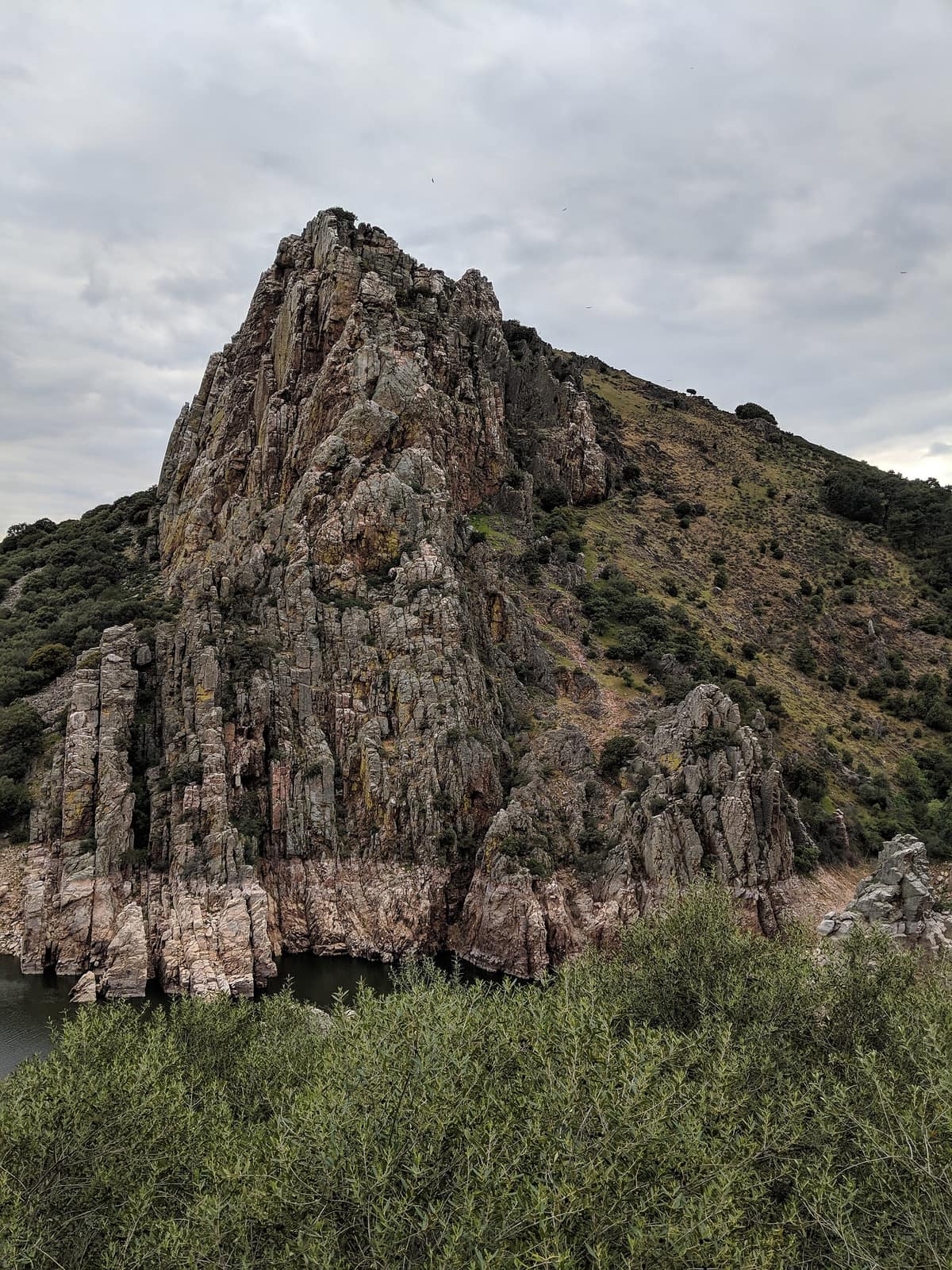
Photo: Frida F.Stolpa · CC BY-SA 4.0 · Wikimedia Commons
The European mecca for raptor watching, holding the largest cinereous vulture (Aegypius monachus) colony in the world and the dramatic Tagus breach at Salto del Gitano.
There are few places in the world where you can watch some of the most sought-after raptors at close quarters without leaving the road. Monfragüe is one of them. Two rivers, the Tagus and the Tiétar, traverse this national park in Cáceres province, and between their banks stretches the largest and best-preserved continuous tract of Mediterranean forest and scrubland in Europe. It was designated a natural park in 1979 and became a national park in March 2007.
What makes it unique
Here the largest tract of well-preserved Mediterranean woodland in Europe can be explored with vultures and eagles in plain view right from the roadside.
The place
Nature
The landscape
Monfragüe is one of the world's finest examples of Appalachian-style relief. The mechanism is simple: resistant quartzite and sandstone layers alternate with soft, fragile shales. The tough strata form parallel ridges; the soft rocks weather down into valleys through which rivers cut entrenched courses. That is why the Tagus, carving through the park, cuts through the Salto del Gitano, one of the monumental rock portals (portillas) giving access to Monfragüe.
Across this bedrock skeleton flourish three main habitats: Mediterranean woodland and dehesa pasture, dramatic quartzite crags, and open water bodies including rivers and reservoirs. In the dehesas, holm oaks, cork oaks, and Portuguese oaks dominate; dense cistus, tree heather, and strawberry trees cloak hillsides in almost impenetrable thickets. On rocky bluffs cling juniper and turpentine trees, while alders and nettle trees fringe waterways, accompanied by wild olives in warm microclimates.
Certain trees carry personal history. Near Villarreal de San Carlos, the nettle tree of Huerto del Ojaranzo reaches eighteen metres in height. Alongside the old Serrejón road stands the Abuelo de El Toril cork oak, an ancient veteran over four hundred years old.
Wildlife and seasons
Over 200 vertebrate species breed in the park, with others overwintering or passing through during migration. Birds reign supreme. The cinereous vulture numbers 286 breeding pairs, the Spanish imperial eagle 12 pairs, and the black stork 30 pairs; there are between 500 and 600 pairs of griffon vulture, 35 pairs of Egyptian vulture, 7 pairs of Bonelli's eagle, and 6 pairs of golden eagle, alongside the Eurasian eagle-owl.
The most iconic viewpoint is Salto del Gitano. From there you can observe countless raptors, including black storks nesting in rock crevices above the river and feeding their young in plain view. The paved road across the park allows you to reach this spot at any hour year-round.
Mammals include the Eurasian otter, Egyptian mongoose, stone marten, European wildcat, badger, and common genet; the red fox is the most abundant carnivore, alongside plentiful red deer, wild boars, and rabbits. Reptiles feature the Montpellier snake, horseshoe whip snake, Spanish terrapin, and ocellated lizard.
Autumn brings the deepest resonance of the year. During late September, the rut of the red deer echoes across valleys, offering rare opportunities to watch mature stags. As chilly autumn mist gathers, woodlands resound with bellowing. Calves arrive in May after eight months of gestation: usually one or two fawns.
Species
With a page in the atlas
Being mentioned in a source doesn't guarantee sightings: check with the people who manage the area.
Memory and protection
History and conservation
The name is Roman: Monsfragorum, the rugged mountain, referring to its wild terrain. Under Islamic rule it was known as Al-Mofrag, meaning the chasm or the crossroads. Long before, prehistoric settlers left cave paintings in natural rock shelters.
Modern protection arose through individual dedication. In 1974 naturalist Jesús Garzón first campaigned to protect Monfragüe, achieving its designation as a Natural Park. Villarreal de San Carlos was then an abandoned hamlet; ruined houses and folds were purchased and renovated to welcome visitors. In 2003 UNESCO recognized Monfragüe as a Biosphere Reserve, integrated within a Special Protection Area for Birds.
The living landscape reflects traditional pastoralism, beekeeping, and cork harvesting, whose continuation remains central to conservation.
Before you set off
Visiting
How to visit
Start in Villarreal de San Carlos. The visitor centre provides maps of trails inside and outside the park, while the Nature Interpretation Centre illustrates geological formations and cultural history. The Wildlife Display Centre showcases taxidermy dioramas depicting crags, riparian zones, and dehesas. To the north stands the Northern Visitor Centre «Jesús Garzón», offering audiovisual exhibits, models, and an interpretive nature loop of 1 km explaining local biodiversity.
For walking, several self-guided trails beckon. The red route is the most comprehensive interior hike: 16 km, moderate difficulty, with three loop sections passing iconic landmarks. The green trail spans 7.9 km with low difficulty, looping along the Malvecino stream and Cerro Gimio to showcase diverse plant communities. The yellow trail, 8.9 km and also gentle, winds toward the Tajadilla lookout through orchards, pastures, and scrub.
For guided activities, the park provides free ranger-led excursions and birdwatching sessions at main viewpoints: La Tajadilla, Salto del Gitano, and Portilla del Tiétar. These are free with prior registration, running from March through June and in October. For geology enthusiasts, a 39 km driving or cycling route along paved roads features nine interpretive stops.
Clear night skies offer another incentive to linger: in 2011 Monfragüe was proposed as an internationally certified Starlight Tourist Destination.
Before you go
The park lies in northern Cáceres, framed by the triangle of Cáceres, Plasencia, and Trujillo. The brown (Serradilla), purple (Torrejón el Rubio), and black (Barbaón) routes enter strict reserve zones and require a written permit that you must carry at all times. Guided excursions and birdwatching activities require prior booking.
Check access, rules and visiting conditions in the official information from the managing body before you set off.
Location
Where it is and how far it reaches
Boundary of Monfragüe · IUCN II · © EEA, CDDA (CC-BY) The coordinate is estimated; it isn't a verified access point.
Transparency
Sources
The research data with its sources, and the official links for this place, are in the Spanish version of this page. See the Spanish version
Around it
Around 30 km away lies Monumento Natural Cueva de Castañar. Further afield, Parque Nacional de Cabañeros shares with Monfragüe the Spanish imperial eagle, cinereous vulture, and black stork, alongside similar mature Mediterranean forest and riparian habitats. Sierra Morena Oriental y Despeñaperros unites the same three bird species across rocky gorges and old-growth woodlands.
If you like this place, elsewhere in Europe
Distant places with uncommon wildlife and habitats in common. The most widespread species don't count. Sharing species doesn't imply a corridor or guaranteed presence.
- Verdon Regional Natural Park - Grand Canyon
Alpes-de-Haute-Provence / Var (Castellane / Moustiers-Sainte-Marie)
In common: Cinereous vulture · Egyptian vulture · Griffon vulture — river corridor, gorge and canyon
The 'Grand Canyon of Europe', sheer limestone cliffs plunging 700 m carved out by the turquoise waters of the Verdon River.
JFMAMJJASONDApril – June · September – October · Crowding moderate
- Els Ports Natural Park
Catalonia / Aragon / Valencian Community (Tarragona / Teruel / Castellón / Roquetes / Tortosa)
In common: Cinereous vulture · Egyptian vulture · Griffon vulture — old-growth forest, gorge and canyon
A rugged karst massif between Catalonia, Aragon, and the Valencian Community featuring limestone cliffs, southern beech groves, and the Iberian ibex.
JFMAMJJASONDApril – June · September – November · Crowding low
Entry #476 of the original atlas.