Jandía Natural Park
Parque Natural de Jandía
Canary Islands (Fuerteventura / Pájara / Morro Jable / Cofete) · Spain
Photo: Tamara k · CC BY-SA 4.0 · Wikimedia Commons
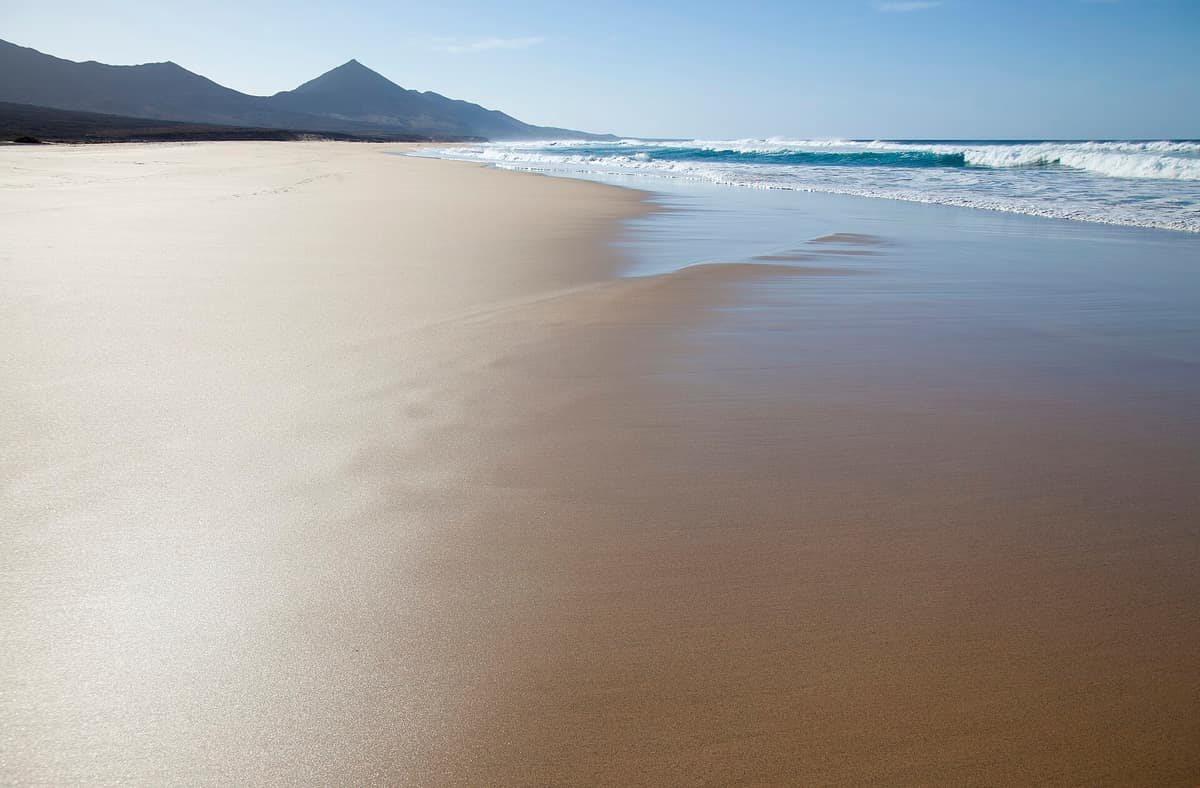
The desert peninsula of southern Fuerteventura where the Pico de la Zarza massif (807 m) plunges toward the 12 km wild volcanic beach of Cofete.
Jandía was once an independent volcanic island. An immense volcano, spanning roughly 26 km across at its peak, arose here 14 or 15 million years ago; today, its remnant forms a mountainous crescent anchored to the southern tip of Fuerteventura by a narrow sandy isthmus, La Pared. Jandía Natural Park protects this vast arid peninsula within the municipality of Pájara, encompassing its highest summit, Pico de la Zarza, and the windswept Barlovento coast unfolding at its base.
What makes it unique
The only place on Earth where the Jandía cardón grows, a cactus-like spurge that serves as the natural symbol of both the park and the entire island.
The place
Nature
The landscape
To understand Jandía, you must reconstruct it in your mind. The ancestral volcano originally rose to at least 1,500 m, but its climactic eruption proved so catastrophic that the entire northern flank collapsed into the Atlantic. What survived is a caldera rim forming a grand volcanic amphitheatre open to the ocean. The terrain is defined by dramatic geological contrast.
Approaching by land, you first cross the desert dunes of the La Pared isthmus. The relief then climbs sharply to Pico de la Zarza (807 m), the rooftop of Fuerteventura, dropping precipitously toward the sweeping bay of Cofete and the wild Barlovento beach.
Vegetation zones stratify by elevation across sandy plains, salt flats, stony hammadas, deep ravines and arid ridges. On higher slopes between 400 and 800 m, jorjao scrub takes hold, while the sheltered northern face of the peak harbours relict fragments of dry monteverde woodland—home to rare aderno, white laurel, heathers and mocán. Even the mountain’s name reflects this flora: the native blackberry, zarzamora, which on Fuerteventura survives solely on the crests of Jandía.
Wildlife and seasons
Jandía rewards birdwatchers with sharp binoculars. Across desert sands and stony flats wander the Canary Islands houbara bustard and the Eurasian stone-curlew. Sheer crags and desert gorges host the Egyptian vulture (locally called guirre), the common kestrel, the Barbary falcon and the osprey, known locally as guincho. Along the wild shoreline, Kentish plover and little ringed plover nest and winter on sandy beaches.
Botanically, the Jandía cardón (Euphorbia handiensis) grows nowhere else, alongside the blue-flowering tajinaste, Winter's marguerite and the wild Jandía aniseed. High rocky slopes shelter micro-endemics such as the rare pelotilla.
Among reptiles, the Atlantic lizard and the East Canary gecko are endemic to the eastern Canaries, alongside the elusive Fuerteventura skink. In total, the park records 28 breeding bird species, 3 reptile species and 12 mammal species. Leatherback sea turtles have occasionally nested on remote beaches—a rare event in European waters—while short-finned pilot whales and sperm whales frequent offshore currents. The sacred ibises seen near coastal settlements are an introduced, semi-captive population.
Jandía is rewarding year-round, though seasonal gear requirements vary.
Species
With a page in the atlas
Being mentioned in a source doesn't guarantee sightings: check with the people who manage the area.
Memory and protection
History and conservation
Jandía gained natural park status in 1987. Adjacent southern coastal sectors are designated ecological sensitivity zones and special protection areas for birdlife. Punta Jandía lighthouse, perched on the southwestern promontory, entered service in 1864 and ranks among the oldest operational beacons in the Canaries. The municipality of Pájara also preserves indigenous Majorero archaeological remains: dry-stone dwellings, pastoral stone enclosures and habitational caves.
A serious threat comes from domestic wildlife: discarded food scraps encourage feral cat and rodent populations, which severely disrupt native ground-nesting birds and endemic lizards.
Before you set off
Visiting
How to visit
The premier walking route ascends Pico de la Zarza: a 6.8 km hike taking around five and a half hours round trip. The path is clearly marked with distance marker posts, and the summit presents an extraordinary view overlooking the crescent of Cofete and the Barlovento shoreline. Carry plenty of drinking water, a wide-brimmed sun hat and high-factor sunscreen, as the entire ridge offers neither springs nor shade.
The other iconic destination is Cofete, an expansive wild beach beneath the jagged mountain wall, home to a hamlet of around 25 residents at Casas de Cofete. Up on the hillside stands the enigmatic Villa Winter, built in 1946.
Before you go
Never leave marked trails or enter restricted biological corridors; walking off-path accelerates fragile soil erosion and damages endemic flora. Open fires are strictly prohibited year-round, especially in arid summer months. Pack out every scrap of rubbish, do not uproot plants or collect mineral specimens, and never disturb or feed wild animals; report injured fauna to emergency services.
Check access, rules and visiting conditions in the official information from the managing body before you set off.
Location
Where it is and how far it reaches
Boundary of Jandía · IUCN Ib · © EEA, CDDA (CC-BY) The coordinate is estimated; it isn't a verified access point.
Transparency
Sources
The research data with its sources, and the official links for this place, are in the Spanish version of this page. See the Spanish version
Around it
Beyond Fuerteventura, the park shares species with Vjosa Wild River National Park, which also hosts Egyptian vultures and little ringed plovers, and with Cabo de Gata-Níjar Natural Park, which mirrors Jandía’s arid coastal steppes and houbara bustard habitats.
If you like this place, elsewhere in Europe
Distant places with uncommon wildlife and habitats in common. The most widespread species don't count. Sharing species doesn't imply a corridor or guaranteed presence.
- Vjosa Wild River National Park
Southern Albania (Përmet / Tepelenë / Memaliaj)
In common: Charadrius dubius · Egyptian vulture
Europe's first wild river national park: the Vjosa flows entirely undammed from Greece to the Adriatic Sea.
JFMAMJJASONDApril – June · September – October · Crowding very low
- Cabo de Gata-Níjar Maritime-Terrestrial Natural Park
Andalusia (Almería / Níjar / Carboneras / San José), [36.75, -2.18]
In common: Houbara bustard — wild coast, steppe and grassland
The largest protected marine-terrestrial area of volcanic origin in Mediterranean Europe, featuring lava cliffs, fossil dunes and Posidonia meadows.
JFMAMJJASONDApril – June · September – November · Crowding moderate
Entry #646 of the original atlas.