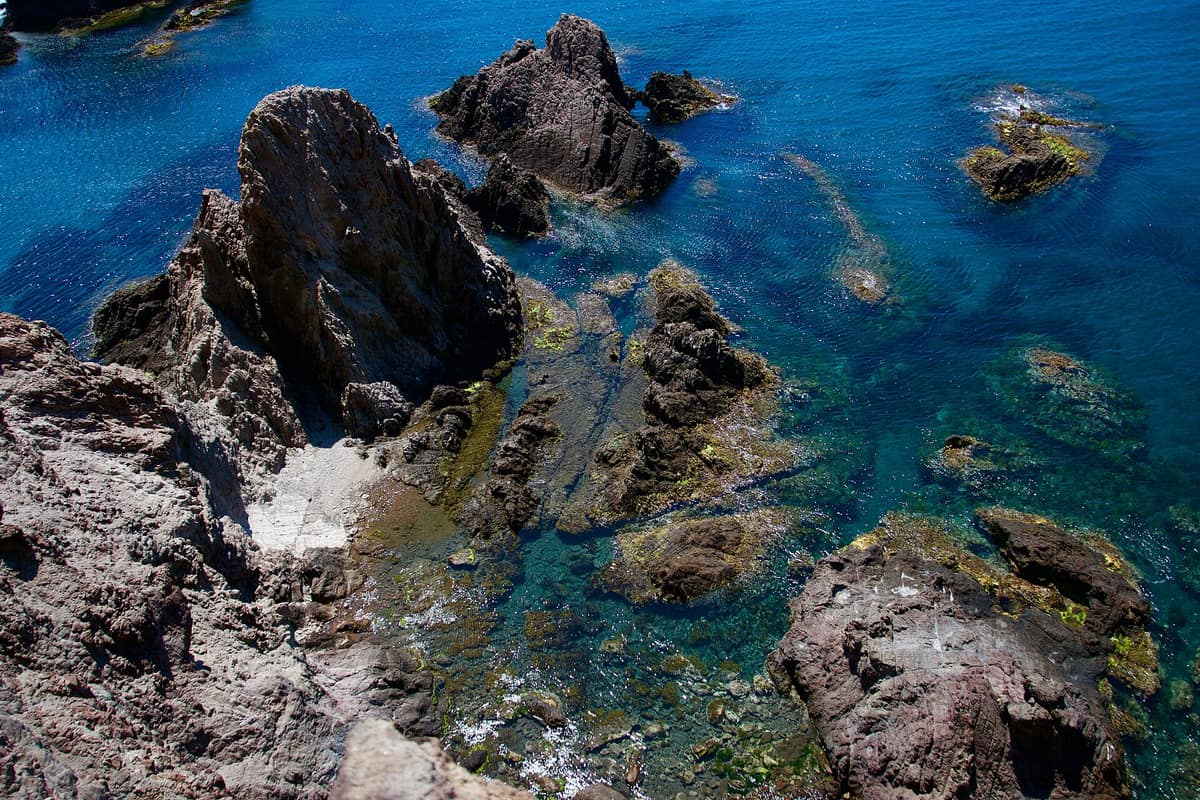
Cabo de Gata-Níjar Maritime-Terrestrial Natural Park
Parque Natural Marítimo-Terrestre del Cabo de Gata-Níjar
Andalusia (Almería / Níjar / Carboneras / San José), [36.75, -2.18] · Spain
Photo: Edoarrdo · CC BY-SA 4.0 · Wikimedia Commons
The largest protected marine-terrestrial area of volcanic origin in Mediterranean Europe, featuring lava cliffs, fossil dunes and Posidonia meadows.
There is no climatic winter here. The climate is so arid that Cabo de Gata-Níjar is the driest natural space in all of Europe, and that arid character has created a landscape of lava, steppe and crystalline seas. It was Andalusia's first protected maritime-terrestrial space, recognized by UNESCO as both a Biosphere Reserve and a Global Geopark.
What makes it unique
A single park brings together arid volcanoes, year-round flamingos in salt pans and Posidonia meadows beneath a protected 63 km coastline.
The place
Nature
The landscape
Everything starts with volcanic rock. Dark volcanic beds dominate: lava flows, domes and fossil beaches painting the landscape in ochre, black and reddish tones. Over them lies a coastal fringe of sand dunes, steppe and salt lagoons, bordered seaward by a marine reserve running parallel to the shore. It is a shifting mosaic rather than a single postcard view: every kilometre brings a change in ecosystem.
The flora reflects this harsh environment. With negligible rainfall and poor soils, the park shelters one of the most singular botanical assemblages in Europe, with over 1,000 exclusive plant species. European fan palm and periploca climb volcanic hillsides, while esparto grass, rosemary and jujube trees carpet the plains. In early spring, thousands of sea daisies turn the cliffs bright yellow.
Beneath the surface, the spectacle continues underwater. Submerged seabed hosts meadows of Posidonia, genuine submarine forests inhabited by crabs, octopuses and fish, alongside the noble pen shell, the largest protected bivalve in the Mediterranean. Rocky seabeds feature false corals, seaweeds and dusky groupers, known as kings of the reef. The marine reserve holds an even rarer wonder: species from both sides of the currents separating Cabo de Gata from North Africa thrive side by side.
Wildlife and seasons
Birds occupy two contrasting arenas. The first is the salt pans of Cabo de Gata. Here pied avocets, black-winged stilts and plovers forage, alongside gulls, wild ducks and flamingos. The greater flamingo remains throughout the entire year, one of the site's ornithological marvels. Because there is no thermal winter, many birds overwinter here, while migratory flocks use the lagoons as a staging post. Between the salt pans and nearby Rambla Morales, over 80 species can be observed across the year.
The second setting is the steppe of Las Amoladeras, sheltered by esparto grass and thyme scrub, home to elusive birds: Eurasian stone-curlews, crested larks, short-toed larks and Dupont's lark. For this reason, the trail traversing this area, known as the bird route, enters a strict Nature Reserve.
Species
With a page in the atlas
Being mentioned in a source doesn't guarantee sightings: check with the people who manage the area.
Memory and protection
History and conservation
The park is equally a cultural landscape. Abandoned farmsteads, water wheels, cisterns and windmills, all designated Cultural Heritage Sites, reflect age-old stewardship of scarce resources. Phoenicians and Romans established fish-salting and purple-dye factories at Torregarcía, while the Moors introduced irrigation systems and watchtowers ringing the coast. Esparto weaving, traditional jarapa rugs and pottery are living crafts inherited from them.
Legal protection arrived early: the park was established in 1987, and its marine reserve protects 63 km of coastline, making it the largest coastal marine reserve in continental Europe. An unexpected harmony protects wildlife: the Cabo de Gata salt pans remain commercially active, because ongoing salt extraction is indispensable for sustaining their birdlife.
Before you set off
Visiting
How to visit
Begin by understanding the terrain. The Las Amoladeras visitor centre traces human occupation in the park back to the Neolithic, and the Casa de los Volcanes was Andalusia's pioneering eco-museum interpreting regional geological features. The park maintains 16 marked walking trails visiting most of its 33 recognized geological landmarks, complete with explanatory signboards. El Pocico-Las Marinas showcases fossil beaches; La Vela Blanca highlights volcanic cliffs; La Molata explores traditional wind and water harvesting; and Requena reveals how early inhabitants lived.
The Loma Pelada trail measures 5,900 metres one-way, takes two and a half hours and is graded easy. It sets out from Los Escullos, where the eighteenth-century San Felipe fort stands as one of the coastal watchposts, overlooking sheer cliffs and secluded coves such as Cala Tomate, with the Cerro del Fraile rising as a landmark peak. Cyclists can pedal through the historic mining village of Rodalquilar up to Cerro del Cinto for sweeping views.
Then comes the sea. You can snorkel in crystal-clear waters like those of La Isleta amid coral-like reefs, colourful fish and Posidonia beds, or take boat excursions to remote coves such as Cala Chica or San Pedro. Kayaking is also popular along the sheltered shoreline.
Before you go
Along the Loma Pelada trail mobile phone coverage is intermittent: keep your battery charged to dial 112 in emergencies. Never discard cigarette butts or anything that could ignite a wildfire.
Check access, rules and visiting conditions in the official information from the managing body before you set off.
Location
Where it is and how far it reaches
Boundary of Cabo de Gata-Nijar · IUCN IV · © EEA, CDDA (CC-BY) The coordinate is estimated; it isn't a verified access point.
Transparency
Sources
The research data with its sources, and the official links for this place, are in the Spanish version of this page. See the Spanish version
Around it
About twenty-three kilometres away lies the Desierto de Tabernas Natural Area, another arid stronghold of south-eastern Spain. Farther away, other Mediterranean coastal reserves share marine areas with Posidonia beds: Ses Salines Natural Park, which also hosts flamingos, Cap de Creus Natural Park, Port-Cros National Park and Kornati National Park.
What else to explore nearby
Approximate straight-line distance between the edges of each area. It doesn't indicate access, routes or driving times.
- Tabernas Desert Natural Area
Andalusia (Almería)
About 23 km away
The only proper desert on the European continent, an extreme badlands landscape where torrential downpours have sculpted canyons and ravines, celebrated as the backdrop for legendary spaghetti westerns.
JFMAMJJASONDOctober – May · Crowding low
If you like this place, elsewhere in Europe
Distant places with uncommon wildlife and habitats in common. The most widespread species don't count. Sharing species doesn't imply a corridor or guaranteed presence.
- Cap de Creus Natural Park
Catalonia (Girona / Cadaqués / El Port de la Selva / Roses)
In common: Posidonia oceanica · Common bottlenose dolphin — wild coast, marine, steppe and grassland
The easternmost point of the Iberian Peninsula, where the Pyrenees plunge into the sea in a labyrinth of metamorphic schists sculpted by the tramontana.
JFMAMJJASONDApril – June · September – October · Crowding moderate
- Kornati National Park
Šibenik-Knin (Kornati Archipelago — Murter)
In common: Posidonia oceanica · Common bottlenose dolphin — wild coast, marine
A labyrinth of nearly ninety barren limestone islands, featuring sheer sea cliffs ("crowns") plunging into the open Adriatic.
JFMAMJJASONDMay – June · September – October · Crowding moderate
- Port-Cros National Park
Provence-Alpes-Côte d'Azur (Var / Hyères)
In common: Posidonia oceanica · Common bottlenose dolphin — wild coast, marine
One of the oldest marine parks in Europe (1963): an island cloaked in Mediterranean forest and posidonia seabed protected for sixty years.
JFMAMJJASONDMay – June · September – October · Crowding moderate
Entry #508 of the original atlas.