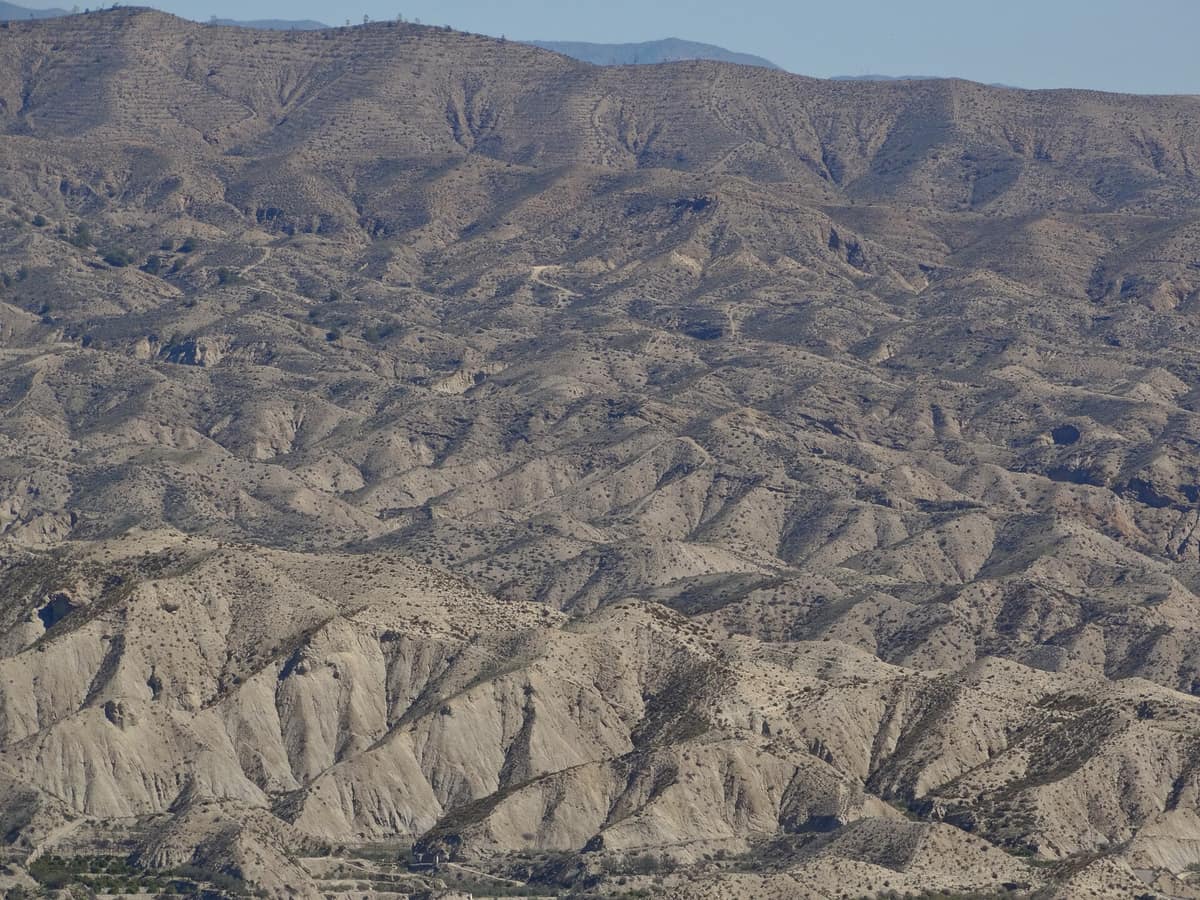
Tabernas Desert Natural Area
Paraje Natural Desierto de Tabernas
Andalusia (Almería) · Spain
Photo: Fährtenleser · CC BY-SA 4.0 · Wikimedia Commons
The only proper desert on the European continent, an extreme badlands landscape where torrential downpours have sculpted canyons and ravines, celebrated as the backdrop for legendary spaghetti westerns.
It rains rarely, and when it rains, it pours with violence. Annual precipitation falls short of 250 mm and arrives in sudden torrential downpours onto marl and sandstone soils that cannot retain moisture. Sheetwash and runoff carve gullies, sharp crests, and dry rambla riverbeds; between them clings vegetation finely tuned to severe aridity. This is how the Tabernas Desert Natural Area in Almería was forged—a stark badlands landscape where you can read every form shaped by erosion.
What makes it unique
Here erosion can be read at the foot of every gully, in landforms ranging from raindrop micro-craters to sweeping canyons, like a full-scale outdoor geological museum.
The place
Nature
The landscape
The Tabernas Desert lies north of the city of Almería, cradled between the Filabres and Alhamilla mountain ranges, within a wider mountain setting that includes Gádor and the Sierra Nevada. This geographical shield isolates it from moist Mediterranean sea breezes, producing a climate of intense contrasts: an annual mean around 17,9 °C, averaging 9 °C in January and 24,5 °C in August. Annual rainfall slightly exceeds 200 mm, with barely one-third falling during the hot season from May to October.
To understand this relief, one must delve into ancient seas. Some eight million years ago, the prehistoric shoreline reached the flanks of the Filabres, leaving fossil coral reefs as enduring evidence. Submarine fans formed across the deep seafloor, depositing turbidites—alternating strata of marls and sands—which constitute the fragile rock foundation sculpted by modern erosion. Other geological treasures include seismites, gypsum deposits dating to the Messinian Salinity Crisis, and the prominent crest of Cerro Alfaro.
Water does the rest. Desert wadis—the ramblas—carry water, mud, and boulders only during episodic flash floods. On bare hillsides, runoff leaves micro-craters from falling raindrops, fairy chimneys, rills, and deep vertical gullies. Underground, piping processes carve out subterranean conduits of true speleological dimensions.
Along the ramblas, beside groundwater seepages that are almost invariably saline, genuine oases appear, where reeds and tamarisks compete for terrain with specialized halophytic plants.
Wildlife and seasons
Flora adapts ingeniously: small, leathery foliage, like the glasswort colonizing rambla verges, or life cycles so rapid that ephemerals germinate, bloom, and set seed before fleeting moisture vanishes. Among distinctive plants is Euzomodendron bourgaeanum, an Almerian endemic shrub that grows on eroded marls and blooms during the first five months of the year. Following rainy springs, moricandia blooms vibrantly across marl slopes.
Birdlife concentrates along the rambla corridors and on sheer cliffs offering shelter and nesting sites: the alpine swift, crag martin, blue rock thrush, and western jackdaw. On cliff faces nest the European roller, little owl, black-eared wheatear, rock sparrow, and trumpeter finch. European bee-eaters excavate nest burrows deep in sandy banks, safe from predators such as the horseshoe whip snake. The red-legged partridge nests beside esparto grasslands; the peregrine falcon and Bonelli's eagle from the Sierra Alhamilla hunt here, while the Eurasian eagle-owl preys on rabbits and small rodents. Steppe birds also thrive, including crested larks, short-toed larks, stone-curlews, little bustards, and black-bellied sandgrouse.
Reptiles are well represented by the spiny-footed lizard, ocellated lizard, and ladder snake, alongside the Perez's frog and natterjack toad. Mammals include red foxes, European rabbits, garden dormice, and both Algerian and European hedgehogs.
Species
With a page in the atlas
Being mentioned in a source doesn't guarantee sightings: check with the people who manage the area.
Memory and protection
History and conservation
The area was officially designated in 1989 as a Natural Area and Special Protection Area for birds, followed in 2016 by classification as a Special Area of Conservation. It encompasses 11.448,49 hectares divided across five Almerian municipalities. The local flora features an exceptional number of narrow endemics exclusive to this basin alongside globally rare species.
Since the late 1950s, more than 300 films have been shot in this desert, predominantly spaghetti westerns. In 2020 the European Film Academy honored the desert with the title of Treasure of European Film Culture.
Before you set off
Visiting
How to visit
Tabernas is an exceptional landscape for desert hiking. Before venturing into the ramblas, check access routes and visitation guidelines; the desert structure reveals itself both on the walls of dry riverbeds and across gullied slopes. Birds are best observed along the ramblas and sheer desert bluffs, alongside textbook erosion landforms ranging from fairy chimneys to badland gullies.
The ideal hiking window spans autumn through spring, avoiding the scorching heat of summer.
Before you go
Avoid summer: the desert heat is punishing and dangerous. Never discard cigarette butts or anything that could cause combustion, in order to prevent wildfires. Pack out all rubbish to the nearest roadside bin and never release domestic animals into the wild, where they threaten vulnerable native wildlife. Check current access conditions and open sectors with the park administration before setting out.
Check access, rules and visiting conditions in the official information from the managing body before you set off.
Location
Where it is and how far it reaches
Boundary of Desierto de Tabernas · IUCN II · © EEA, CDDA (CC-BY) The coordinate is estimated; it isn't a verified access point.
Transparency
Sources
The research data with its sources, and the official links for this place, are in the Spanish version of this page. See the Spanish version
Around it
Other notable protected spaces in Almería include the Sierra Nevada National and Natural Park, visible on the horizon, and the Cabo de Gata-Níjar Natural Park, with its volcanic sea cliffs and arid coastal salt pans.
What else to explore nearby
Approximate straight-line distance between the edges of each area. It doesn't indicate access, routes or driving times.
- Sierra Nevada National and Natural Park
Andalusia (Granada / Almería / Capileira / Trevélez / Monachil)
About 5 km away
The roof of the Iberian Peninsula (Mulhacén 3,479 m and Veleta 3,396 m), a Biosphere Reserve with over 80 exclusive endemic plant species.
JFMAMJJASONDMay – October · Crowding moderate
- Cabo de Gata-Níjar Maritime-Terrestrial Natural Park
Andalusia (Almería / Níjar / Carboneras / San José), [36.75, -2.18]
About 23 km away
The largest protected marine-terrestrial area of volcanic origin in Mediterranean Europe, featuring lava cliffs, fossil dunes and Posidonia meadows.
JFMAMJJASONDApril – June · September – November · Crowding moderate
If you like this place, elsewhere in Europe
Distant places with uncommon wildlife and habitats in common. The most widespread species don't count. Sharing species doesn't imply a corridor or guaranteed presence.
- Coussouls de Crau National Nature Reserve
Bouches-du-Rhône (Arles / Saint-Martin-de-Crau)
In common: Lesser kestrel — steppe and grassland
The only genuine pebble steppe in Northern and Central Europe (Coussoul), an ancient fossil delta of the Durance river.
JFMAMJJASONDApril – June · September – October · Crowding very low
Entry #509 of the original atlas.