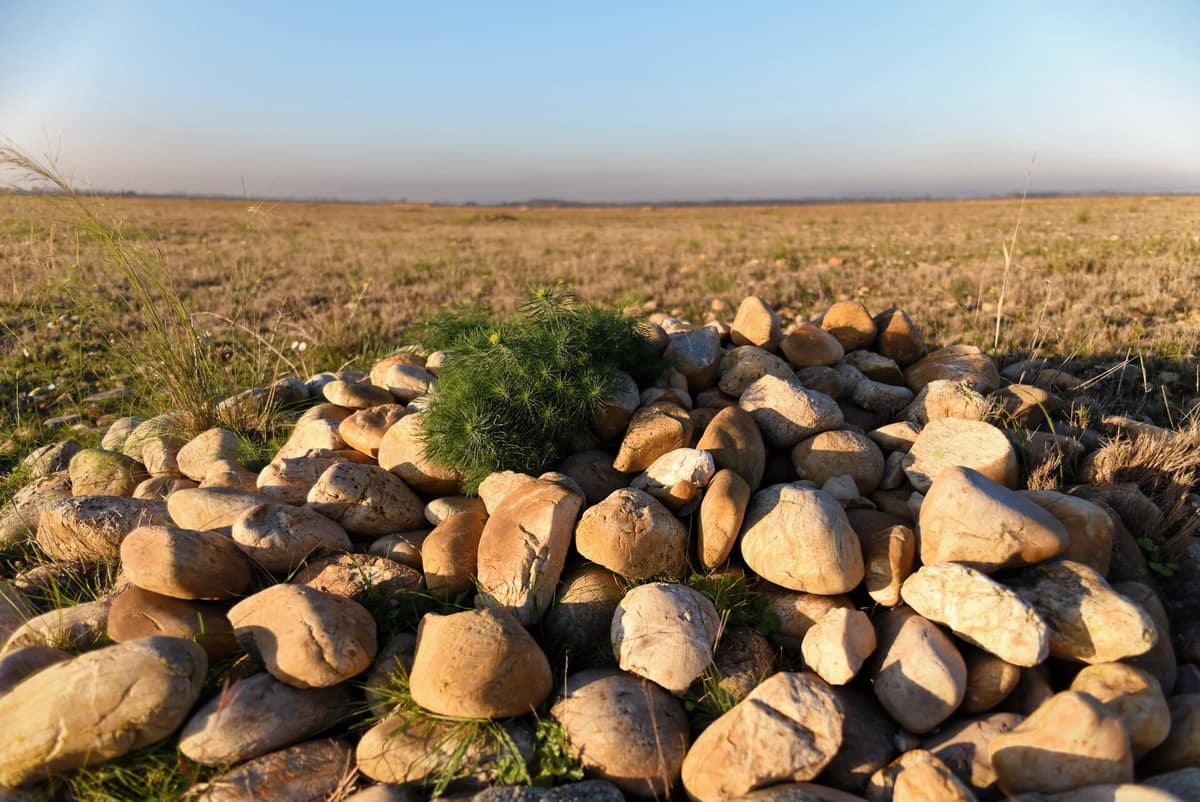
Coussouls de Crau National Nature Reserve
Réserve Naturelle Nationale de la Coussoul de Crau
Bouches-du-Rhône (Arles / Saint-Martin-de-Crau) · France
Photo: Gemarin · CC BY-SA 4.0 · Wikimedia Commons
The only genuine pebble steppe in Northern and Central Europe (Coussoul), an ancient fossil delta of the Durance river.
People often drive past without stopping, and that is a mistake. La Crau looks like a bleak, barren wasteland, but just a stone's throw from the Camargue it conceals a steppe of stones and sparse grasses harboring wildlife found nowhere else in France. This is the coussoul, and the Coussouls de Crau National Nature Reserve protects some 7 500 ha of it, with the pin-tailed sandgrouse and lesser kestrel as its most renowned inhabitants and sheep flocks serving as its gardeners.
What makes it unique
A fossil delta transformed into steppe inhabited by birds originating from North African and Iberian steppes.
The place
Nature
The landscape
The story begins with a river. La Crau is an alluvial plain of 60 000 ha at the gates of Arles, between the Alpilles and the Mediterranean: the fossil delta of the Durance. For five million years the river transported rounded pebbles down from the Alps; 75 000 years ago tectonic movements diverted its course, the delta dried out, leaving behind a semi-arid steppe known as the coussoul. Beneath the grass, these ancient pebbles are naturally cemented into an almost impermeable layer of puddingstone that seals surface flora and fauna off from groundwater.
Surviving here is demanding. Between grazing flocks, summer droughts, and the fierce mistral, plant life is an ongoing struggle, yet the ecological balance is fragile: once disturbed, the coussoul cannot regenerate on its own and cannot be artificially restored. Stiff brome dominates as the staple forage for sheep; hollow-stemmed asphodel, thyme, and feather grass form a plant community unique in the world. The coussoul holds few rare plants, but the reserve's temporary pools, damp grasslands, and marshes shelter at least thirty protected plant species.
Wildlife and seasons
This is a steppe of birds. Many originate from the steppes of North Africa or the Iberian Peninsula; the lesser kestrel and the little bustard maintain a large part of their national populations here, while the pin-tailed sandgrouse and calandra lark are found exclusively here in France. Out of 479 bird species in France, around 300 have been observed in La Crau and 150 within the reserve. Breeding birds include the Eurasian stone-curlew, European roller, tawny pipit, and little owl.
La Crau hosts France's only population of pin-tailed sandgrouse, numbering around one hundred pairs. In 2021 around 250 breeding pairs of lesser kestrels were counted in La Crau, supported by artificial nest boxes installed for their conservation.
Further down the food chain, life is equally extraordinary. Grasshopper densities reach 60 000 individuals per hectare in August, among them the endangered Crau bush-cricket; there are also 14 ant species, and the ocellated lizard thrives among the coussoul fauna.
In summer, from the hide at the Peau de Meau sheepfold, you can watch for pin-tailed sandgrouse, little bustards, stone-curlews, and hoopoes.
Species
With a page in the atlas
Being mentioned in a source doesn't guarantee sightings: check with the people who manage the area.
Memory and protection
History and conservation
Flocks of sheep have grazed the coussoul since antiquity and even since Neolithic times, as Roman sheepfold remains attest. Today 160 pastoralists bring 100 000 sheep to graze, mainly in winter and spring, before driving them in transhumance up into the Alps. This extensive grazing shaped the steppe vegetation and remains essential for its conservation.
In the twentieth century, industrial expansion, urbanization, and intensive agriculture shrank the steppe, prompting farmers and conservationists to join forces to protect it. The reserve was established on 8 October 2001 and since 2004 has been co-managed by the regional nature conservatory and the Bouches-du-Rhône Chamber of Agriculture.
A severe incident struck on 7 August 2009 when an oil pipeline crossing the reserve ruptured, spilling 5 400 m³ of crude oil across roughly 4,5 ha. Ecological rehabilitation removed 72 000 tonnes of contaminated soil, took down fences in 2014 so sheep could return, and reintroduced the harvester ant Messor barbarus. Moreover, a former 375 ha peach orchard adjacent to the reserve was restored to Mediterranean steppe, where sheep have grazed again since 2010.
Before you set off
Visiting
How to visit
The Peau de Meau nature trail features fifteen interpretive panels explaining the geology, wildlife, flora, and pastoral heritage of the coussoul. It covers 4,7 km, has a bird hide at the sheepfold, and is open year-round for self-guided exploration, without motorized vehicles. Entry requires a permit and trail map collected from the Écomusée de la Crau in Saint-Martin-de-Crau; the pass is valid for two days, consecutive or not.
If you prefer a guided visit, reserve staff organizes commentary tours for groups of at least ten people, and on the first Friday of each month, except July and August, there is a field outing with a ranger. The Écomusée is accessible to persons with reduced mobility and is closed every Monday and from 24 December to 5 January.
Before you go
Visitors must remain strictly on marked trails. Prohibited are dogs, any collecting of flora, fauna, or minerals, campfires, bivouacking, camping, and noisy or motorized activities.
Check access, rules and visiting conditions in the official information from the managing body before you set off.
Location
Where it is and how far it reaches
Boundary of reserve naturelle nationale des coussouls de crau · IUCN IV · © EEA, CDDA (CC-BY) The coordinate is estimated; it isn't a verified access point.
Transparency
Sources
The research data with its sources, and the official links for this place, are in the Spanish version of this page. See the Spanish version
Around it
The Marais du Vigueirat is 5 km away. Further afield, other steppe reserves share little bustards and pin-tailed sandgrouse with La Crau: the Bardenas Reales Natural Park in Navarre and the Gallocanta Lagoon Nature Reserve in Aragon.
What else to explore nearby
Approximate straight-line distance between the edges of each area. It doesn't indicate access, routes or driving times.
- Vigueirat Marshes
Provence-Alpes-Côte d'Azur (Bouches-du-Rhône / Mas-Thibert)
About 5 km away
A 1.200 ha nature reserve on the threshold of the Camargue hosting all 9 European heron and egret species.
JFMAMJJASONDApril – June · September – October · Crowding low
If you like this place, elsewhere in Europe
Distant places with uncommon wildlife and habitats in common. The most widespread species don't count. Sharing species doesn't imply a corridor or guaranteed presence.
- Bardenas Reales de Navarra Natural Park
Navarra (Tudela / Arguedas / Valtierra)
In common: Pin-tailed sandgrouse · Little bustard — steppe and grassland
Desert and badlands landscape of 42,000 ha carved into clays, gypsum, and sandstones, crowned by iconic isolated buttes like Castildetierra.
JFMAMJJASONDOctober – May · Crowding moderate
- Gallocanta Lagoon Nature Reserve
Aragon / Castilla-La Mancha (Zaragoza / Teruel — Gallocanta / Bello)
In common: Pin-tailed sandgrouse · Little bustard — steppe and grassland
Western Europe's largest saline lagoon and the Iberian Peninsula's foremost stopover for the common crane.
JFMAMJJASONDOctober – March · Crowding low
Entry #381 of the original atlas.