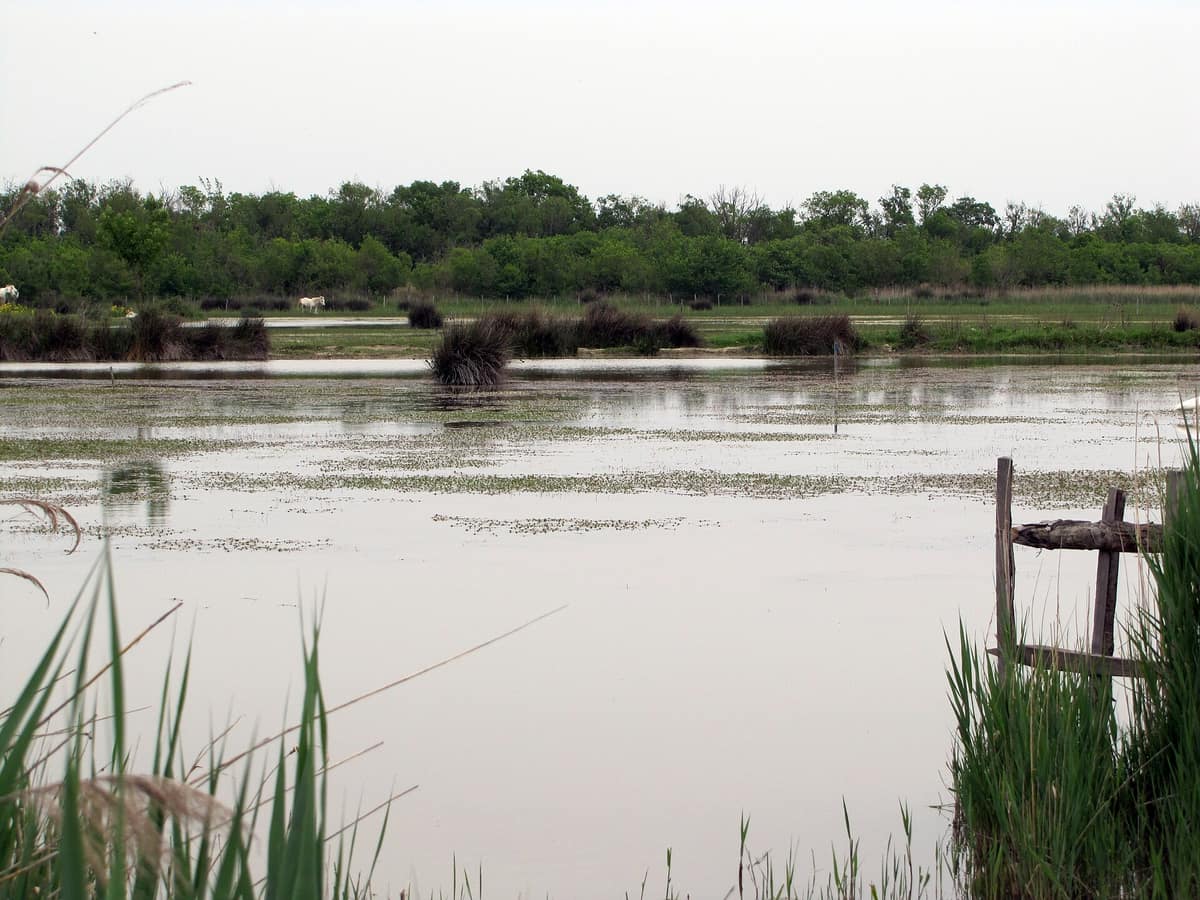
Vigueirat Marshes
Marais du Vigueirat
Provence-Alpes-Côte d'Azur (Bouches-du-Rhône / Mas-Thibert) · France
Photo: Hyppolyte de Saint-Rambert · CC BY-SA 4.0 · Wikimedia Commons
A 1.200 ha nature reserve on the threshold of the Camargue hosting all 9 European heron and egret species.
Nine species of herons and egrets, and all nine breed or dwell here. The Marais du Vigueirat encompass 1.200 hectares of floodplain marsh, reedbeds, and canals between the Grand Rhône delta and the stony Crau plain, representing one of the Conservatoire du littoral's largest protected holdings in the Camargue. Co-managed by LPO France and LPO PACA, the view from its boardwalks reveals a living Camargue: fighting bulls, semi-wild horses, and wetland avifauna sharing the same waters.
What makes it unique
France's premier stronghold for Eurasian bitterns, sheltering between 17 and 20 % of the national breeding population in reedbeds barely visible from outside.
The place
Nature
The landscape
Water governs every aspect of the landscape. The reserve protects permanent and seasonal freshwater marshes, canals, drainage ditches (roubines), lagoons, and saline sansouïres carpeted with shrubby seablite, glassworts, and sea lavender. It preserves the Camargue's largest protected continuous reedbed.
The botanical richness is remarkable: scientists have recorded 909 species of plants, fungi, and lichens, including over 600 vascular plants, 41 of which hold protected or heritage conservation status. In spring, delicate bell-shaped blossoms of summer snowflake line the wet footpaths. Furthermore, the yellow water-lily, once feared extinct in the Camargue, was rediscovered thriving in the Vigueirat canal, its sole known station across the delta.
Wildlife and seasons
More than 310 bird species have been recorded in the reserve. Herons serve as the flagship: squacco herons nest in tamarisk thickets, while great white egrets and purple herons colonize the deep reedbeds. The secretive Eurasian bittern blends invisibly into the reeds, celebrated each spring with themed listening walks.
Every season brings distinct wildlife encounters. Dry open rangelands host European bee-eaters, European rollers, and cryptic Eurasian stone-curlews; raptors feature abundant western marsh harriers and rarer visitors such as greater spotted eagles, Bonelli's eagles, and ospreys. Winter transforms the marshes into a major haven for dabbling ducks and water rails, and since 2018 large flocks of common cranes overwinter here. Between 80 and 100 pairs of common terns nest on artificial floating rafts deployed under the LIFE+ENVOLL project to compensate for lost coastal nesting beaches.
Among mammals, five herds of Camargue cattle and horses graze freely from late March to mid-December as living ecological mowers. Eurasian otters and beavers leave occasional tracks along waterways. Diverse bats forage across the pools, interpreted in a dedicated hut along the Homme et Nature trail. Mediterranean tree frogs are abundant, while the European pond turtle basks on muddy canal banks. Critically endangered European eels use these productive lagoons to mature before migrating to the Sargasso Sea.
Species
With a page in the atlas
Being mentioned in a source doesn't guarantee sightings: check with the people who manage the area.
Memory and protection
History and conservation
Habitat management integrates extensive equine and bovine grazing, colonial nesting rafts, and invasive alien weed eradication: 13 alien species are monitored, with water primroses (Ludwigia), groundsel bush (Baccharis), and pampas grass actively uprooted to prevent choking of indigenous marsh flora.
Before you set off
Visiting
How to visit
There are two contrasting ways to discover the reserve. The self-guided Sentiers de l'Étourneau total nearly six kilometres of themed trails. The Sentier des Cabanes is a half-kilometre stilted boardwalk with eight interactive family nature huts; the Palunette trail extends for some two kilometres beside the Vigueirat canal with two hides and an elevated viewing platform; the Homme et Nature trail, inaugurated in spring 2022, covers nearly 2 km exploring Camargue pastoral landscapes; and an ethnobotanical garden presents five traditional Camargue habitats and the culinary, medicinal, and dyeing uses of their plants.
The protected core reserve, by contrast, is accessible exclusively with an expert naturalist guide. Guided tours depart by open-sided electric shuttle, lasting two hours and a half with roughly 700 m of walking between observation towers. For thorough exploration, full-day guided walking treks of 5 km traverse marshes, lagoons, and sansouïres across the Camargue's largest reedbed.
Cycling access is straightforward: from the Van Gogh Bridge in Arles, the ViaRhôna trail runs for 16 km to Mas-Thibert, where an additional 5 km dedicated link reaches the visitor centre. By public transit, regional bus line 703 (Arles to Port-Saint-Louis-du-Rhône) stops at Mas-Thibert, roughly 3,5 km from the site.
Before you go
The core nature reserve can only be entered on guided tours, so verify timetables and book in advance. Bring sturdy walking footwear, weather-appropriate clothing, and field binoculars.
Check access, rules and visiting conditions in the official information from the managing body before you set off.
Location
Where it is and how far it reaches
Boundary of Marais du vigueirat · IUCN IV · © EEA, CDDA (CC-BY) The coordinate is estimated; it isn't a verified access point.
Transparency
Sources
The research data with its sources, and the official links for this place, are in the Spanish version of this page. See the Spanish version
Around it
Around 5 km away lies the Réserve Naturelle Nationale des Coussouls de Crau on the steppe plain. Further afield, sharing purple herons and flamingoes, the site shares coastal wetland ecology with the Venice Lagoon and the Ebro Delta Natural Park.
What else to explore nearby
Approximate straight-line distance between the edges of each area. It doesn't indicate access, routes or driving times.
- Coussouls de Crau National Nature Reserve
Bouches-du-Rhône (Arles / Saint-Martin-de-Crau)
About 5 km away
The only genuine pebble steppe in Northern and Central Europe (Coussoul), an ancient fossil delta of the Durance river.
JFMAMJJASONDApril – June · September – October · Crowding very low
If you like this place, elsewhere in Europe
Distant places with uncommon wildlife and habitats in common. The most widespread species don't count. Sharing species doesn't imply a corridor or guaranteed presence.
- Ebro Delta Natural Park
Catalonia (Tarragona / Deltebre / Sant Jaume d'Enveitja / Amposta)
In common: Purple heron · Greater flamingo — wetland
The most important wetland in the Iberian Mediterranean after Doñana (320 km²), featuring reed-fringed lagoons, the Trabucador sandbar, and thousands of flamingos.
JFMAMJJASONDApril – June · September – November · Crowding low
- Aiguamolls de l'Empordà Natural Park
Catalonia (Girona / Castelló d'Empúries / Sant Pere Pescador)
In common: Purple heron · Greater flamingo — wetland
Coastal wetland and fluvial marsh reserve at the mouths of the Muga and Fluvià rivers on the Costa Brava.
JFMAMJJASONDMarch – May · September – November · Crowding low
Entry #181 of the original atlas.