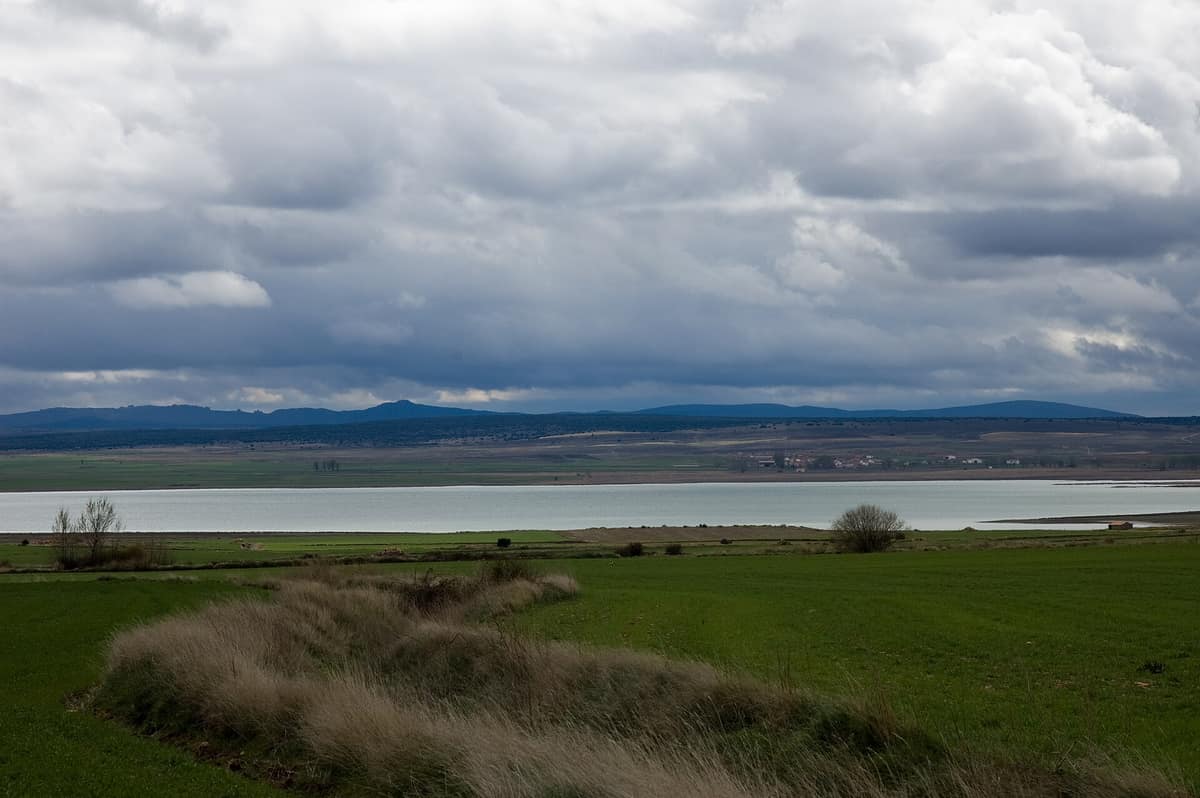
Gallocanta Lagoon Nature Reserve
Reserva Natural Dirigida de la Laguna de Gallocanta
Aragon / Castilla-La Mancha (Zaragoza / Teruel — Gallocanta / Bello) · Spain
Photo: Jose Manuel Mota · CC BY 2.0 · Wikimedia Commons
Western Europe's largest saline lagoon and the Iberian Peninsula's foremost stopover for the common crane.
By mid-October the first cranes begin arriving timidly, in small flocks, from northern and eastern Europe. Having flown thousands of kilometres, they find their haven to rest and refuel: Gallocanta, the largest natural lake on the Iberian Peninsula, lying at about a thousand metres altitude between the provinces of Zaragoza and Teruel. Within weeks the basin fills to capacity. On peak November days over 19,000 cranes are counted, and winter censuses average 150,000 birds.
What makes it unique
A saline lagoon barely two metres deep, set at a thousand metres altitude, transforms each autumn into the Iberian Peninsula's premier crane stopover.
The place
Nature
The landscape
Gallocanta stretches at most 7 km long by 2 wide, spanning 1924 ha encircled by another 4553 ha of peripheral buffer zone. It is an upland endorheic basin: a closed valley without an outlet to the sea, nestled within the Iberian System between Campo de Daroca and Jiloca. Elevations range between 995 and 1085 metres, framed by the Sierra de Santa Cruz, Pardos, Menera, and Caldereros ranges.
Water is sparse and intensely saline here. Average water depth is barely 70 cm with a maximum of 2 m. The lake is replenished primarily by subterranean aquifers and tests ten times saltier than the ocean, so that during arid spells thick salt crusts coat the shoreline. Together with Fuente de Piedra lagoon in Málaga, it ranks as the largest saline lake in Europe. Due to this hypersalinity fish are entirely absent: birdlife, amphibians, and reptiles populate streams and pools, while mammals inhabit the surrounding ranges.
Vegetation arranges itself in concentric bands. Halophytic plants withstand severe salinity, among them endemics and protected botanicals such as Puccinellia pungens, Lythrum flexuosum, and Anacamptis palustris. In fresher water pockets reedbeds and cattails flourish. The uplands preserve stands of Scots pine, holm oak, gall oak, and juniper. Surrounding the lagoon, the steppe-like basin is partitioned into fields of grain, sunflowers, maize, vegetables, and alfalfa.
Wildlife and seasons
The seasonal rhythm is governed by the common crane. Flocks arrive from northern Europe between mid-October and mid-December, with a substantial contingent overwintering until spring. The vanguard arrives gradually in the opening weeks of autumn migration. In spring, northbound passage commences in February, concluding by early March. Since the 70s the passage has been shifting earlier, a trend linked to warming temperatures and shrinking flooded surface area under climate change.
Yet cranes are not alone. Gallocanta represents Aragon's most critical wetland for waterbirds and Spain's second-most significant after Doñana. More than 220 bird species have been recorded, including vultures, eagles, hoopoes, and coots. The winter census averages 150,000 birds, peaking at 400,000 in the winter of 1998.
In the surrounding sierras and hills roam roe deer, weasels, foxes, European wildcats, wild boars, martens, rabbits, and badgers.
Species
With a page in the atlas
Being mentioned in a source doesn't guarantee sightings: check with the people who manage the area.
Memory and protection
History and conservation
In centuries past, local lands were cultivated with grapevines and saffron. Today the lagoon is protected as a nature reserve, designated on 30 November 2006 under Law 11/2006 of Aragon, additionally holding SCI and SPA conservation status.
Before you set off
Visiting
How to visit
The best place to begin is the reserve's Visitor Centre, situated along the road linking Bello and Tornos. From there, the 'Route of the Cranes' programme offers free guided excursions accompanied by an environmental educator, featuring observation stops and interpretive explanations. In autumn these take place every weekend and public holiday until early December, in two daily slots, at 10.30 and 15.30, requiring prior reservation.
The guided itinerary lasts three hours, conducted primarily by vehicle along well-maintained gravel tracks and requiring your own transport. It demands no physical exertion, but is lengthy and recommended for visitors aged 6 and above. Bring warm clothing and binoculars if available. The Gallocanta observatory provides accessible paving and unobstructed interior spaces for wheelchairs.
Before you go
The peak window spans October to March, coinciding with crane migration and overwintering concentrations. Visitor presence is moderate at the hides around sunrise and sunset during the height of crane passage.
Check access, rules and visiting conditions in the official information from the managing body before you set off.
Location
Where it is and how far it reaches
Boundary of Laguna de Gallocanta · © EEA, CDDA (CC-BY) The coordinate is estimated; it isn't a verified access point.
Transparency
Sources
The research data with its sources, and the official links for this place, are in the Spanish version of this page. See the Spanish version
Around it
Gallocanta has no immediate neighbours in the atlas, but shares steppe affinities with other expanses. The Bardenas Reales Natural Park of Navarre and the Coussoul de Crau National Nature Reserve share with it the little bustard and the pin-tailed sandgrouse; Bardenas additionally shares Dupont's lark. The Hortobágy National Park - The Puszta shares the common crane and the great bustard, across vast wetlands and steppes.
If you like this place, elsewhere in Europe
Distant places with uncommon wildlife and habitats in common. The most widespread species don't count. Sharing species doesn't imply a corridor or guaranteed presence.
- Bardenas Reales de Navarra Natural Park
Navarra (Tudela / Arguedas / Valtierra)
In common: Dupont's lark · Pin-tailed sandgrouse · Little bustard — steppe and grassland
Desert and badlands landscape of 42,000 ha carved into clays, gypsum, and sandstones, crowned by iconic isolated buttes like Castildetierra.
JFMAMJJASONDOctober – May · Crowding moderate
- Coussouls de Crau National Nature Reserve
Bouches-du-Rhône (Arles / Saint-Martin-de-Crau)
In common: Pin-tailed sandgrouse · Little bustard — steppe and grassland
The only genuine pebble steppe in Northern and Central Europe (Coussoul), an ancient fossil delta of the Durance river.
JFMAMJJASONDApril – June · September – October · Crowding very low
- Hortobágy National Park - The Hungarian Puszta
Hajdú-Bihar / Jász-Nagykun-Szolnok
In common: Great bustard · Common crane — wetland, steppe and grassland
Central Europe's largest steppe grassland (80.000 ha) featuring traditional pastoralists and massive crane migrations.
JFMAMJJASONDApril – June · September – November · Crowding low
- Körös-Maros National Park
Southeastern Great Hungarian Plain (Békés / Csongrád-Csanád)
In common: Great bustard · Common crane — steppe and grassland
Mosaic of saline puszta grasslands, loess steppes, and riparian gallery forests harbouring Central Europe's premier great bustard stronghold.
JFMAMJJASONDApril – June · Crowding very low
Entry #1042 of the original atlas.