Polesie National Park
Poleski Park Narodowy
Lublin Voivodeship (Urszulin) · Poland
Photo: Tarasna0922 · CC BY-SA 4.0 · Wikimedia Commons
A mosaic of boreal tundra-like peatlands and freshwater lakes in the Polesie Plain.
There is a tranquil corner of Poland where the ground consists almost entirely of peat and the horizon stretches endlessly flat. In western Polesie, swamps, oxbow lakes, and natural forest tracts blanket a low-lying plain without discernible relief, harbouring something you would hardly anticipate: a living pocket of tundra, the south-westernmost outpost of its kind in Europe. This is Polesie National Park, created on 1 May 1990 and spanning 9760.2864 ha, with the common crane serving as its official symbol.
It forms the core of the West Polesie Biosphere Reserve and is protected under the Ramsar Convention as an internationally important wetland. These mire ecosystems have evolved without human drainage since the retreat of the last Pleistocene glaciation.
What makes it unique
It is the primary sanctuary of the European pond turtle in Poland, enveloped by peat bogs, dystrophic lakes, and an isolated fragment of boreal tundra.
The place
Nature
The landscape
Nearly the entire park comprises extensive peat plains, featuring predominantly level relief patterned with marshes, raised bogs, and oxbow waterbodies. Here you will find neither crags nor ravines: the landscape reveals itself across shimmering water surfaces, waving reedbeds, and pale thickets of downy birch.
The woodlands are dominated by bog birch carrs, nutrient-poor pine stands, and waterlogged alder carrs. Close to a thousand vascular plant species have been recorded, 170 of them rare and 81 strictly protected, with glacial relicts featuring dwarf birch (Betula nana), Lapland willow (Salix lapponum), and bilberry willow (Salix myrtilloides).
Wildlife and seasons
Some 290 vertebrate species have been documented within the park. Birds provide the greatest spectacle: around two hundred species recorded, of which approximately one hundred and fifty breed locally. The Eurasian bittern attains its highest breeding density in Poland here; the aquatic warbler sustains its third-largest national population; and an active conservation reintroduction program has established a thriving population of black grouse. The white-tailed eagle nests in mature stands, alongside nocturnal raptors such as the Eurasian eagle-owl.
Mammals number 48 species; the Eurasian beaver was reintroduced in 1992, while European roe deer represents the dominant wild ungulate with some eight hundred individuals, alongside red deer, elk, and wild boar.
The European pond turtle (żółw błotny) is the discreet flagship of Polesie. A glacial relict and one of the most critically endangered reptiles in Poland, it is one of seven reptile species recorded in the park. Thirteen amphibian species populate the wetlands, with green and brown frogs occurring in enormous numbers, alongside 21 fish species, four of which enjoy legal protection. Rare invertebrates include the medicinal leech and wetland butterflies of European conservation priority such as Euphydryas aurinia and Phengaris teleius.
May to October offers the finest conditions for exploration. The two observation towers along the Perehod route facilitate watching waders and waterfowl, especially during spring and summer.
Species
With a page in the atlas
Being mentioned in a source doesn't guarantee sightings: check with the people who manage the area.
Memory and protection
History and conservation
The eminent botanist Władysław Szafer first proposed establishing a national park across Polish Polesie in 1933. Prior to the park's formal declaration, four strict nature reserves were successfully preserved between 1966 and 1982: Durne Bagno, Jezioro Moszne, Jezioro Długie, and Torfowisko Orłowskie. Sadly, the vast adjacent peatland complex of Krowie Bagno could not be saved, having been drained and converted to intensive grassland.
Before you set off
Visiting
How to visit
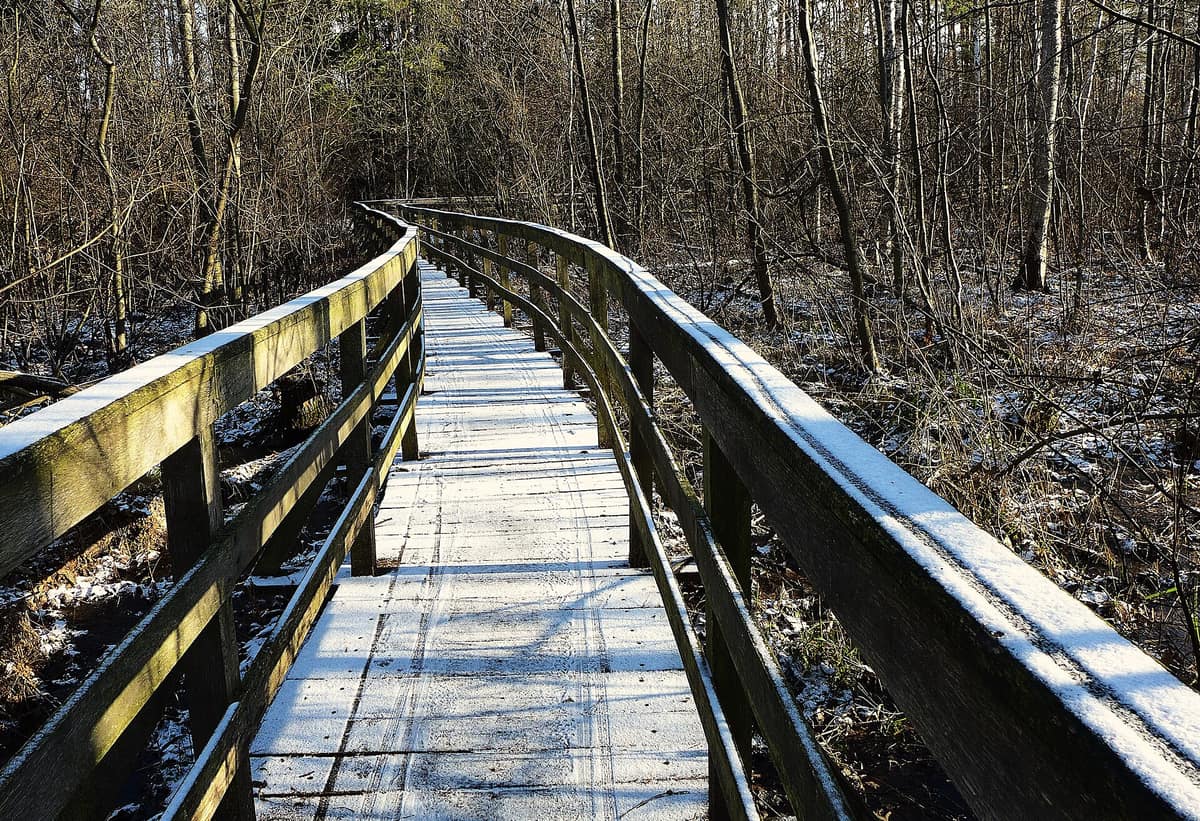
The Dąb Dominik trail departs from Kolonia Łomnica, offering a short loop of two and a half kilometres, with a longer variant of three and a half extending to Jamniki. It winds through contrasting forest stands and peat bogs encircling Lake Moszne, where carnivorous sundews, flowering wild orchids, and bog bilberries line the boardwalks.
For birdwatching, the Perehod trail runs for roughly five kilometres among the Pieszowola fishponds, equipped with two viewing towers and a sheltered observation hide, proving particularly rewarding during spring and autumn migrations. The observation tower on the Obóz Powstańczy trail provides a panoramic vantage point for scanning for waterbirds, elk, roe deer, and wild boar. Cyclists can follow the Mietiułka bike trail, covering twenty-one kilometres of woodland tracks, wet meadows, and the course of the Mietiułka River near the Durne Bagno peat bog reserve. Trails across the park feature educational panels, boardwalks, jetties, and viewing towers.
Two visitor centres welcome travellers. The centre in Stare Załucze features a museum exhibiting archaeological, ethnographic, and natural history artefacts, an open-air pavilion for historical farm gear, the educational Żółwik pond path, a wildlife rehabilitation centre with an aviary, and a covered picnic shelter with a fire pit. The administrative centre in Urszulin houses the Turtle Protection Centre (Ośrodek Ochrony Żółwia Błotnego), where juvenile European pond turtles can be observed from September to May, alongside an educational botanical garden.
Before you go
Check visitor centre opening hours on the official park website before travelling. The trails feature wooden boardwalks, viewing towers, and jetties; bring footwear suitable for wet ground.
Check access, rules and visiting conditions in the official information from the managing body before you set off.
Location
Where it is and how far it reaches
Boundary of Poleski Park Krajobrazowy · IUCN V · © EEA, CDDA (CC-BY) The coordinate is estimated; it isn't a verified access point.
Transparency
Sources
The research data with its sources, and the official links for this place, are in the Spanish version of this page. See the Spanish version
Around it
While no atlas sites lie in the immediate vicinity, Hortobágy National Park - The Puszta shares with Polesie the European pond turtle, common crane, and extensive wetlands; the Lower Prut Scientific Reserve shares pond turtles and floodplain lakes; and The Flow Country — Caithness and Sutherland Peatlands shares whooper swans and expansive blanket bogs.
If you like this place, elsewhere in Europe
Distant places with uncommon wildlife and habitats in common. The most widespread species don't count. Sharing species doesn't imply a corridor or guaranteed presence.
- Hortobágy National Park - The Hungarian Puszta
Hajdú-Bihar / Jász-Nagykun-Szolnok
In common: Emys orbicularis · Common crane — wetland
Central Europe's largest steppe grassland (80.000 ha) featuring traditional pastoralists and massive crane migrations.
JFMAMJJASONDApril – June · September – November · Crowding low
- The Flow Country — Caithness and Sutherland Peatlands
Scotland (Caithness and Sutherland — Forsinard)
In common: Whooper swan — wetland, lake
Europe's largest blanket bog expanse, World Heritage site since 2024: an intricate expanse of pool complexes and sphagnum moss locking up carbon since the last Ice Age.
JFMAMJJASONDMay – July · Crowding none
- Körös-Maros National Park
Southeastern Great Hungarian Plain (Békés / Csongrád-Csanád)
In common: Emys orbicularis · Common crane
Mosaic of saline puszta grasslands, loess steppes, and riparian gallery forests harbouring Central Europe's premier great bustard stronghold.
JFMAMJJASONDApril – June · Crowding very low
Entry #169 of the original atlas.