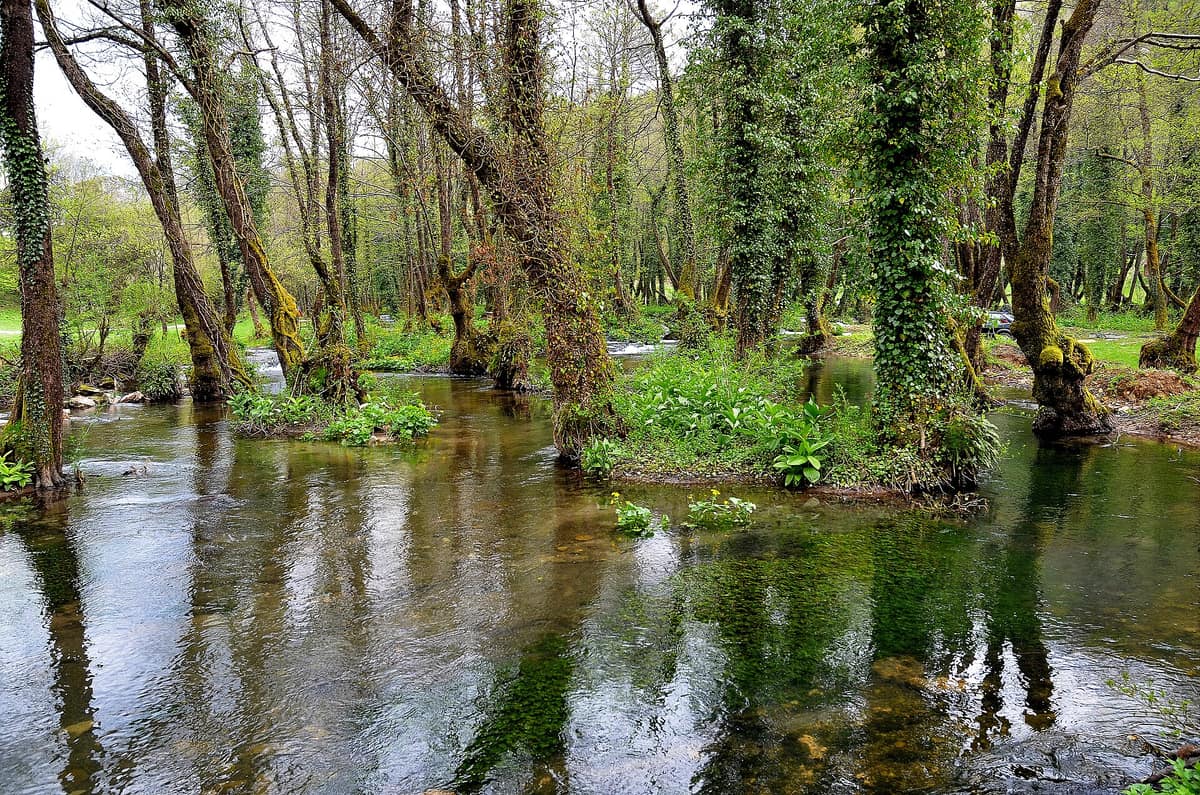
Janj Primeval Forest - Strict Nature Reserve
Prašuma Janj - Strogi rezervat prirode
Republika Srpska (Šipovo) · Bosnia and Herzegovina
Photo: Dusan2015 · CC BY-SA 4.0 · Wikimedia Commons
Strict karst reserve of fir, beech, and spruce inscribed as a UNESCO World Heritage site.
You do not simply stroll into Janj: you request prior permission, and you enter alongside a forest ranger tasked with safeguarding it. The reason is elementary. This strict nature reserve, classified under IUCN Category Ia, blankets the western slopes of Mount Stolovaš in the municipality of Šipovo, within Republika Srpska, and nearly the entire protected enclave consists of virgin old-growth forest. Between 1,180 and 1,510 metres above sea level, European beech, silver fir, and Norway spruce form a forest ecosystem looked after purely by being left alone. It stands as a vital component part of the serial UNESCO primeval beech forests property safeguarded across multiple regions of Europe.
What makes it unique
A primeval forest of beech, fir, and spruce on dolomite, under restricted access, in the Dinaric Alps.
The place
Nature
The landscape
Nearly 300 hectares constitute the core area, enveloped by a protective buffer zone of 380 hectares. The underlying bedrock consists of Triassic dolomite, which has weathered over millennia into rendzinas, brown forest soils, and thick lignohumus layers. The climate is montane, where moist maritime air masses collide directly with harsher continental weather fronts.
Upon this geological foundation flourish the Dinaric, Illyrian, and high-montane beech, fir, and spruce woods that dominate the landscape. It is a world of towering veteran trees and natural ecological transitions: a modest stand of Scots pine and spruce illustrates a distinctive successional phase, another chapter in the unwritten book through which the virgin forest constantly renews itself.
Beneath the sheltering boughs, official botanical inventories record the martagon lily (Lilium martagon), willow gentian (Gentiana asclepiadea), and common snowdrop (Galanthus nivalis), among diverse herbaceous plants.
Wildlife and seasons
Management records document the rich faunal communities of the forest. Resident mammals include the stoat, roe deer, red fox, European pine marten, red squirrel, edible dormouse, European hare, and wild boar; among apex predators, Eurasian lynx, grey wolf, and brown bear roam the massif.
Forest birds complete this intact wilderness community: western capercaillie, hazel grouse, northern goshawk, peregrine falcon, and common wood pigeon nest within the old timber.
None of these records come tied to fixed sightings or predictable calendars: they represent comprehensive inventories of what lives within this wild refuge. What is known with certainty is that visiting occurs solely alongside an official ranger, whose intimate knowledge guides every step through the woods.
Species
With a page in the atlas
Being mentioned in a source doesn't guarantee sightings: check with the people who manage the area.
Memory and protection
History and conservation
In 1910 foresters drew up the earliest formal land management plan encompassing this territory. In 1951 Janj was officially designated a primeval forest reserve, and in 1954 it was placed under statutory legal protection as an object of scientific research and a rare natural monument. The reserve is managed by ŠG Gorica, headquartered in Šipovo with local forest administration based in Novo Selo, and the state environmental assessment records an operative management plan spanning 2014–2029.
The principal ecological threat originates outside the boundary line: park authorities warn of intensive industrial logging taking place directly along the eastern perimeter, just across the inter-entity administrative boundary.
Before you set off
Visiting
How to visit
Visitors may move within the protected area only with advance written authorization from the managing authority and accompanied by an official guide—the designated ranger of Prašuma Janj. Organized group visits are restricted to a maximum of 20 participants, conducted under strict ranger supervision.
Educational activities, such as environmental field schools, nature study groups, seminars, and specialized field trips, require early notification and scheduling with the reserve management. The nearest rural settlements are Pribeljci, Podobzir, and Babići.
Before you go
Entering without prior written permission from the reserve authority or without an official ranger guide is strictly prohibited. Photography, video recording, and audio capturing within the reserve likewise require prior official authorization. There is no public visitor reception building on site: all formal arrangements must be coordinated in advance with the managing enterprise.
Check access, rules and visiting conditions in the official information from the managing body before you set off.
Location
Where it is and how far it reaches
Boundary of Prašuma Janj · IUCN Ia · © EEA, CDDA (CC-BY) The coordinate is estimated; it isn't a verified access point.
Transparency
Sources
The research data with its sources, and the official links for this place, are in the Spanish version of this page. See the Spanish version
Around it
Janj has no contiguous neighbours within the atlas, yet it shares strong ecological kinship with several wild massifs. Parcul Național Retezat shares the stoat, pine marten, and capercaillie. Parcul Național Defileul Jiului - Codrii seculari coincides in Galanthus nivalis, northern goshawk, and peregrine falcon within primeval woods. Národní přírodní rezervace Jizerskohorské bučiny adds the goshawk and pine marten in virgin beech habitats. And Totes Gebirge - Karst Desert shares the hazel grouse, capercaillie, and brown bear.
If you like this place, elsewhere in Europe
Distant places with uncommon wildlife and habitats in common. The most widespread species don't count. Sharing species doesn't imply a corridor or guaranteed presence.
- Retezat National Park
Hunedoara County (Hațeg)
In common: Mustela erminea · European pine marten · Western capercaillie
The realm of the granitic and glacial Retezat, with over 80 crystal tarns and the Gemenele scientific reserve.
JFMAMJJASONDJune – October · Crowding low
- Jizera Mountains Beechwoods
Liberec Region (Jizera Mountains)
In common: Accipiter gentilis · European pine marten — primary forest
Spectacular mountain slope clothed in ancient beechwoods with granite outcrops, inscribed by UNESCO.
JFMAMJJASONDMay – October · Crowding low
Entry #43 of the original atlas.