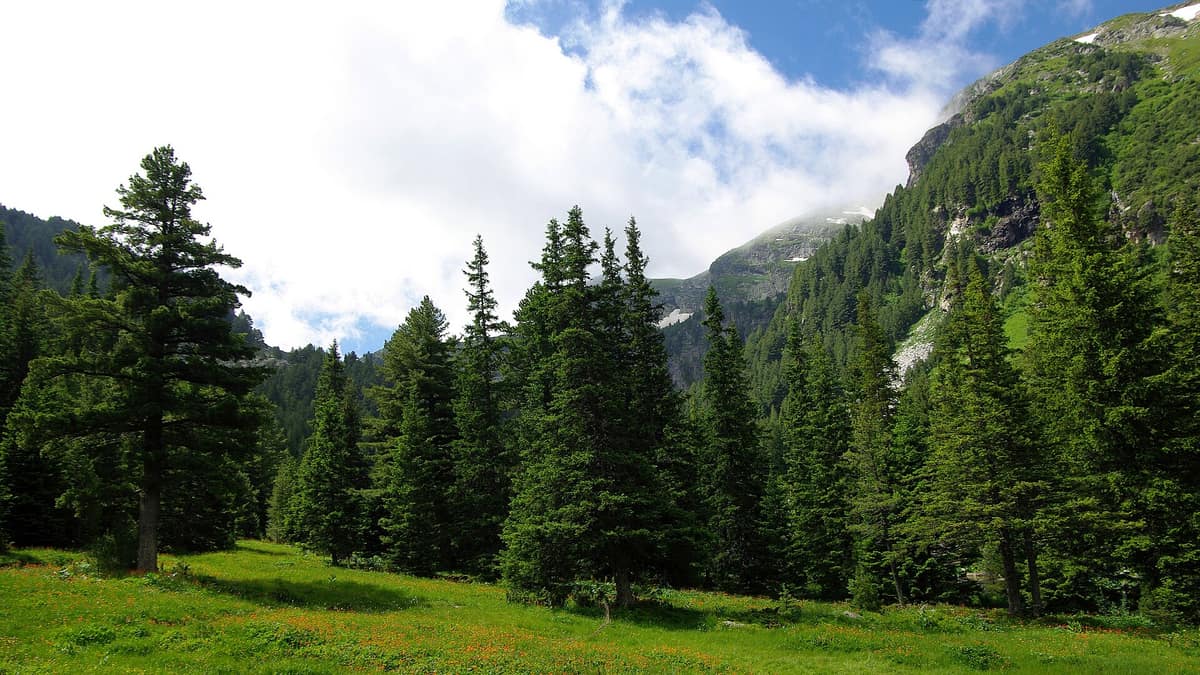
Rila National Park - Old Forests
Sofia, Blagoevgrad, Kyustendil and Smolyan Provinces · Bulgaria
Photo: Martin Danovski · CC0 · Wikimedia Commons
The highest massif in the Balkans (Musala 2.925 m) with relict Macedonian pine forests and glacial lakes.
On the summit of Musala, at 2 925 m, the highest temperature ever recorded is 18,7 °C. It is the highest mountain in the Balkans, and Rila encircles it with an 810,46 km² national park, the largest in Bulgaria, situated in the southwest of the country. From 800 m near Blagoevgrad up to that summit, the park rises through centuries-old coniferous forests, 120 natural lakes—most of them glacial—and the headwaters of major rivers like the Maritsa and the Iskar.
What makes it unique
It is the roof of the Balkan Peninsula and the birthplace of the Maritsa, the most voluminous river flowing entirely within the Balkans.
The place
Nature
The landscape
Rila is a water-giving mountain. Nearly 4 % of all Bulgarian rivers originate within the park, including the Maritsa, the most voluminous river running entirely within the Balkans, and the Iskar, the longest flowing entirely within Bulgaria. The driving force is snow: stable snow cover lasts more than 200 days a year, exceeding 2 m in depth above 2 000 m during late winter. When it melts from April onward, river flows swell dramatically, providing most of the drinking water for surrounding settlements.
Up high, the climate is harsh. Temperatures remain below freezing for nine months of the year and rarely exceed 15 °C in summer; the record minimum is -31,2 °C. Fierce winds are a trademark of the park, with speeds surpassing 30 m/s.
The lakes have distinct identities. Among the 120, the Seven Rila Lakes stand out; lakes Babreka, Salzata, and Okoto harbor the greatest richness and diversity of freshwater algae.
The forest thrives at high altitudes. It covers 534,81 km², or 66 % of the park, dominated by ancient stands of Norway spruce, Macedonian pine, and Scots pine. The average forest elevation is 1 800 m, with over three-quarters lying between 1 500 and 2 300 m, conditions exceptionally favorable to conifers.
The flora includes roughly 1 400 vascular plant species, 282 mosses, and 130 freshwater algae. There are 57 endemic species, three of them local: Rila primrose, Rila rhubarb, and a lady's mantle (pavlovsko shapiche). Moreover, 105 are relicts: 74 from the ice age and 31 from the Tertiary. Additionally, 233 fungal species are known, representing more than 11 % of Bulgaria's mycota.
Wildlife and seasons
The fauna comprises 48 mammal species, 99 birds, 20 reptiles and amphibians, and 5 fish, as well as 2 934 invertebrate species, 282 of which are endemic. The brown bear, the chamois, and the grey wolf, whose Bulgarian range is strictly limited, are species of outstanding conservation value.
Among birds, the park holds core populations of western capercaillie, hazel grouse, rock partridge, yellow-billed chough, and wallcreeper. Rare or threatened raptors include the golden eagle, short-toed snake eagle, peregrine falcon, three-toed woodpecker, and white-backed woodpecker.
Three reptiles and amphibians are glacial relicts: the alpine newt, a mountain frog, and the viviparous lizard. The alpine newt is globally threatened.
Species
With a page in the atlas
Being mentioned in a source doesn't guarantee sightings: check with the people who manage the area.
Memory and protection
History and conservation
The national park was designated on 24 February 1992 to protect ecosystems of national significance. It contains four strict nature reserves: Parangalitsa, Central Rila, Ibar, and Skakavitsa. The four reserves together cover 16 232,5 hectares, roughly one-fifth of the park.
Before you set off
Visiting
How to visit
The visitor and tourist information center is located in Panichishte, in Sapareva Banya municipality. It provides details on biodiversity, park rules, self-guided trails, educational programs, and audiovisual presentations.
Two European long-distance paths cross the park: E4 and E8. For an introductory trek, the Ibar route starts from the spa town of Kostenets and follows the Chavcha and Ravnivrashka rivers up to the Belmeken hut. In the Skakavitsa reserve there is a marked trail between Panichishte and the Skakavitsa hut, and a transit route traverses the Central Rila reserve through the Tiha Maritsa valley toward Musala peak.
Near the park boundary stands the Rila Monastery, a renowned cultural monument and a top destination in the region.
Before you go
In Rila, hiking is permitted only along marked tourist trails. Campfires and camping are allowed exclusively in designated areas established to prevent forest fires.
Check access, rules and visiting conditions in the official information from the managing body before you set off.
Location
Where it is and how far it reaches
Boundary of Rila · IUCN II · © EEA, CDDA (CC-BY) The coordinate is estimated; it isn't a verified access point.
Transparency
Sources
The research data with its sources, and the official links for this place, are in the Spanish version of this page. See the Spanish version
Around it
Pirin National Park - Forest Wilderness lies about eleven kilometers away, and the Kresna Gorge - Struma River Wildlife Corridor is roughly twenty-six kilometers away.
What else to explore nearby
Approximate straight-line distance between the edges of each area. It doesn't indicate access, routes or driving times.
- Pirin National Park - Forest Wilderness
Blagoevgrad Province (Bansko / Sandanski)
About 11 km away
Dramatic granite and karst peaks sheltering the ancient Baykushev pine (over 1,300 years old).
JFMAMJJASONDJune – October · Crowding low
- Kresna Gorge - Struma River Wildlife Corridor
Blagoevgrad Province (Kresna / Simitli)
About 26 km away
Sub-Mediterranean granite gorge stretching 18 km that represents Bulgaria's foremost hotspot for reptile and amphibian diversity.
JFMAMJJASONDApril – June · September – October · Crowding low
Entry #87 of the original atlas.