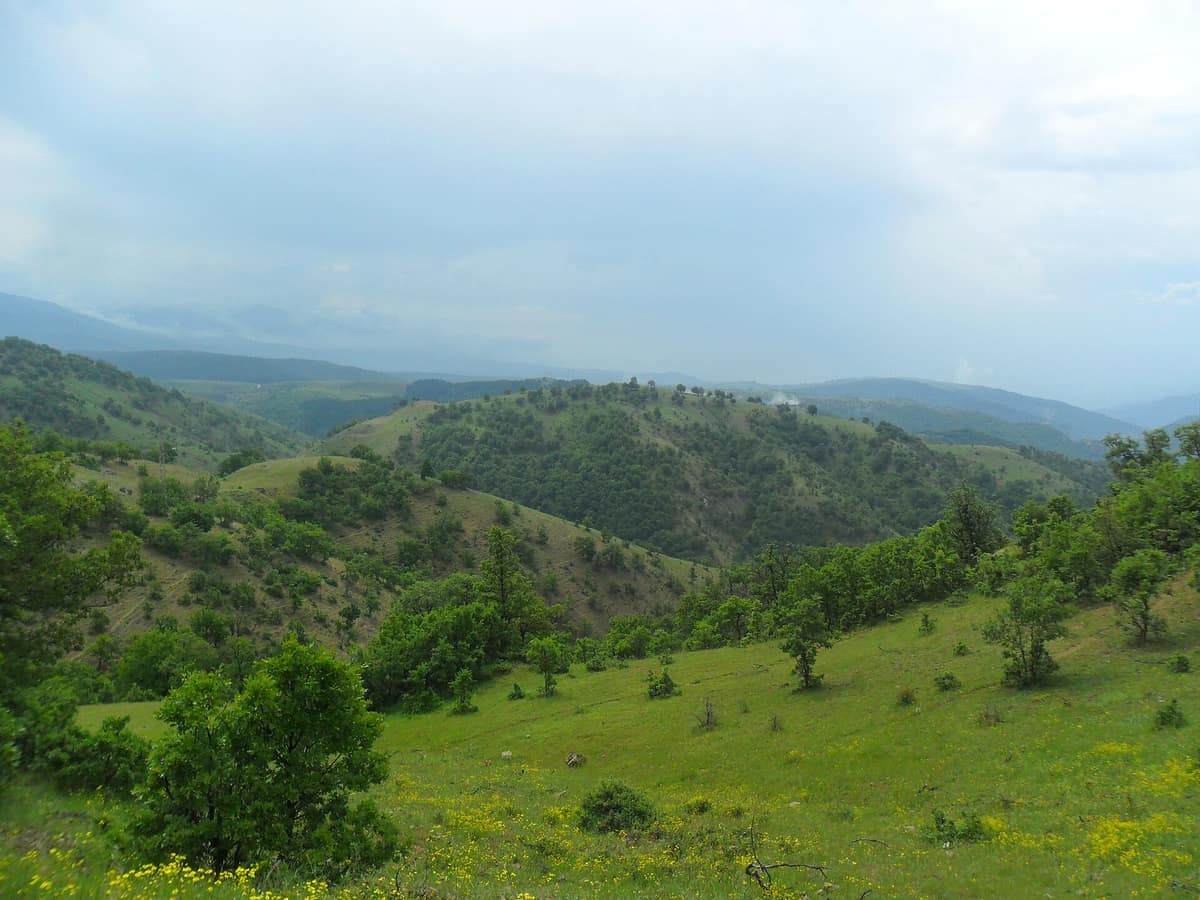
Kresna Gorge - Struma River Wildlife Corridor
Kresnensko Defile
Blagoevgrad Province (Kresna / Simitli) · Bulgaria
Photo: DLBankov · CC BY-SA 4.0 · Wikimedia Commons
Sub-Mediterranean granite gorge stretching 18 km that represents Bulgaria's foremost hotspot for reptile and amphibian diversity.
A highway, a railway line, and a rushing river wedged tightly inside the same rocky defile. Kresna Gorge in southwestern Bulgaria forms an 18 km rugged ravine carved by the Struma River between the Maleshevska Mountains and the towering Pirin massif. Brown bears, wolves, and migrating flyways channel through this rocky narrows, acting simultaneously as a crucial international transport artery and an irreplaceable ecological lifeline.
What makes it unique
A bottleneck canyon where two climatic realms intersect and major mammal corridors converge, under severe ecological pressure from heavy highway traffic.
The place
Nature
The landscape
The Struma carves through a narrow, steeply terraced valley incised into ancient crystalline granites and metamorphic bedrocks. The topography changes sharply from one reach to another: unstable scree slopes, vertical granite cliffs, and boulder-choked riverbeds. The river retains semi-natural braided gravel bars fringed by riparian gallery woodlands of grey alder, white willow, and oriental plane.
Here lies the transition between Mediterranean and Central European climatic zones, fostering extraordinary biological richness: dense concentrations of endemic, thermophilous, and relict species. Surrounding hillsides support sub-Mediterranean oak woodlands with downy oak (Quercus pubescens), oriental hornbeam (Carpinus orientalis), and flowering ash (Fraxinus ornus), alongside evergreen maquis species like kermes oak (Quercus coccifera) and mock privet (Phillyrea latifolia).
To the south, the gorge cleaves the Tisata Nature Reserve into two sectors, established to protect unique evergreen Mediterranean flora: Bulgaria's largest populations of Grecian juniper (Juniperus excelsa) and wild olive, alongside the nation's solitary dense stand of tree heath (Erica arborea).
Wildlife and seasons
For such a compact defile, its biodiversity tally is astonishing: roughly 31 reptile species, 75 mammal species, and 232 recorded bird species. Mammal records encompass the Eurasian otter, the grey wolf, and roaming brown bears; reptiles feature Hermann's tortoise and the leopard snake; while native ichthyofauna includes the Struma spined loach and asp, alongside the Balkan crested newt.
For migratory birds, the gorge forms a key bottleneck along the Via Aristotelis flyway, one of Europe's primary migration routes funneling southbound migrants to Africa. The globally endangered Egyptian vulture and rare raptors utilize the thermal updrafts and rocky crags for roosting. For large terrestrial carnivores, it serves as an indispensable genetic bridge uniting mountain ranges of the southern Balkan Peninsula.
Species
With a page in the atlas
Being mentioned in a source doesn't guarantee sightings: check with the people who manage the area.
Memory and protection
History and conservation
In 1913, during the Second Balkan War, the decisive Battle of Kresna Gorge was fought across these rocky narrows between the armies of Bulgaria and Greece.
Modern environmental efforts revolve directly around the transport corridor. Proposed as a Site of Community Importance in 2007, it gained Special Area of Conservation designation in 2021. The unmitigated two-lane road causes devastating wildlife roadkill. The Bulgarian Ministry acknowledges the gorge's exceptional biodiversity value, and official agreements endorse routing the future Struma Motorway entirely outside the canyon. The Bern Convention has repeatedly urged Bulgarian authorities to honor this pledge, redirecting through-traffic and retaining the existing I-1 (E79) solely for local access.
Before you set off
Visiting
How to visit
Travellers primarily experience the canyon via the main national road I-1, which threads the defile from north to south over roughly 23,1 km, or from the Sofia–Blagoevgrad–Kulata railway line running parallel for some 20 km along the valley's left bank. Experiencing the gorge is, above all, a slow drive or train journey undertaken with attentive eyes.
Before you go
If you drive through the gorge by car, exercise extreme vigilance: wildlife frequently crosses the roadway day and night.
Check access, rules and visiting conditions in the official information from the managing body before you set off.
Location
Where it is and how far it reaches
Boundary of Kresnensko defile · IUCN VI · © EEA, CDDA (CC-BY) The coordinate is estimated; it isn't a verified access point.
Transparency
Sources
The research data with its sources, and the official links for this place, are in the Spanish version of this page. See the Spanish version
Around it
Pirin National Park - Forest Wilderness lies roughly 9 km to the east and Rila National Park - Old Forests twenty-six kilometres to the north. Further east, Strandzha Nature Park shares with Kresna Hermann's tortoises and otters.
What else to explore nearby
Approximate straight-line distance between the edges of each area. It doesn't indicate access, routes or driving times.
- Pirin National Park - Forest Wilderness
Blagoevgrad Province (Bansko / Sandanski)
About 9 km away
Dramatic granite and karst peaks sheltering the ancient Baykushev pine (over 1,300 years old).
JFMAMJJASONDJune – October · Crowding low
- Rila National Park - Old Forests
Sofia, Blagoevgrad, Kyustendil and Smolyan Provinces
About 26 km away
The highest massif in the Balkans (Musala 2.925 m) with relict Macedonian pine forests and glacial lakes.
JFMAMJJASONDJune – October · Crowding moderate
If you like this place, elsewhere in Europe
Distant places with uncommon wildlife and habitats in common. The most widespread species don't count. Sharing species doesn't imply a corridor or guaranteed presence.
- Sagittario Gorge Nature Reserve
Abruzzo (Anversa degli Abruzzi / Scanno)
In common: Four-lined snake · Grey wolf — gorge and canyon, river corridor
An awe-inspiring karst canyon carved by the Sagittario River between vertical limestone cliffs hundreds of metres high.
JFMAMJJASONDMay – October · Crowding very low
- Domogled - Cerna Valley National Park
Caraș-Severin, Mehedinți, and Gorj Counties
In common: Hermann's tortoise · Eurasian otter · Grey wolf — gorge and canyon
Deep tectonic canyon flanked by Banat black pine and catchments with virgin montane beech woods.
JFMAMJJASONDMay – October · Crowding very low
- Strandzha Nature Park
Burgas (Malko Tarnovo / Sinemorets / Tsarevo)
In common: Hermann's tortoise · Eurasian otter — river corridor, old-growth forest
The largest protected area in Bulgaria: Pontic-type deciduous forests with an understorey of rhododendron and laurel, unique within the EU.
JFMAMJJASONDApril – June · September – October · Crowding very low
- Vjosa Wild River National Park
Southern Albania (Përmet / Tepelenë / Memaliaj)
In common: Hermann's tortoise · Eurasian otter — gorge and canyon, river corridor
Europe's first wild river national park: the Vjosa flows entirely undammed from Greece to the Adriatic Sea.
JFMAMJJASONDApril – June · September – October · Crowding very low
Entry #401 of the original atlas.