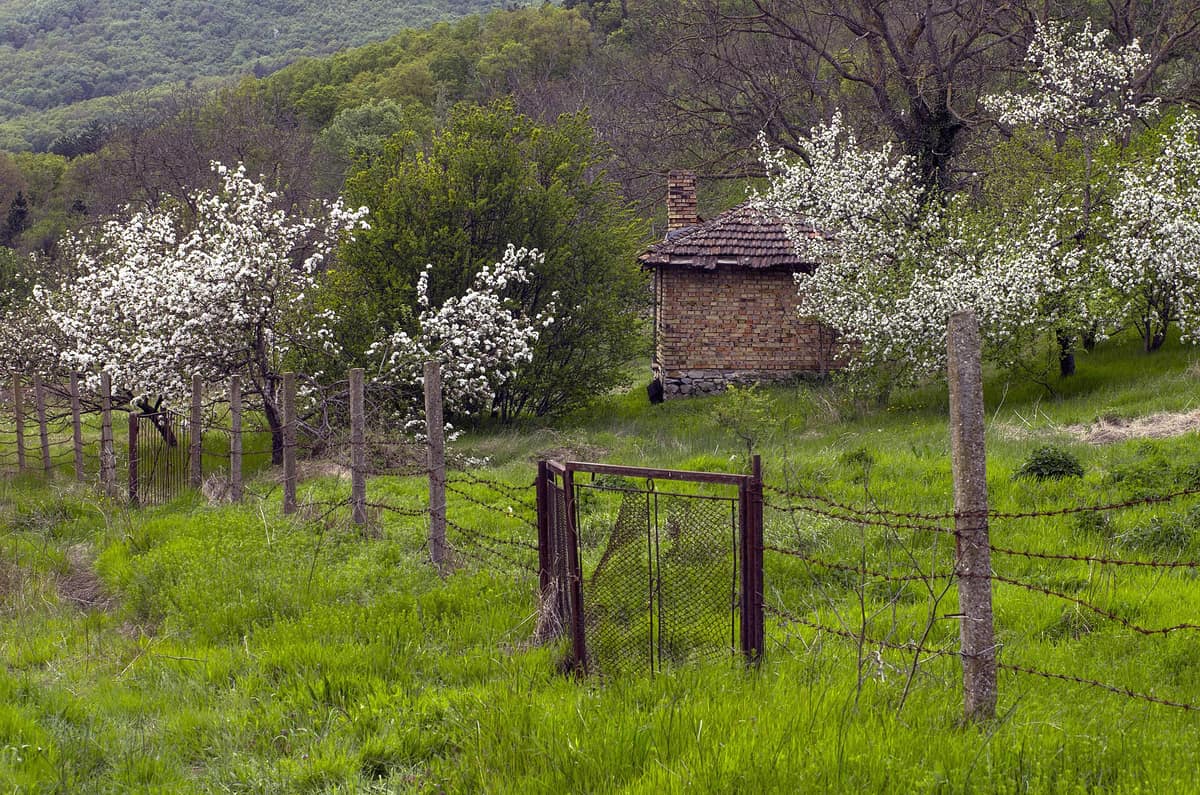
Strandzha Nature Park
Природен парк Странджа
Burgas (Malko Tarnovo / Sinemorets / Tsarevo) · Bulgaria
Photo: Denka marinova · CC BY-SA 4.0 · Wikimedia Commons
The largest protected area in Bulgaria: Pontic-type deciduous forests with an understorey of rhododendron and laurel, unique within the EU.
A forest where winter temperatures rarely drop below 0 °C and the understorey never sheds its leaves. Strandzha occupies the southeasternmost corner of Bulgaria, bordering Turkey and the Black Sea, and at 1,161 km² stands as the country's largest protected area. Forests mantle 80% of the park, with 30% consisting of old-growth stands. They are, moreover, Europe's last temperate forests harboring an evergreen laurel understorey, a biogeographical rarity shaped by its climate.
What makes it unique
Here blooms a rhododendron that across all of Europe grows only in Strandzha and in the northwest of the Iberian Peninsula.
The place
Nature
The landscape
Strandzha is a mountain of gentle rolling hills rather than jagged peaks: the highest point, Mount Gradishte, barely reaches 710 m, and the park descends all the way to the Black Sea coast. Its secret lies in the climate. The proximity of three seas—the Black, Marmara, and Aegean—spared it from Quaternary glaciation and fostered a mild, relatively humid climate under which the woodland preserved Neogene relicts. It is among the warmest areas in Bulgaria: the Black Sea buffers temperatures, which rarely drop below 0 °C in winter or exceed 24 °C in summer.
The outcome is a mosaic: 130 distinct habitats, leading all protected areas in Europe. Warm oak woodlands flourish with an evergreen shrub understorey of tree heath and butcher's-broom, alongside oriental beech woods intermixed with sessile oak, Strandzha oak, Hungarian oak, and hornbeam. Beneath them grow Pontic rhododendron, Caucasian whortleberry, cherry laurel, and Black Sea holly. Along the coast, Silistar boasts the highest plant density per square kilometre in Bulgaria.
Water carves the remaining relief. The Veleka, extending 147 km, is the longest and mightiest river of Strandzha; the Rezovo is swifter and colder, supporting richer trout populations. To the west, a karst terrain of ponors, caverns, and caves stretches between Varovnik and Malko Tarnovo. And the coastline preserves its own ancient history: some 80 million years ago, in the Late Cretaceous, volcanic activity shook this land, and Golyamata Papiya peak stood as an active volcano.
Wildlife and seasons
The park harbors the highest vertebrate tally among Bulgaria's protected areas: 66 mammals, 269 birds, and 24 reptiles. The most common mammals are the roe deer, the red deer, the wild boar, the grey wolf, the golden jackal, fox, badger, and pine marten. The park protects critical populations of the Eurasian otter and the European wildcat, and the otter population along the Veleka River is considered the best preserved in Europe. Among bats, 25 species occur, including Bechstein's bat.
Strandzha lies on the Via Pontica, Europe's second-largest bird migration highway, and coastal bays offer vital overwintering havens. It supports globally significant populations of the white-backed woodpecker, semi-collared flycatcher, olive-tree warbler, and sombre tit, alongside European-significant populations of the Egyptian vulture, white stork, black stork, and Eurasian eagle-owl.
Reptiles include Aesculapian snake, slow worm, sheltopusik (Europe's largest legless lizard), Kotschy's gecko, European pond turtle, the Moorish tortoise, and Hermann's tortoise. The Black Sea bleak and Bulgarian minnow are strict endemics restricted to the Veleka and Rezovska basins.
In May, cast your eyes to the undergrowth: this is when the zelenika, the Pontic rhododendron, bursts into bloom, transforming the forest into a living reflection of ancient Colchis.
Species
With a page in the atlas
Being mentioned in a source doesn't guarantee sightings: check with the people who manage the area.
Memory and protection
History and conservation
The park was established on 25 January 1995 to protect the ecosystems alongside the region's rich cultural and folklore heritage. Its Silkosiya reserve, founded in 1933, is the oldest nature reserve in Bulgaria, and Uzunbodzhak holds biosphere reserve status. There are five nature reserves, with entry restricted to scientific teams alongside a few strictly delineated interpretive trails.
History here is written by changing frontiers. After 1878 the region remained under Ottoman rule, sparking the Ilinden-Preobrazhenie Uprising of 1903. Relics of that era survive in the timber architecture of Brashlyan, Kosti, and Malko Tarnovo, and in a ritual preserved in the village of Balgari: nestinarstvo, fire-walking on glowing embers, held on 3 and 4 June.
The foremost contemporary threat stems from unchecked coastal mass tourism. In June 2007 a court revoked the park's protected status; following widespread public protests, Parliament enacted legislation prohibiting judicial appeals against protected area boundaries established by the Council of Ministers. The park's coastal strip has consequently remained largely pristine.
Before you set off
Visiting
How to visit
There are two visitor centres, in Malko Tarnovo and Gramatikovo. In Malko Tarnovo, the natural history museum uses photography and interactive exhibits to present Strandzha's biodiversity; Brashlyan features an ethnographic collection and an information post of the park directorate.
The Zvezdets–Brashlyan route is a hike of about five hours along forest tracks and footpaths, wading across the Katun and Veleka rivers. Averaging 250 m altitude, it is relatively easy and equipped with viewpoints, benches, resting spots, and interpretive boards. Another 'green corridor' accommodates cyclists, equestrians, and visitors with reduced mobility. If you prefer a shorter walk, a loop of about two hours departs from north of Kondolovo.
Along the coast between south of Ahtopol and the mouth of the Veleka stand 15 panels interpreting geological features, and the Butamyata–Silistar geological trail takes about two hours.
Before you go
On the Zvezdets–Brashlyan itinerary you must wade across two rivers. Access to strict nature reserves is restricted to scientific teams and a few designated tracks. The park directorate, based in Malko Tarnovo, oversees visits.
Check access, rules and visiting conditions in the official information from the managing body before you set off.
Location
Where it is and how far it reaches
Boundary of Strandzha · © EEA, CDDA (CC-BY) The coordinate is estimated; it isn't a verified access point.
Transparency
Sources
The research data with its sources, and the official links for this place, are in the Spanish version of this page. See the Spanish version
Around it
There are no other atlas sites nearby. At a considerable distance, sharing habitats and species with Strandzha, are Vjosa Wild River National Park (Hermann's tortoise, black stork, and otter), Babadag Plateau - Steppe Reserve (Moorish tortoise and black stork), and Kresna Gorge - Struma River Biological Corridor (Hermann's tortoise, otter, and old-growth forest).
If you like this place, elsewhere in Europe
Distant places with uncommon wildlife and habitats in common. The most widespread species don't count. Sharing species doesn't imply a corridor or guaranteed presence.
- Măcin Mountains National Park
Tulcea County (Greci / Măcin)
In common: Moorish tortoise · Lesser spotted eagle · Black stork — old-growth forest
Europe's oldest mountains (over 300 million years old), with Pontic-Sarmatic steppe, sub-Mediterranean forests, and raptor migration flyways.
JFMAMJJASONDApril – June · September – October · Crowding very low
- Vjosa Wild River National Park
Southern Albania (Përmet / Tepelenë / Memaliaj)
In common: Hermann's tortoise · Black stork · Eurasian otter — river corridor
Europe's first wild river national park: the Vjosa flows entirely undammed from Greece to the Adriatic Sea.
JFMAMJJASONDApril – June · September – October · Crowding very low
- Kresna Gorge - Struma River Wildlife Corridor
Blagoevgrad Province (Kresna / Simitli)
In common: Hermann's tortoise · Eurasian otter — old-growth forest, river corridor
Sub-Mediterranean granite gorge stretching 18 km that represents Bulgaria's foremost hotspot for reptile and amphibian diversity.
JFMAMJJASONDApril – June · September – October · Crowding low
Entry #1036 of the original atlas.