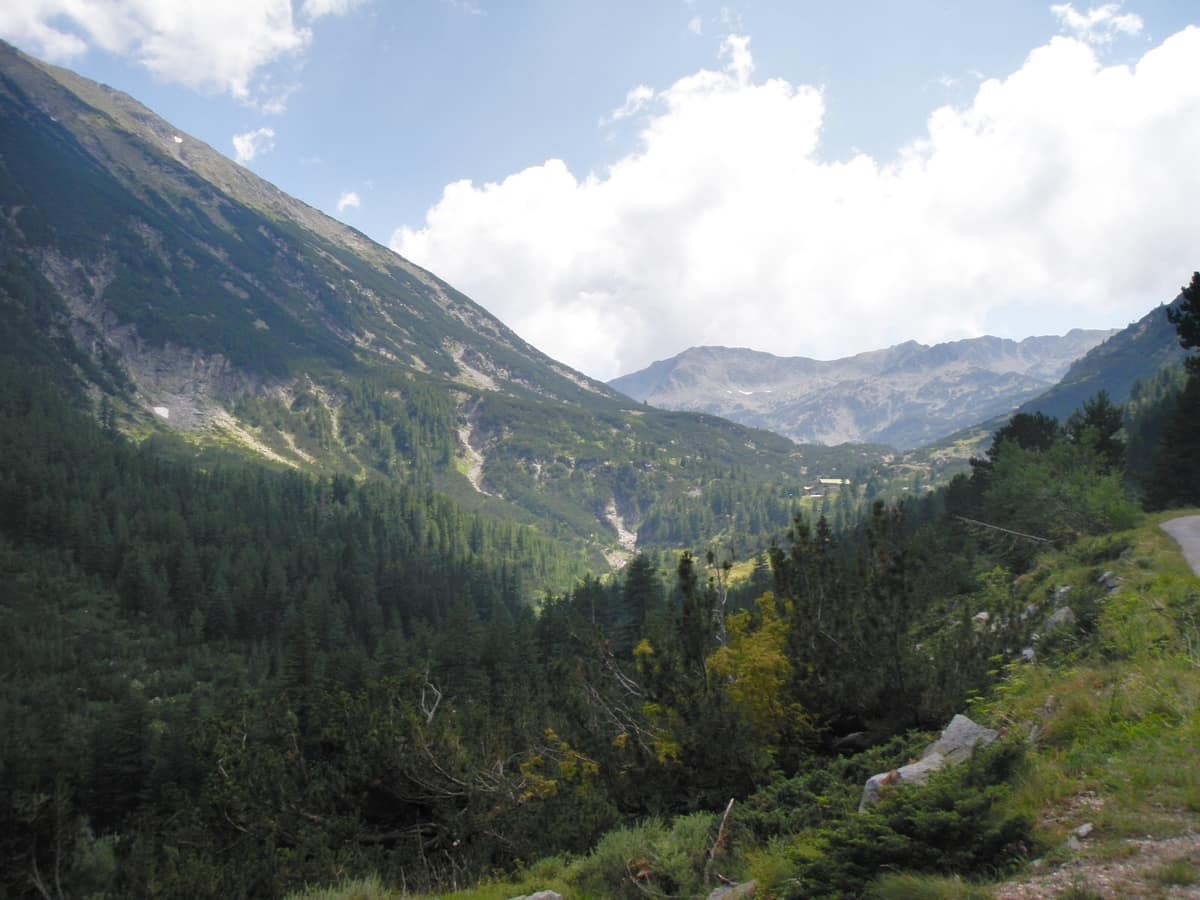
Pirin National Park - Forest Wilderness
Blagoevgrad Province (Bansko / Sandanski) · Bulgaria
Photo: Mianikolov · CC0 · Wikimedia Commons
Dramatic granite and karst peaks sheltering the ancient Baykushev pine (over 1,300 years old).
Beneath the massif's highest crest, nestled inside Golemiya Kazan cirque, lies a relict pocket of ice from the last glacial epoch: Snezhnika, Europe's southernmost glacier. That remarkable detail encapsulates Pirin. The national park protects the greater part of the Pirin Mountains in south-western Bulgaria, rising from 950 m up to the 2,914 m apex of Mount Vihren, entirely devoid of permanent human settlements. It is true alpine wilderness in the southern Balkans, characterized by glacial tarns, white marble walls and the nation's most ancient tree.
What makes it unique
Home to the Baykushev pine, roughly 1,300 years old, and the southernmost glacier in Europe.
The place
Nature
The landscape
Pirin's topography was carved by ice. During the Pleistocene epoch the range underwent extensive alpine glaciation, leaving 118 glacial tarns, many cupped in high cirques; Lake Popovo is both the largest and deepest. Two micro-glaciers persist: Snezhnika and Banski Suhodol.
The underlying geology transitions from north to south. The towering marble Vihren ridge gathers the massif's three loftiest summits: Vihren (2,914 m), Kutelo (2,908 m) and Banski Suhodol (2,884 m), linked by the knife-edge arête of Koncheto. Nearly 60% of the park lies above 2,000 m in elevation.
Winter brings immense snowfall. Above 1,800 m, snow accumulation reaches 160-180 cm by March, and avalanches are frequent.
Vegetation is strictly stratified across montane, subalpine and alpine zones. Forests cover 57.3% of the park, with 95% of woodland composed of conifers. Mountain pine covers the largest area, followed by Macedonian pine, Norway spruce, European beech and Bosnian pine. Pirin's Macedonian and Bosnian pine forests represent 42% and 52% of their total range in Bulgaria. The celebrated Baykushev pine is the oldest tree in the country: a Bosnian pine around 1,300 years old. In the subalpine belt, dwarf mountain pine and Siberian juniper predominate.
Pirin shelters 17 local endemics, 36 Bulgarian endemics and 110 Balkan endemics. Among local rarities is the Pirin poppy (Papaver degenii), with 165 plant species strictly protected by law.
Wildlife and seasons
Naturalists record 240 vertebrate species, including 166 birds and 50 mammals. Keystone species of high conservation priority include the brown bear, grey wolf, European wildcat, European pine marten, wild boar, red deer, roe deer and the chamois, a regional Balkan endemic. The European snow vole is a glacial relict.
Among birds, three species are post-glacial relicts: boreal owl, white-backed woodpecker and three-toed woodpecker. Notable raptors and woodland species include the golden eagle, short-toed snake eagle, saker falcon, peregrine falcon, western capercaillie, hazel grouse and rock partridge.
Mountain streams and cold tarns support a limited fish fauna including sea trout, while the European eel is now considered extirpated. Amphibians and reptiles include the fire salamander, yellow-bellied toad, common adder and viviparous lizard. The Apollo butterfly (Parnassius apollo) is a standout high-mountain insect.
Species
With a page in the atlas
Being mentioned in a source doesn't guarantee sightings: check with the people who manage the area.
Memory and protection
History and conservation
The park was founded in 1962 to safeguard virgin mountain ecosystems, dramatic landscapes and endemic wildlife communities, and was inscribed as a UNESCO World Heritage site in 1983. Its entire area belongs to the European Natura network. Two strict nature reserves lie within its boundaries: Bayuvi Dupki–Dzhindzhiritsa and Yulen. Administration is overseen by a dedicated park directorate based in Bansko under the Ministry of Environment and Water.
Pressures are considerable. Environmental threats include commercial stone quarrying, arson, illegal logging, poaching, trail erosion and above all ski development. The Bansko ski resort was expanded despite park regulations prohibiting such infrastructure within core boundaries.
Before you set off
Visiting
How to visit
Most journeys begin in Bansko, site of the main park information centre featuring interactive exhibits on local forests, flora and fauna. A second visitor centre is situated in Sandanski. From Bansko, trail III connects the town with Banderitsa hut and Vihren hut; Banderitsa was constructed in 1915 on the orders of Tsar Ferdinand I of Bulgaria.
The park maintains 20 marked hiking trails threading through cirques, tarns, ridges and crags. Trail 1, part of the European long-distance path E4, traverses the massif from Predel hut through Yavorov hut, Vihren, Lake Tevno, Pirin hut and Popovi Livadi. Route V links Dobrinishte, Gotse Delchev and Bezbog before continuing towards Melnik.
The most demanding traverse is the Koncheto ridge arête, at roughly 2,810 m between Banski Suhodol and Kutelo.
Before you go
The park directorate strongly advises sturdy mountain boots, waterproofs and checking mountain forecasts before setting out. Winter brings heavy snowfall, and avalanches are frequent.
Check access, rules and visiting conditions in the official information from the managing body before you set off.
Location
Where it is and how far it reaches
Boundary of Pirin · IUCN II · © EEA, CDDA (CC-BY) The coordinate is estimated; it isn't a verified access point.
Transparency
Sources
The research data with its sources, and the official links for this place, are in the Spanish version of this page. See the Spanish version
Around it
Rila National Park Old Forests lies roughly 11 km away, and Kresna Gorge - Struma River Biocorridor about 9 km.
What else to explore nearby
Approximate straight-line distance between the edges of each area. It doesn't indicate access, routes or driving times.
- Kresna Gorge - Struma River Wildlife Corridor
Blagoevgrad Province (Kresna / Simitli)
About 9 km away
Sub-Mediterranean granite gorge stretching 18 km that represents Bulgaria's foremost hotspot for reptile and amphibian diversity.
JFMAMJJASONDApril – June · September – October · Crowding low
- Rila National Park - Old Forests
Sofia, Blagoevgrad, Kyustendil and Smolyan Provinces
About 11 km away
The highest massif in the Balkans (Musala 2.925 m) with relict Macedonian pine forests and glacial lakes.
JFMAMJJASONDJune – October · Crowding moderate
If you like this place, elsewhere in Europe
Distant places with uncommon wildlife and habitats in common. The most widespread species don't count. Sharing species doesn't imply a corridor or guaranteed presence.
- Northern Velebit National Park
Lika-Senj (Croatia)
In common: Parnassius apollo · Chamois · Brown bear — old-growth forest, high mountain, karst and caves
Karst relief, ancient beech forests and mountain pastures in Northern Velebit.
JFMAMJJASONDMay – November · Crowding low
Entry #88 of the original atlas.