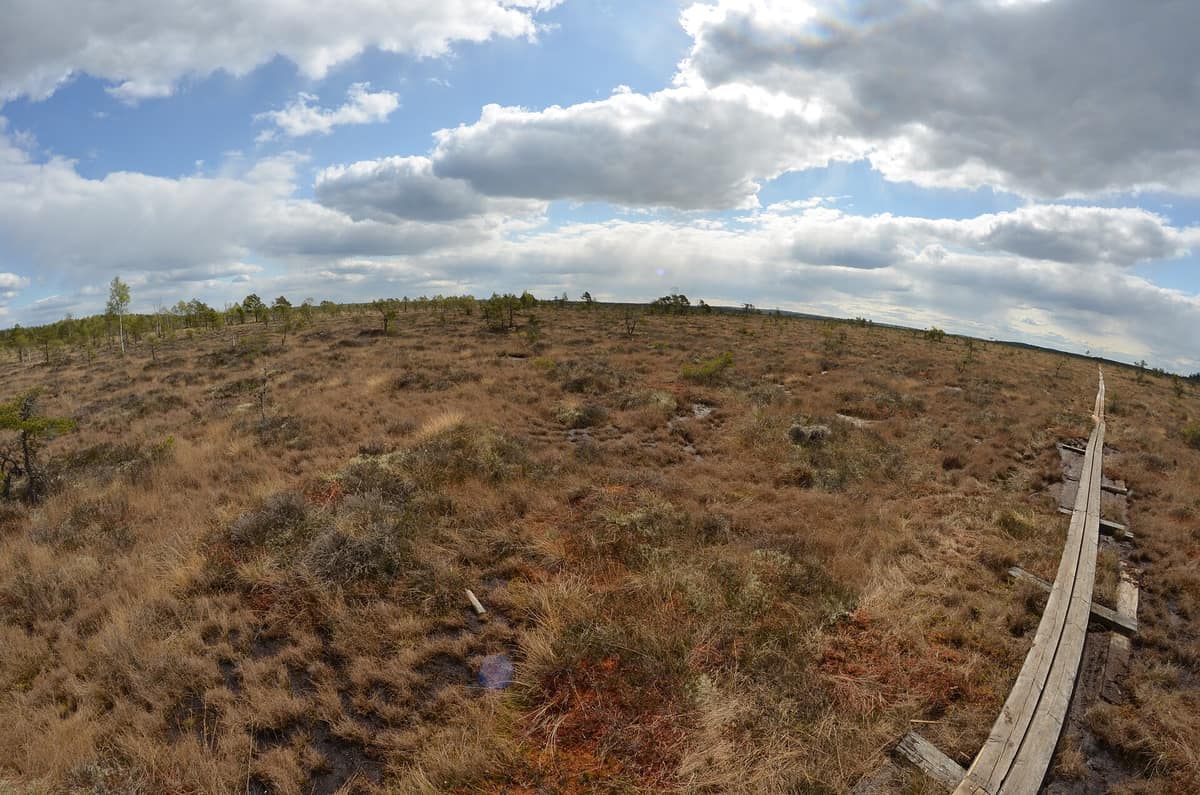
Store Mosse National Park
Jönköping (Värnamo / Gnosjö / Hillerstorp) · Sweden
Photo: Wikimalte · CC BY-SA 3.0 · Wikimedia Commons
The largest ombrotrophic bog complex south of Lapland (100 km² of mires and tarns traversed by wooden boardwalks).
At Store Mosse the ground is a moss sponge, where life fills every crevice. Covering 78.5 square kilometres, it is the largest bog complex in southern Sweden, and far from monotonous: the expansive mire adjoins Lake Kävsjön, renowned for its birdlife, a pastoral cultural landscape, and a mosaic of pine woodlands. It was designated a national park in 1983.
Wooden boardwalks make exploring much easier than it appears, complemented by a twelve-metre bird observation tower, accessible paths, and a Naturum visitor centre to plan your visit.
What makes it unique
Nearly half of Sweden's roughly sixty dragonfly species thrive across this vast mire system.
The place
Nature
The landscape
Store Mosse lies at some 165–180 metres above sea level, nestled between the river valleys of the Lagan and the Nissan. The landscape was carved by the last glaciation, but also shaped by human hands through commercial peat cutting and the lowering of lake water levels; walking the paths, you will occasionally come across traces of the bygone peat-extraction industry.
More than 20 species of sphagnum moss and three of sundew (sileshår) grow across the raised bog plateau. In spring, bog rosemary blossoms with pink bell-shaped flowers while cottongrass illuminates the waterlogged bog woodlands. In the south, Björnekullakärret forms a striking anomaly: a small calcareous fen of roughly five hectares, one of the few in the Småland uplands, harboring rare orchids, specialized mosses, and a minute snail species. A calcareous fen is nutrient-poor yet mineral-rich in lime; these austere conditions restrict the plants that can survive, making it an endangered habitat reliant on traditional haymaking or light grazing, often lost elsewhere to drainage. A wooden boardwalk crosses the fen, allowing you to explore without rubber boots.
Wildlife and seasons
Here the sky takes center stage. In early spring, black grouse display at several lekking sites across the park, with a public observation hide located west of Lilla Lövö for watching courtship. In May, the hollow drumming call of the jack snipe echoes from the Hagudden tower; wetland birds also include Eurasian curlew and whimbrel. In springtime, Lake Kävsjön offers views of common crane, whooper swan, mallard, and marsh harriers.
Winter brings the eagles. Each winter from November to March, white-tailed eagles and golden eagle are provided supplementary winter food in the park, and golden eagles also nest locally. Feeding with roadkill carrion can be watched from a public hide 400 metres away along a gravel track, or followed via a live webcam.
Among mammals, moose can be encountered throughout the year, alongside roe deer, red fox, badger, lynx, and Eurasian otter. On summer evenings, Södra Svänö is the finest spot for watching foraging bats, with six species documented across the national park.
Species
With a page in the atlas
Being mentioned in a source doesn't guarantee sightings: check with the people who manage the area.
Memory and protection
History and conservation
The mire was exploited for peat cutting and lake water levels were lowered: part of today's terrain stems from that industrial past. Calcareous fens like Björnekullakärret remain fragile and threatened habitats.
Before you set off
Visiting
How to visit
The main entrance and the Naturum centre lie on road 151 between Värnamo and Gnosjö, 17 km from Värnamo. The park has several entry points and can be reached by car, train, bus, or bicycle; cycling is permitted on marked paths, though difficult in sections like the wooden boardwalks.
The Naturum by the main entrance interprets the bog's ecosystem and wildlife, provides hiking advice, and offers a quiet rest area. The large bird observation tower beside the main entrance overlooks Lake Kävsjön and the quaking mire, housing an interpretive display on the lake's fauna and management alongside an audio player featuring bird calls.
Marked trails total around 40 kilometres, with roughly 5.5 kilometres adapted for wheelchairs and strollers. The Wibecksleden measures 1.6 km round trip (about thirty minutes), winding through mixed forest and marshy birch woods to an observation platform overlooking the floating fen. The Svartgölsleden runs some 1.3 km each way and, like Wibecksleden, is fully adapted for wheelchairs, visually impaired visitors, and prams.
For a longer trek, the Kävsjön runt trail loops around the lake for 12 kilometres (three to four hours), accessible from four trailheads; it features detours to several bird towers along boardwalks and uneven, root-strewn forest tracks between open pine barrens and dense spruce stands. The loop around Lilla Lövö spans about 6 km and becomes quite waterlogged in rain, making waterproof boots advisable. For children, the Skogstrollens stig fairytale trail takes about 30 minutes, presented in Swedish, easy Swedish, English, and German.
Before you go
Entering the Kävsjön bird sanctuary is prohibited between 1 March and 15 August; the restricted boundary is marked with yellow signs. Picking plants, flowers, mosses, lichens, and wood-inhabiting bracket fungi is strictly forbidden, and camping is permitted only at designated shelters. Dogs must be kept on a leash at all times.
Check access, rules and visiting conditions in the official information from the managing body before you set off.
Location
Where it is and how far it reaches
Boundary of Store mosse nationalpark · IUCN II · © EEA, CDDA (CC-BY) The coordinate is estimated; it isn't a verified access point.
Transparency
Sources
The research data with its sources, and the official links for this place, are in the Spanish version of this page. See the Spanish version
Around it
Store Mosse shares moose, common crane, or white-tailed eagle with other distant wetlands: Ķemeri National Park and Forêt d'Orient host crane and eagle amidst wetlands and mature forest, Lille Vildmose Nature Reserve supports moose and eagle, and the Babadag Plateau also shelters white-tailed eagle.
If you like this place, elsewhere in Europe
Distant places with uncommon wildlife and habitats in common. The most widespread species don't count. Sharing species doesn't imply a corridor or guaranteed presence.
- Ķemeri National Park
Latvia (Jūrmala / Tukums)
In common: Common crane · Moose · White-tailed eagle — wetland, old-growth forest
Raised bogs, swamp forests and coastal lagoons half an hour from Riga, featuring the Great Ķemeri Bog boardwalk.
JFMAMJJASONDApril – June · September – October · Crowding low
- Skuleskogen National Park (High Coast of Sweden)
Västernorrland (Höga Kusten / Örnsköldsvik / Kramfors)
In common: Common crane · Moose · White-tailed eagle — old-growth forest
The heart of Sweden's High Coast (Höga Kusten), the site of the world's greatest post-glacial isostatic rebound (286 m of land uplift after the ice), featuring the Slåttdalssvackan canyon.
JFMAMJJASONDMay – October · Crowding low
Entry #592 of the original atlas.