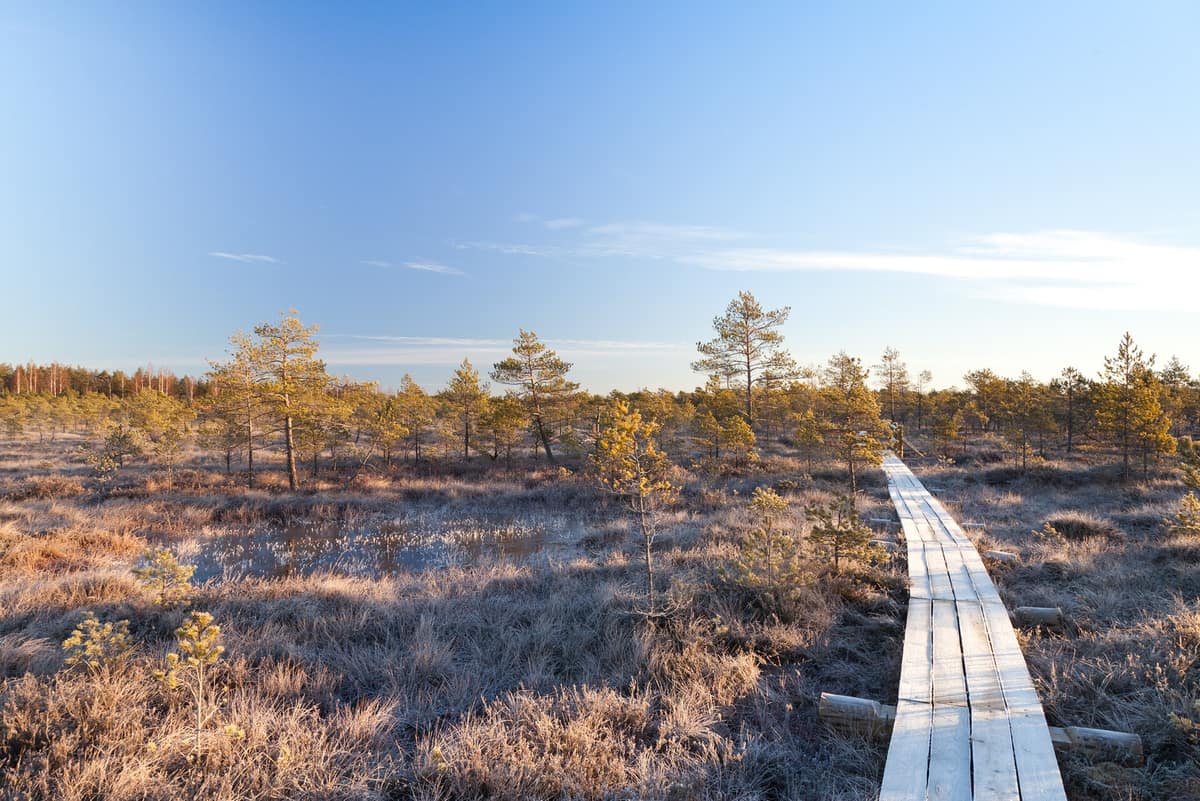
Teiči Strict Nature Reserve
Teiču dabas rezervāts
Latvia (Madona / Krustpils) · Latvia
Photo: Jevgenijs Nikitins · CC BY-SA 3.0 · Wikimedia Commons
One of the largest pristine raised bogs in the Baltic region, a strict nature reserve dotted with forested mineral islands rising from the peat.
The largest raised bog in Latvia remains virtually untouched, and entering it requires the company of an authorized guide. The Teiči Nature Reserve was created in 1982 to preserve the Teiči bog massif, among the grandest in Latvia and the entire Baltic basin. It represents one of only four strict nature reserves in the country: a conservation category reserved strictly for wilderness areas with minimal or zero human footprint. Of its 19.779 ha, 13.681 constitute the pristine raised bog itself.
What makes it unique
An immense, virtually untouched sphagnum moss bog, accessible only when accompanied by an authorized ranger.
The place
Nature
The landscape
Teiči is predominantly an ombrotrophic raised bog, essentially unaltered by human exploitation: the scenery resolves into water, peat moss, and open sky. Within the bog labyrinth lie 18 small dystrophic lakes and forested mineral islands, while true forest occupies roughly 3729 ha, mostly along the northern margin. Lakes exceeding 2 ha include Kurtava, Pieslaists, and Mindaugas, all characteristically dystrophic.
Directly adjoining Teiči lies the Pelečāre bog. These two raised and transition mires are naturally linked and surrounded by protective forest buffers, together forming a vast wetland that stabilizes regional hydrology and microclimate: curbing seasonal floods and moderating groundwater levels during droughts. Historical drainage ditches represented the primary disturbance, but their impacts have been largely reversed by self-blocking canals, beavers, and restoration dams.
Wildlife and seasons
Above all, this is a realm for wildfowl. It serves as a vital feeding and roosting staging ground for migratory waterbirds as well as sedentary wetland species, harboring cranes and geese in immense flocks. Botanical surveys have documented 38 protected species of vascular plants and ferns, alongside 24 rare bryophytes.
Avian numbers illustrate the wetland's importance: between 30 and 45 breeding pairs of common crane nest across the bog, with up to 2800 staging in autumn prior to departure. The mire supports 34 to 91 nesting pairs of European golden plover, alongside 3 to 4 pairs of lesser spotted eagle. A pair of golden eagles has resumed nesting in the reserve following a hiatus. Leks feature 20 to 40 displaying western capercaillie cocks and 200 to 300 black grouse. During autumn passage, bean geese and greater white-fronted geese arrive in flocks numbering up to 2000 individuals at once.
Species
With a page in the atlas
Being mentioned in a source doesn't guarantee sightings: check with the people who manage the area.
Memory and protection
History and conservation
The bog system has been designated a Ramsar Wetland of International Importance since 1995 and forms an integral part of the Natura 2000 network. In 1989 the reserve was already identified as an Important Bird Area. On the isolated mineral island of Siksala resides a historic community of Russian Old Believers, descendants of refugees who fled religious persecution during the XVII century; four homesteads remain inhabited on Siksala and one on Mindaugas island.
Before you set off
Visiting
How to visit
Spontaneous visits are not permitted. Within the strict nature reserve core, only authorized scientific expeditions are allowed with written permits. The regulated zone can be visited between June and October exclusively with an accredited guide: visitors enter accompanied by reserve personnel during designated tour windows. A public wooden viewing tower in the Krustpils parish sector can be climbed freely without a guide.
Before you go
Entering the strict reserve zone is strictly prohibited except for approved scientific research and wardening, and entering the regulated visitor zone requires formal administrative permits. Along the Sildas-Siksala route, guided walking excursions run regularly during the growing season. Contact park administration in advance to arrange guided access.
Check access, rules and visiting conditions in the official information from the managing body before you set off.
Location
Where it is and how far it reaches
Boundary of Teiču dabas rezervāts · © EEA, CDDA (CC-BY) The coordinate is estimated; it isn't a verified access point.
Transparency
Sources
The research data with its sources, and the official links for this place, are in the Spanish version of this page. See the Spanish version
Around it
Sharing extensive mire habitats and staging cranes are Słowiński National Park in Poland and Doñana National Park in Spain; sharing breeding European golden plovers are Ķemeru National Park in Latvia and The Flow Country in Scotland.
If you like this place, elsewhere in Europe
Distant places with uncommon wildlife and habitats in common. The most widespread species don't count. Sharing species doesn't imply a corridor or guaranteed presence.
- Călimani National Park - Volcanic Forest Massif
Suceava, Mureș, Bistrița-Năsăud, and Harghita Counties
In common: Lesser spotted eagle · Western capercaillie · Eurasian lynx
The largest extinct volcanic crater in Europe (10 km in diameter) covered with high-mountain fir and spruce forests.
JFMAMJJASONDJune – October · Crowding very low
- Ķemeri National Park
Latvia (Jūrmala / Tukums)
In common: European golden plover · Common crane — wetland, lake
Raised bogs, swamp forests and coastal lagoons half an hour from Riga, featuring the Great Ķemeri Bog boardwalk.
JFMAMJJASONDApril – June · September – October · Crowding low
Entry #1011 of the original atlas.