Grumsin Ancient Beech Forest - UNESCO
UNESCO-Weltnaturerbe Buchenwald Grumsin
Brandenburg (Angermünde) · Germany
Photo: Fabian Wilske · CC BY-SA 3.0 · Wikimedia Commons
Lowland glacial beech forest with moraine relief and interior mires protected by UNESCO.
For decades, public visits were restricted. In the GDR, this corner of Brandenburg was a state hunting ground: access was forbidden and intensive forestry absent. That past is an integral part of the forest's history. Today, the Grumsin Beech Forest, spanning some 590 hectares in the southeast of the Grumsiner Forst/Redernswalde nature reserve, is a UNESCO World Heritage Site. You can explore its surroundings on foot along signposted trails among lakes, mires, and beeches; the core zone remains under strictly restricted access.
What makes it unique
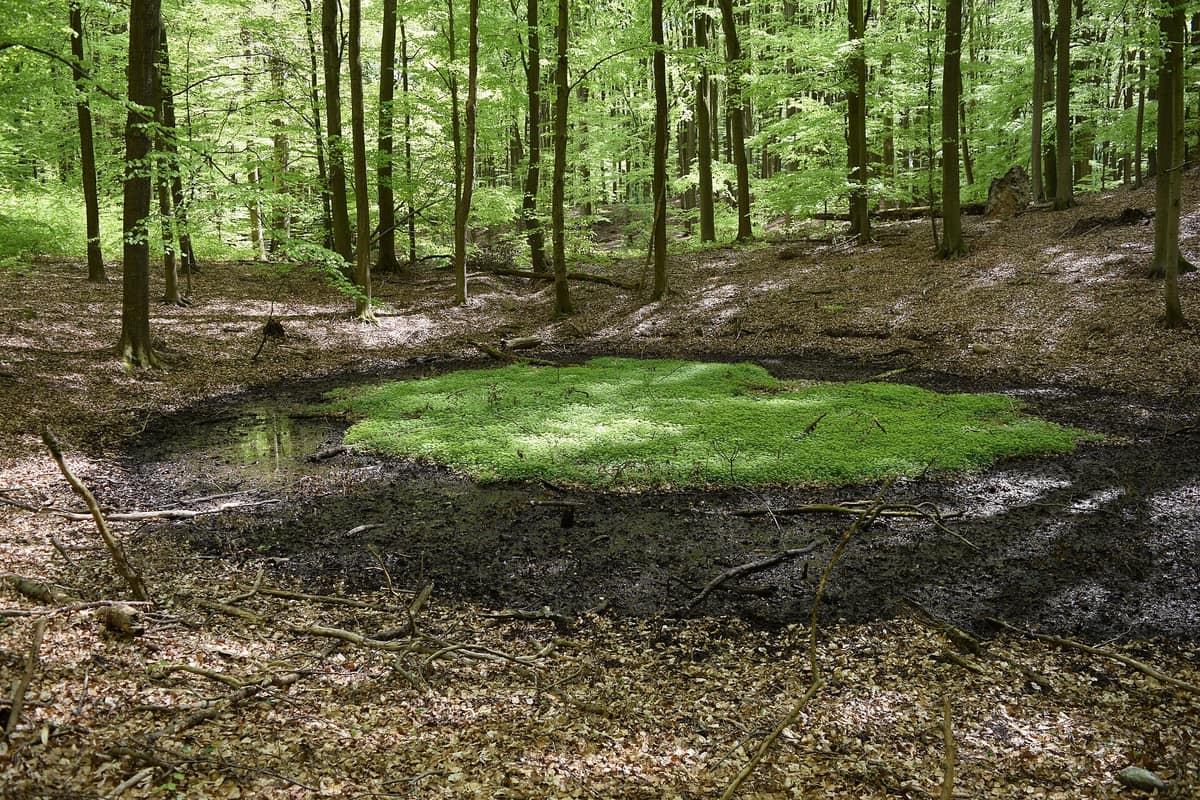
A lowland beech forest born from ice that retreated millennia ago, with mires and kettle ponds nestled between its moraines.
The place
Nature
The landscape
Everything stems from the last ice age, the Weichselian glaciation. The ice left moraines and morainic sheets, giving the landscape its remarkably rolling, roller-coaster relief. In the hollows between moraines, waterlogged alder carrs, mires, and kettle lakes formed. The highest point in the reserve, the Blocksberg, barely reaches about 139 m: sheer height is not needed for the ground to rise and fall with every step.
The Grumsin beech forest is a lowland beech forest resting on base-rich soils. Woods of this kind are regarded as remnants of the great beech tracts that once blanketed central Europe. Within the wider nature reserve, an area of 847,91 hectares forms a total reserve: there you will find rain-fed lakes, glacial kettles, and terrestrialisation mires separated by moraines.
Across the wider nature reserve's forests, 349 higher plant species have been recorded, four of them on the Red List, such as the white helleborine (Weiße Waldvögelein). Others include bogbean and, in the intact mires, sundew, cotton grass, bog rosemary, and sedges.
Wildlife and seasons
Birds help you discover the forest and its wetlands. Five species of woodpecker dwell here, including the black woodpecker, and the collared flycatcher also breeds in the woods. Along the water appears the common kingfisher. Notable bird records for the nature reserve include the white-tailed eagle and the common crane. The black stork and the lesser spotted eagle rank among the rarest birds taking refuge in these woodlands.
Ponds benefit the European tree frog, while dead wood sustains saproxylic beetles like the Kopfhornschröter and Balkenschröter. In 2012, researchers discovered five dipteran species previously unknown to science in the reserve's forests.
From May to October is the recommended period for a visit; guided walks from April to October operate on their own calendar.
Species
With a page in the atlas
Being mentioned in a source doesn't guarantee sightings: check with the people who manage the area.
Memory and protection
History and conservation
This forest has long been inhabited. Archaeological traces of Neolithic and Bronze Age settlements, as well as Slavic hamlets from the twelfth and thirteenth centuries, have been unearthed within the reserve. In the late sixteenth century it served for hunting, with an enclosure over 70 km long erected across parts of the area, maintained by dedicated fence wardens. In the early nineteenth century, lands were drained for farming, and from the fifties onward heavy timber felling supplied construction wood and fuel.
Later came the GDR era and its state hunting preserve. The nature reserve has enjoyed formal protection since 1 October 1990, coinciding with the establishment of the Schorfheide-Chorin Biosphere Reserve. The cutback in commercial exploitation preserved vital refuges for woodland wildlife. On 25 June 2011, 590 hectares of Grumsin were inscribed as UNESCO World Heritage.
Grumsin forms part of the Ancient and Primeval Beech Forests of the Carpathians and Other Regions of Europe, a serial property with 93 beech forest components spread across 18 European countries, together with Hainich, Kellerwald-Edersee, Jasmund national parks and the Serrahn sector of Müritz. This collective entity represents the postglacial recolonisation of beech across Europe, which does not imply every single stand has stayed untouched by humans ever since. Natural beech woodlands like this rank among Europe's most threatened habitats, even if the common beech itself is not an endangered species.
Before you set off
Visiting
How to visit
The main starting point is Altkünkendorf, which hosts a visitor centre and information point for the beech forest. Exhibits explain forest protection measures and its World Heritage designation.
Grumsin features five colour-coded circular trails. The Red Trail is the longest: 21,5 km looping around the entire World Heritage area, and can also be started in Altkünkendorf. The Green Trail, measuring 7,2 km, begins at the Ice Age Museum in Groß-Ziethen, home of Georg the mammoth, crossing mires, forest lakes, and alder carrs before returning along an old cobbled lane. The Orange Trail sets out from Altkünkendorf and can be shortened at Luisenhof. The Genusswanderweg departs from Angermünde station, passing through Sternfelde, Schmargendorf, Zuchenberg, and Luisenhof to Altkünkendorf.
If you prefer to be guided, certified nature and landscape guides run tours on the second and fourth Saturdays from April to October. "A Primeval Forest is Born" sets off from Schmargendorf, lasts about four hours, and showcases ancient beeches, rolling terrain, and extensive mires. "Living World Heritage" lasts about three hours and covers 6 km.
Before you go
Keep strictly to marked trails in the nature reserve. The core zone is closed to independent exploration: you can enter only on authorised tours led by trained guides. Along the southern leg of the Orange Trail, fallen trunks require you to step over them; beech-leaf path surfaces are not suitable for wheelchairs or rollators. Avoid the forest during strong winds due to falling branches, which can also happen in calm weather.
Check access, rules and visiting conditions in the official information from the managing body before you set off.
Location
Where it is and how far it reaches
Boundary of Grumsiner Forst/Redernswalde · IUCN IV · © EEA, CDDA (CC-BY) The coordinate is estimated; it isn't a verified access point.
Transparency
Sources
The research data with its sources, and the official links for this place, are in the Spanish version of this page. See the Spanish version
Around it
The Schorfheide-Chorin Forest Landscape shares the territory of the same biosphere reserve with Grumsin. About 13 km away lie the Uckermark Lakes Nature Park Forests.
If you like this place, elsewhere in Europe
Distant places with uncommon wildlife and habitats in common. The most widespread species don't count. Sharing species doesn't imply a corridor or guaranteed presence.
- Store Mosse National Park
Jönköping (Värnamo / Gnosjö / Hillerstorp)
In common: Common crane · White-tailed eagle — old-growth forest
The largest ombrotrophic bog complex south of Lapland (100 km² of mires and tarns traversed by wooden boardwalks).
JFMAMJJASONDApril – June · September – October · Crowding very low
- Orient Forest - Woodland Sectors
Grand Est (Aube / Troyes)
In common: Common crane · White-tailed eagle — old-growth forest
Lush deciduous forests encircling artificial reservoir lakes that have become a crucial migration stopover for waterfowl.
JFMAMJJASONDMarch – May · October – November · Crowding low
- Skuleskogen National Park (High Coast of Sweden)
Västernorrland (Höga Kusten / Örnsköldsvik / Kramfors)
In common: Common crane · White-tailed eagle — old-growth forest
The heart of Sweden's High Coast (Höga Kusten), the site of the world's greatest post-glacial isostatic rebound (286 m of land uplift after the ice), featuring the Slåttdalssvackan canyon.
JFMAMJJASONDMay – October · Crowding low
Entry #126 of the original atlas.