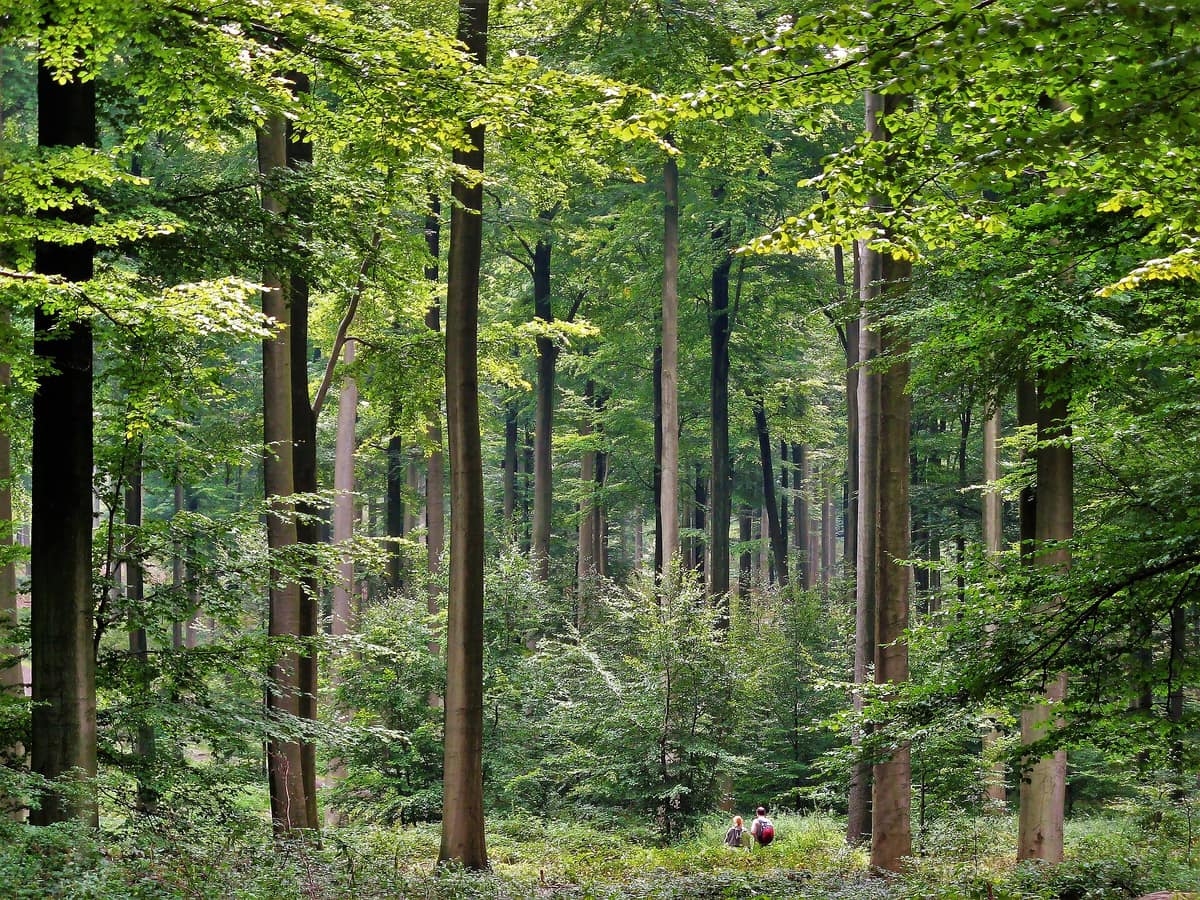
Sonian Forest / Zoniënwoud - Core Zones
Forêt de Soignes / Zoniënwoud - Zones d'une réserve naturelle
Brussels / Flanders / Wallonia · Belgium
Photo: Donarreiskoffer · CC BY 3.0 · Wikimedia Commons
The 'Beech Cathedral', an ancient peri-urban forest at the gates of Brussels inscribed on the UNESCO list.
A beech forest with the stature of a cathedral at the gates of a European capital. The Sonian Forest, Zoniënwoud in Dutch, is a peri-urban forest of some 5 000 ha southeast of Brussels. The Bois de la Cambre links it directly to the city and reaches within 4 km of the centre, allowing you to pass from asphalt to beech canopies without ever leaving the capital. Nearly 80 % of the tree cover is beech, and its towering stands earned part of the woodland the moniker of «cathedral beechwood».
Three regions share its administration: Flanders manages 56 %, Brussels 38 %, and Wallonia 6 %.
What makes it unique
It is the only forest in Belgium with seven species of woodpecker, and it grows right next to the capital.
The place
Nature
The landscape
To understand this forest, you have to begin with the soil. During the great ice ages, each thaw released torrents of water that could not soak into the frozen ground; it swept over the surface and carved it out into the deeply ravined relief you see today. Beneath the silt and humus lies a dense, compacted layer: the fragipan. This barrier prevents the beeches from sinking deep taproots, making these giants remarkably vulnerable: during major storms, dozens of trees tumble like dominoes, laying bare their shallow root plates.
These beeches are not an accidental gift of nature, but the legacy of deliberate human design. During the Austrian period they were planted systematically, completely transforming a forest that had previously blended a diverse mix of broadleaves; the oldest stands date from that era. Today, timber is harvested around 200 years of age, when the wood quality begins to decline and trees become susceptible to fungal disease and insect attack.
Inside an old-growth beech stand, the atmosphere shifts completely. The closed canopy admits very little light and the dense leaf litter acidifies the ground, leaving the understorey almost bare. Where the woodland mingles oak, ash, maple, wild cherry, hornbeam, and birch, however, the flora flourishes. And in the valley of the Vuylbeek, now a nature reserve, beneath the alders an array of moisture-loving plants has returned, drawing in abundant insects, including dragonflies.
Wildlife and seasons
The ideal window to observe the flora is between March and May. During these months the forest floor is blanketed with wood anemones and bluebells, accompanied by woodland violets, greater stitchwort, lords-and-ladies, and baneberry to complete the palette.
In winter the woodland takes on a different rhythm. Early in the morning is the best time to catch sight of roe deer, which gather into small herds at this season. They are the only large native mammals that remain, successfully reintroduced after complete extirpation, and their population is estimated at around 150 across the entire forest, though their density has fallen: there were 0,6 per square kilometre in 2021 compared to 1 between 2008 and 2013. In striking contrast, around 2007 wild boar suddenly reappeared, having been considered extinct here since 1957.
Among the aged hollow trunks roost bats and forest birds such as the Eurasian nuthatch and treecreeper. In the Brussels section alone survive about forty species of mammals, 18 of them bats. Five are threatened, including Bechstein's bat, whose presence was decisive in designating the forest as a Natura 2000 site.
Woodpeckers are the forest's signature inhabitants: European green woodpecker, great spotted woodpecker, black woodpecker, middle spotted woodpecker, and lesser spotted woodpecker, the latter currently in decline. Alongside them dwell raptors such as the tawny owl, long-eared owl, common buzzard, and European honey buzzard. Along ponds and streams look for ducks, coots, grey herons, and the common kingfisher. The forest also supports red squirrel, fire salamander, northern crested newt, and slow worm.
There are also notable absences. The European nightjar bred regularly in clearings and heaths until the mid-twentieth century, and the Eurasian woodcock has seen its breeding numbers dwindle in recent years.
Species
With a page in the atlas
Being mentioned in a source doesn't guarantee sightings: check with the people who manage the area.
Memory and protection
History and conservation
Around the year one thousand the forest became a hunting preserve of the counts of Leuven, later dukes of Brabant, which largely shielded it from widespread clearance. Under Charles V it still spanned 20 000 hectares, but subsequent clear-cutting steadily eroded its perimeter. Between 1822 and 1836 large tracts were auctioned off, stripping away three-fifths of its surface before the Belgian state acquired the surviving core. During the Battle of Waterloo, the allied army of Wellington was deployed with this very forest immediately to its rear.
The twentieth century sliced through it with motorways and a railway line, fragmenting its habitats. To mitigate this disruption, the Groenendaal ecoduct was constructed across the Brussels ring road and opened in June 2018 to reconnect severed sectors. In 2016 the woodland joined the European Rewilding Network, seeking to bolster natural wildlife populations including roe deer and wild boar. Selected pristine sectors are recognised as UNESCO World Heritage for their primeval character, and since 2023 the Flemish portion forms part of the Brabantse Wouden National Park.
Forest management has also changed course: continuous cover forestry is now preferred, mixing tree species and age classes to supply diverse ecological niches for wildlife and plant communities.
Before you set off
Visiting
How to visit
This forest is meant to be explored unhurriedly and in many ways. It offers more than 350 km of paths for walking, cycling, and horse riding, along with a virtual pedestrian network of 170 km of waymarked routes and numbered junctions.
To prevent visitors from dispersing indiscriminately, since 2012 the forest has established designated «entry gates» that channel arrivals toward specific hubs. The five primary gateways are Tervuren Park, Rood Klooster in Auderghem, Ter Kamerenbos in Bosvoorde, Groenendaal, and the Solvay Regional Domain in La Hulpe. Reaching them by public transport is remarkably convenient, and park-and-ride facilities operate during peak periods.
If you want to understand the forest before setting out on foot, the Forest Museum (Bosmuseum Jan van Ruusbroec) occupies the former farm of Groenendael Priory and showcases local flora, fauna, historical heritage, and woodland ecology.
Before you go
Hunting was suspended in 1974 and fully prohibited a few years later. Gathering plants and mushrooms is strictly forbidden in both the Flemish and Brussels sections, protecting over 1 000 recorded fungal species that trampling and foraging place in jeopardy. Several sectors are closed to the public to allow natural forest regeneration, certain paths are reserved exclusively for walkers, riders, or cyclists, and elsewhere you cannot step off the paths. Access points near Brussels become congested on sunny weekends; strict nature reserves have strictly restricted access.
Check access, rules and visiting conditions in the official information from the managing body before you set off.
Location
Where it is and how far it reaches
Boundary of Het Zoniënwoud · © EEA, CDDA (CC-BY) The coordinate is estimated; it isn't a verified access point.
Transparency
Sources
The research data with its sources, and the official links for this place, are in the Spanish version of this page. See the Spanish version
Around it
There are no other atlas sites nearby. At a considerable distance, Badínsky Prales Primeval Forest shares with this forest the presence of Bechstein's bat and the same character of mature, primeval woodland.
If you like this place, elsewhere in Europe
Distant places with uncommon wildlife and habitats in common. The most widespread species don't count. Sharing species doesn't imply a corridor or guaranteed presence.
- Badínsky Prales Primeval Forest
Banská Bystrica (Badín / Banská Bystrica)
In common: Bechstein's bat — old-growth forest, primary forest
Virgin fir and beech forest over 400 years old protected since 1913, famous for receiving an official visit by Charles III of the United Kingdom for its ecological value.
JFMAMJJASONDMay – October · Crowding none
- Tronçais Forest
Auvergne-Rhône-Alpes (Allier / Cérilly)
In common: Stag beetle · European wildcat — old-growth forest
The most celebrated sessile oak forest in Europe, planted in the era of Colbert and preserving veteran trees over 400 years old.
JFMAMJJASONDMay – October · Crowding low
- Cozia National Park - Primeval Woodlands
Vâlcea County
In common: Stag beetle · European wildcat — primary forest
Limestone crags and the Olt River gorge cloaked in virgin beech forests and high-altitude oak groves.
JFMAMJJASONDMay – October · Crowding low
Entry #127 of the original atlas.