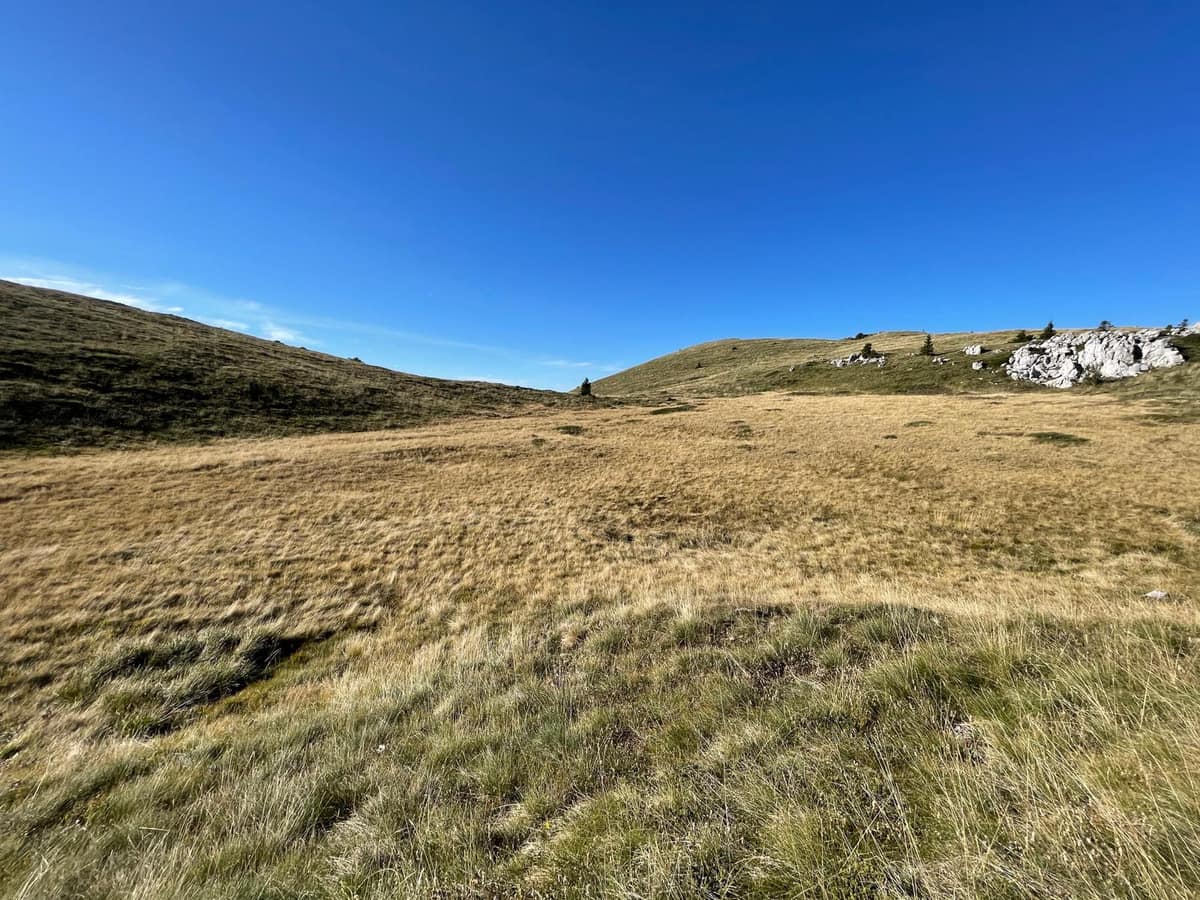
Hajdučki and Rožanski Kukovi Strict Reserve
Hajdučki i Rožanski Kukovi - Strogi rezervat
Lika-Senj County (Sjeverni Velebit) · Croatia
Photo: StarDroid 5000 · CC BY-SA 4.0 · Wikimedia Commons
Dantesque labyrinth of limestone monoliths and abyssal karst pits such as Lukina Jama (1,431 m deep).
Beneath the barren crests of northern Velebit lies a stone forest, and beneath that, an entirely different world. In the Hajdučki and Rožanski kukovi strict reserve, 1220 hectares in the northern sector of the national park, an extraordinary number of subterranean cavities cluster together. By late 2020 more than 600 caves had been discovered across the park, predominantly vertical shafts, and one of them—the Lukina jama–Trojama system in Hajdučki kukovi—is the world's most sheer vertical pit: 1,431 metres deep. Above ground, pinnacles and white limestone boulders dominate the skyline; below lies sheer darkness. Strung between the two, a hand-crafted path allows you to peer right into the core of this wild terrain.
What makes it unique
The cliffs of the two kukovi host the park's highest concentration of endemic plants and, beneath them, chasms plunging over a thousand metres.
The place
Nature
The landscape
The kukovi are bare limestone peaks, naked karst exposed to the elements. Two distinct groups, Hajdučki and Rožanski, are separated by the Lubenovačka vrata pass. They shelter the park's greatest concentration of endemic plants, and among the shattered rocks live rare endemic animals such as Horvath's rock lizard (Iberolacerta horvathi) and the Balkan snow vole (Dinaromys bogdanovi).
The forest here takes on a rugged high-mountain character. On the steep limestone bluffs of both kukovi, Norway spruce (Picea abies) dominates, accompanied by rowan and occasional stunted, weather-twisted beech. Beech also forms subalpine woodlands, some featuring buttercups and others belonging to the Polysticho lonchitis-Fagetum association; all endure heavy snows, frigid temperatures, a short vegetative season, and ferocious mountain winds.
Underground lies another dimension entirely. The official national parks portal notes that the deep abysses of the strict reserve harbour the endemic subterranean leech Croatobranchus mestrovi, while scientific papers document that the non-biting midge Troglocladius hajdi was collected deep inside Lukina jama–Trojama at a depth of 980 metres and appears capable of flight.
Wildlife and seasons
Life here unfolds across two tiers. Up high among the rocky crags live Horvath's rock lizard and the Balkan snow vole. Down below in the freezing shafts dwell the troglobitic leech and deep-cave flying midges. Plants such as Alpine rose (Rosa pendulina) or Borbás's honeysuckle (Lonicera borbasiana) accompany spruce in the open kukovi woodlands.
To witness the peak of alpine blooms, the Velebit Botanical Garden outside the strict reserve recommends visiting in June and July, when almost all species are flowering. Plants there are marked with illustrated nameplates, and interpretive signs explain the main ecological features.
Species
With a page in the atlas
Being mentioned in a source doesn't guarantee sightings: check with the people who manage the area.
Memory and protection
History and conservation
Statutory protection for Hajdučki and Rožanski kukovi dates back to 1969, according to United Nations protected planet inventories. The Premužić Trail predates formal nature reserve status: construction began in 1930 and concluded in the summer of 1933, surveyed and built by forestry engineer Ante Premužić, after whom it is named. In 2009 the trail was designated in its entirety as a cultural asset of national significance.
Before you set off
Visiting
How to visit
A strict nature reserve is a legal category that prohibits economic exploitation and other disruptive activities, though the ministry permits managed educational visits and scientific research when authorized. The universally open gateway into this realm is the Premužić Trail, which threads through the most rugged and otherwise inaccessible crags of Hajdučki and Rožanski kukovi. Sixteen of its kilometres cross Northern Velebit National Park.
The complete hike between the mountain huts of Zavižan and Alan takes around five or six hours. If you wish to branch off to the Rossi hut, the climb along the Premužić path requires about two hours from Zavižan or three from Alan, with the return trip adding its own travel time.
The deep abyss, by contrast, is visited without going underground. At Velebit House in Krasno you can explore Lukina jama virtually without descending into the chasm. The interpretive mountain exhibition spans four floors, all fully wheelchair-accessible via a lift.
Before you go
Within accessible sectors of the park, leaving marked paths and collecting plants or mushrooms is strictly prohibited. The deep vertical shafts are closed to tourism: you explore them through the interactive exhibits at Velebit House.
Check access, rules and visiting conditions in the official information from the managing body before you set off.
Location
Where it is and how far it reaches
Boundary of Hajdučki i Rožanski kukovi · IUCN Ia · © EEA, CDDA (CC-BY) The coordinate is estimated; it isn't a verified access point.
Transparency
Sources
The research data with its sources, and the official links for this place, are in the Spanish version of this page. See the Spanish version
How it fits into the territory
Calculated from the Atlas boundaries. «Part of» is only stated with an official boundary; an estimated area only means that they overlap.
Part of Northern Velebit National Park
Around it
The Rewilding Velebit Plains lie roughly twelve kilometres away. Among comparable wild massifs, Prašuma Lom - Strogi rezervat prirode shares Rosa pendulina, Norway spruce, and European beech. Rezervația Codrul Secular Slătioara coincides in rowan, beech, and Eurasian lynx; while Bukovské vrchy pralesový komplex - NP Poloniny and Prašuma Perućica - Nacionalni park Sutjeska share beech, lynx, and grey wolf.
If you like this place, elsewhere in Europe
Distant places with uncommon wildlife and habitats in common. The most widespread species don't count. Sharing species doesn't imply a corridor or guaranteed presence.
- Lom Primeval Forest Strict Nature Reserve
Republika Srpska (Petrovac / Klekovača)
In common: Rosa pendulina · Picea abies · Fagus sylvatica — high mountain, primary forest
Beech and fir reserve set upon the deep karstic terrain of Mount Klekovača.
JFMAMJJASONDJune – October · Crowding very low
- Slătioara Primeval Forest Nature Reserve
Suceava County (Rarău Mountains)
In common: Sorbus aucuparia · Fagus sylvatica · Eurasian lynx — high mountain, primary forest
The 'Cathedral of the Firs', one of Romania's oldest mixed primeval forests of silver fir and European beech.
JFMAMJJASONDMay – October · Crowding very low
- Bukovské Vrchy Primeval Forest Complex - NP Poloniny
Prešov Region (Snina District)
In common: Fagus sylvatica · Eurasian lynx · Brown bear — high mountain, primary forest
Slovakia’s largest tract of virgin primeval beech forests contiguous with subalpine ridge meadows (poloniny).
JFMAMJJASONDMay – October · Crowding very low
- Perućica Primeval Forest - Sutjeska National Park
Republika Srpska (Foča / Maglić)
In common: Fagus sylvatica · Eurasian lynx · Brown bear — high mountain, primary forest
The best-preserved beech and fir primeval forest in Southeastern Europe, with trees over 300 years old and the Skakavac waterfall.
JFMAMJJASONDJune – October · Crowding very low
Entry #300 of the original atlas.