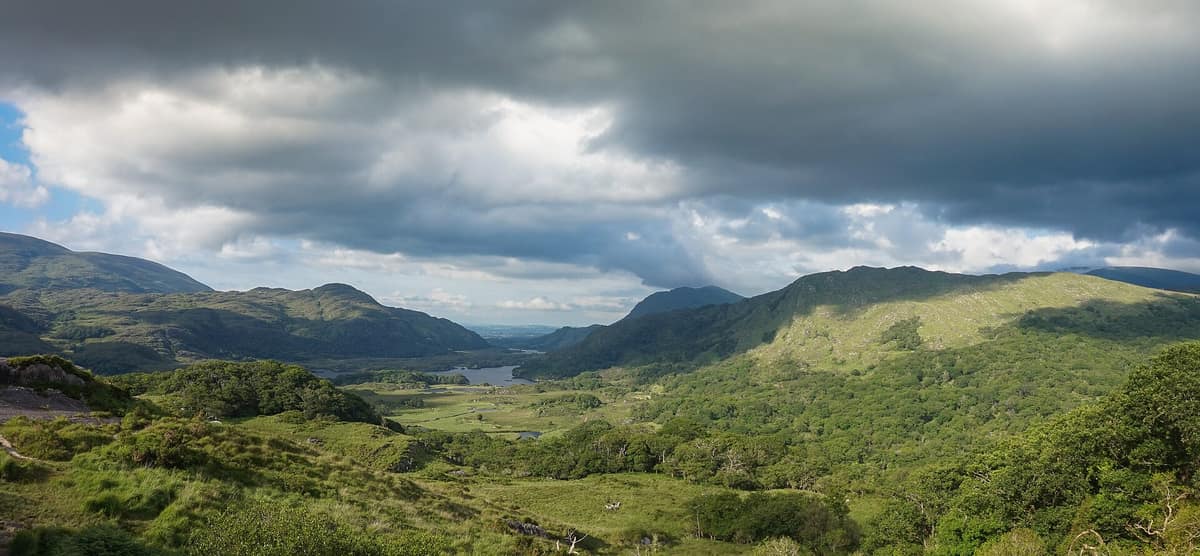
Killarney National Park
Kerry (Killarney / Muckross) · Ireland
Photo: Marco Ober · CC BY-SA 4.0 · Wikimedia Commons
Ireland's first national park: moss-draped ancient Atlantic oakwoods, lakes, and the island's sole native red deer herd.
There is a red deer herd in Ireland that has grazed these hills since the Neolithic. All other red deer in the country descend from reintroduced stock; Killarney's herd is the last surviving remnant of the original indigenous lineage. This was also Ireland's very first national park, created in 1932 when the historic Muckross Estate was presented to the nation. Between the Lakes of Killarney in County Kerry rise sandstone mountains, sessile oakwoods, alder carrs, and western Europe's finest yew forest.
What makes it unique
The only place in Ireland harbouring an indigenous red deer herd, amidst lakes, oak woodlands, and western Europe's largest yew forest.
The place
Nature
The landscape
Here you encounter three distinct landscapes in one. At the heart lie the Lakes of Killarney: Lough Leane, the largest, dotted with over 30 islands; Muckross Lake, the deepest, plunging to a maximum depth of 73.5 m beneath Torc Mountain; and the serene Upper Lake. Together the three lakes cover nearly a quarter of the park's territory. Enclosing them rise Mangerton, Torc, Shehy, and Purple Mountain, beneath which old-growth woods stretch to the shorelines.
This rich diversity is rooted in geology: Devonian Old Red Sandstone collides with Carboniferous limestone. This yields three contrasting woodland types: acid oakwoods on sandstone, a moss-cushioned yew wood on karst limestone, and waterlogged alder woods fringing the lake margins. It is one of the rare places in Ireland continuously wooded since the retreat of the glaciers some 10,000 years ago, with the oakwoods representing the largest surviving tract of semi-natural native forest in the country. The strawberry tree (Arbutus unedo) forms a celebrated component of these woods.
In the Reenadinna yew wood, tucked between Muckross Lake and Lough Leane, ancient yews date between 200 and 250 years old, comprising the largest stand of its kind in western Europe. Other botanical treasures include the rare Killarney fern, decimated in the nineteenth century during the Victorian fern-collecting craze, and Lusitanian relict flora such as St Patrick's cabbage and kidney saxifrage, native to western Ireland and northern Iberia.
Wildlife and seasons
Life in the park centres on the red deer. In early June, hinds climb into high corries to calve, where park rangers tag the newborn calves. In August stags separate into bachelor groups, and October brings the dramatic rut: for weeks stags defend their harems through displays of strength, roaring challenges, parallel walking, and clashing antlers. Sika deer, introduced from Japan in 1865, have multiplied substantially across the woodlands.
Other notable fauna includes the Killarney shad (known locally as the goureen), a landlocked fish found only in Lough Leane. A rare caddisfly, Setodes argentipunctellus, is confined in Ireland solely to Killarney, while the northern emerald dragonfly, the country's rarest odonate, survives in just two small park bogs, flying from May to September. Eurasian otters hunt along lake shores at dawn and dusk. Over Lough Leane, the white-tailed eagle soars once more, having been absent from Ireland since the early twentieth century until an ambitious reintroduction project brought it back.
Of Ireland's more than 450 bird species, over 140 have been recorded within the park. In May 2023, satellite transmitters were fitted to three Killarney cuckoos and one from the Burren to track their African migrations.
Species
With a page in the atlas
Being mentioned in a source doesn't guarantee sightings: check with the people who manage the area.
Memory and protection
History and conservation
The Muckross Estate was gifted to the Irish Free State in 1932, establishing Ireland's inaugural national park. Human exploitation stretches back millennia: copper extraction at Ross Island dates to the early Bronze Age. Ross Castle on the shores of Lough Leane is a fifteenth-century tower house built by chieftain O'Donoghue Mór, while in the cloister of Muckross Abbey flourishes a venerable yew tree reputedly planted when the abbey was founded.
Today the park is designated a UNESCO Biosphere Reserve and Special Area of Conservation protecting yew woods, the Kerry slug, freshwater pearl mussels, and sea lampreys. Invasive rhododendron affects about two-thirds of the oakwoods, where eradication teams work continuously.
Before you set off
Visiting
How to visit
The park is best explored on foot. The Knockreer Circular Walk spans 5 km, offering gentle walking from Killarney House and Gardens with views over Lough Leane and the MacGillycuddy's Reeks. The path from Dundag to Torc affords panoramic vistas of Muckross Lake and the meadows of Torc, often dotted with grazing red deer, leading to Torc Waterfall. A trail loops the Muckross Peninsula through oakwoods, open meadows, and the Reenadinna yew wood—one of only three such woodlands in Europe. The Lakeside Walk traces the shore of Lough Leane to Muckross House, passing historic Muckross Abbey, while the Mining Trail covers an easy 3 km. The rugged Old Kenmare Road traverses the uplands as part of the Kerry Way.
On the water, open boat trips depart from the Old Boat House near Muckross House and from Ross Castle, touring Lough Leane, Innisfallen Island, Lord Brandon's Cottage, and Dinis Peninsula. Canoeing and kayaking are permitted, subject to prior permit and biosecurity power-washing.
Guided tours operate regularly at Muckross House, Killarney House, and Ross Castle.
Before you go
October is the peak red deer rutting season; visitor traffic is high around Muckross House and through the Gap of Dunloe. Dogs are welcome on a short lead, but open flames and campfires are strictly forbidden. On warm, still days midges can be troublesome, and walking off-trail carries a risk of tick bites, which can transmit Lyme disease.
Check access, rules and visiting conditions in the official information from the managing body before you set off.
Location
Where it is and how far it reaches
Boundary of Killarney National Park · © EEA, CDDA (CC-BY) The coordinate is estimated; it isn't a verified access point.
Transparency
Sources
The research data with its sources, and the official links for this place, are in the Spanish version of this page. See the Spanish version
Around it
Killarney has no direct neighbours in the atlas. It shares species and ancient woodland habitats with Sierra de las Nieves National Park (yew, otter, golden eagle), Monfragüe National Park (strawberry tree and golden eagle), Mount Olympus National Park, and Cheile Râmețului (yew and golden eagle).
If you like this place, elsewhere in Europe
Distant places with uncommon wildlife and habitats in common. The most widespread species don't count. Sharing species doesn't imply a corridor or guaranteed presence.
- Achill Island and Croaghaun Cliffs
Ireland (County Mayo / Keel / Keem)
In common: Saxifraga spathularis · White-tailed eagle · Eurasian otter — high mountain
Ireland's largest island (connected by bridge), home to spectacular Keem Bay and Croaghaun Cliffs (688 m, the third highest in Europe).
JFMAMJJASONDMay – October · Crowding low
- Sierra de las Nieves National Park
Andalusia (Málaga — Ronda / Tolox / Yunquera)
In common: Taxus baccata · Eurasian otter · Golden eagle — high mountain
Spanish fir forests (pinsapares), a relict conifer growing only in these ranges, over deep karst harboring some of the deepest chasms in Spain.
JFMAMJJASONDMarch – May · October – December · Crowding low
- Mount Olympus National Park
Pieria / Larissa (Litochoro)
In common: Taxus baccata · Golden eagle — old-growth forest, high mountain
Greece's inaugural national park (1938): the country's highest peak, incised by the Enipeas Gorge and renowned for endemic flora.
JFMAMJJASONDJune – October · Crowding moderate
Entry #1024 of the original atlas.