Koli National Park
Kolin kansallispuisto
North Karelia (Lieksa / Joensuu) · Finland
Photo: Ninara · CC BY 2.0 · Wikimedia Commons
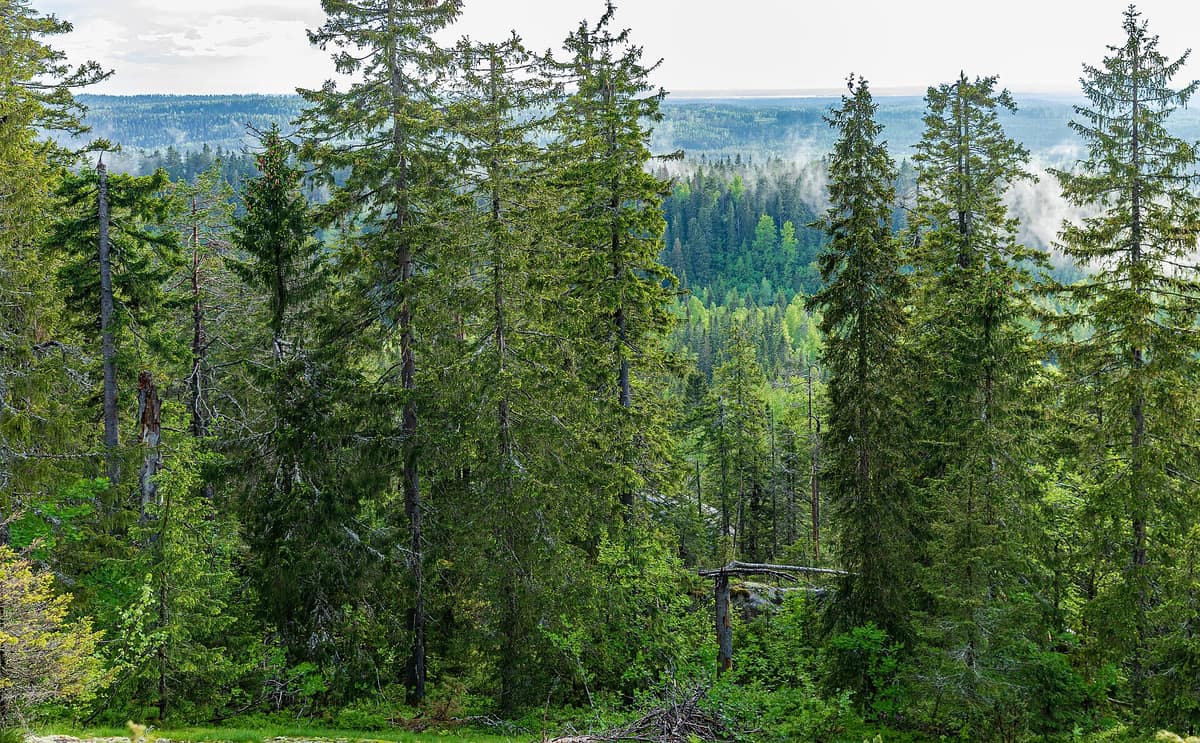
Quartzite ridges overlooking Lake Pielinen: Finland's iconic national landscape, blending heritage meadows with old-growth boreal forest.
The Himalayas are far younger than these worn ridges. Koli, rising beside Lake Pielinen, represents the eroded stump of an ancient mountain belt thrust upward almost two billion years ago when two continental plates collided to forge the Karelides, once rivaling today's highest ranges in altitude. Following eons of erosion, only hard quartzite peaks smoothed by Pleistocene glaciers survive, protecting Finland's oldest accessible bedrock within a celebrated national park.
What makes it unique
Ascend what was once a Himalayan-scale mountain range and descend into traditionally scythed meadows, with Finland's iconic panorama sweeping across Lake Pielinen.
The place
Nature
The landscape
The highest summit is Ukko-Koli at 347 metres, its bare white quartzite bedrock polished gleaming smooth by retreating ice sheets. From its open crest unfolds Finland's definitive national landscape gazing out over Lake Pielinen. The ridge marks a sharp geological divide between two distinct bedrock ages: to the east lies Archaean granitic gneiss older than two billion six hundred million years, while younger Proterozoic quartzites dominate to the west. Pielinen itself, Finland's fourth-largest lake, stretches for 93 kilometres in length yet averages under ten metres in depth.
Draped over this primordial rock is an undulating quilt of ancient woodland, lush herb-rich glades, and pastoral meadows. On the slopes of Ipatti along the Kaskenkierros trail, trees have stood unlogged for well over a century: towering spruces and aspen trunks supply deadwood vital for rare saproxylic beetles, mosses, and bracket fungi. Sheltered nutrient-rich hillside gullies support luxuriant deciduous woods with tall perennial herbs, ferns, and delicate orchids, explored along the Paimenenpolku trail. Rangers actively remove invading spruces to maintain sunlight and prevent soil acidification.
Then come the historical heritage meadows. Former slash-and-burn farming clearings are preserved through annual scything, while native sheep, cattle, and horses graze traditionally maintained rural biotopes.
Wildlife and seasons
On the lake, iconic birds include the red-throated diver and the rare lesser black-backed gull, while on the Koli archipelago an osprey breeds atop a specially erected artificial platform. In early summer, the northern forests echo with the fluting songs of red-flanked bluetails, greenish warblers, and red-breasted flycatchers.
Within old-growth mixed stands, an observant visitor may glimpse the elusive Siberian flying squirrel, which depends on mature aspens with abandoned woodpecker cavities. Plentiful mountain hares sustain resident Eurasian lynx, while open meadows provide hunting grounds for pine martens and stoats. Clean forest pools shelter smooth newts alongside rare great crested newts. In Lake Pielinen, the landlocked salmon population was driven to extinction during the 1960s by hydro-engineering on the Lieksanjoki river, prompting current restoration initiatives with Lake Saimaa broodstock.
In spring and summer the sunny meadows erupt in wildflowers and butterflies. Winter trails are not mechanically maintained, yet snowshoe tracks stay well trodden across scenic ridge crests.
Species
With a page in the atlas
Being mentioned in a source doesn't guarantee sightings: check with the people who manage the area.
Memory and protection
History and conservation
Human habitation traces back to the Stone Age, and slash-and-burn cultivation predated permanent settlements, fundamentally moulding the floral tapestry. Permanent farms were established across the hills in the mid-eighteenth century. Koli proudly preserves this heritage: traditional burn-beating is carried out every few seasons to safeguard heritage landraces of rye and turnip.
Koli also inspired Finland's National Romantic cultural awakening. In the sacrificial fissure of Uhrihalkeama, protected under heritage law, visitors have tossed coins into the cleft for over a century. Novelist Juhani Aho, painter Eero Järnefelt, and composer Jean Sibelius found deep inspiration here: Sibelius's Fourth Symphony was partly conceived following his mountain trek, while Pekka Halonen captured the ridges in his masterwork "Koli in Winter". The park permanently safeguards these iconic North Karelian highlands and ancient forests.
Before you set off
Visiting
How to visit
Around 80 km of marked trails traverse the park, suitable for self-guided or ranger-led exploration. The most famous vantage point crowns Ukko-Koli; a short, demanding accessible trail of 0,8 km ascends to the summit lookout from the Ukko Nature Centre.
The Kasken Kierros nature trail (4,1 km) loops through representative slash-and-burn succession landscapes, ideal for families and school groups. For seasoned backpackers, the Herajärvenkierros circuit (from 30 to 61 km) crosses rugged forested ridges with designated tent sites, lean-to shelters, and wilderness huts. Twelve kilometres south of Koli village lies Pirunkirkko, an intriguing 33-metre Z-shaped boulder crevice cave reached from Herajärvi along the Kiehinen trail.
Before you go
Dogs must remain on leashes at all times. Camp only at designated camping pitches and light campfires exclusively at official hearths; all fires are strictly prohibited during forest fire warnings. There are no refuse bins in the park, so carry out all waste. Foraging for edible berries and mushrooms is permitted except in restricted core zones, but picking wildflowers or other plants is unlawful. Downhill skiing and snowboarding are banned on the panoramic slopes of Ukko-Koli, Akka-Koli, and Paha-Koli. Cycling is allowed only on roadways, never along walking trails.
Check access, rules and visiting conditions in the official information from the managing body before you set off.
Location
Where it is and how far it reaches
Boundary of Kolin kansallispuisto · © EEA, CDDA (CC-BY) The coordinate is estimated; it isn't a verified access point.
Transparency
Sources
The research data with its sources, and the official links for this place, are in the Spanish version of this page. See the Spanish version
Around it
Far to the south, Aigüestortes i Estany de Sant Maurici National Park, the Irati Forest, and the Fuentes del Narcea, Degaña e Ibias Natural Park and Muniellos Reserve share with Koli mature boreal-temperate forests and specialist woodland fauna like the black woodpecker and capercaillie.
If you like this place, elsewhere in Europe
Distant places with uncommon wildlife and habitats in common. The most widespread species don't count. Sharing species doesn't imply a corridor or guaranteed presence.
- Aigüestortes and Lake Saint Maurici National Park
Catalonia (Lleida)
In common: Black woodpecker · Western capercaillie — old-growth forest, lake
The only National Park in Catalonia, a glacial circus wonderland harboring over 200 tarns (estanys) beneath the iconic twin summits of Els Encantats.
JFMAMJJASONDJune – October · Crowding moderate
- Irati Forest
Pyrénées-Atlantiques (FR) / Chartered Community of Navarre (ES)
In common: Black woodpecker · Western capercaillie — old-growth forest
Pyrenean beech and silver fir forests, mountain torrents, and communal summer pastures spanning the Navarrese and French valleys of Irati.
JFMAMJJASONDMay – October · Crowding moderate
- Fuentes del Narcea, Degaña and Ibias Natural Park and Muniellos Reserve
Asturias (Cangas del Narcea / Degaña / San Antolín de Ibias)
In common: Black woodpecker · Western capercaillie — old-growth forest
The largest sessile oak (Quercus petraea) forest in Spain and one of the best preserved in Europe (Muniellos).
JFMAMJJASONDMay – November · Crowding very low
Entry #1033 of the original atlas.