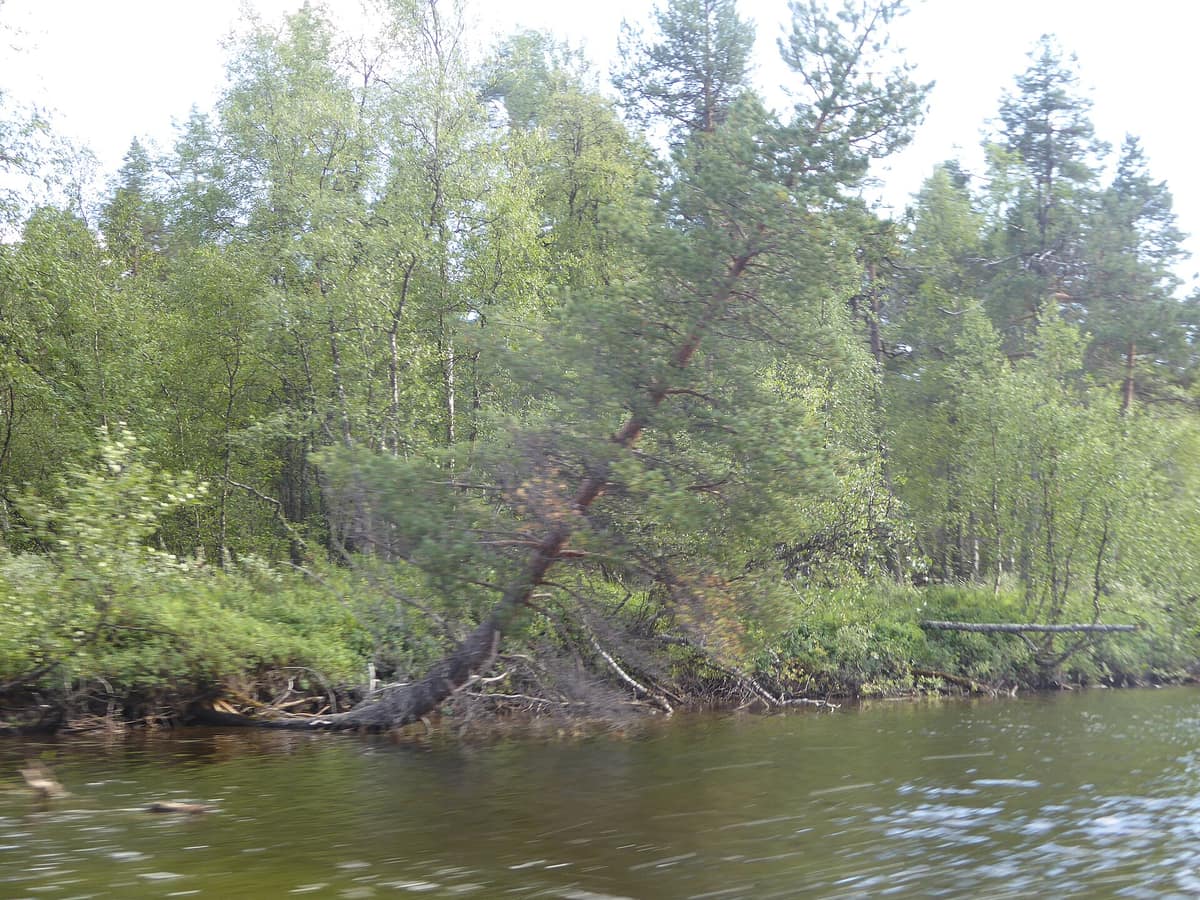
Lemmenjoki National Park
Finnish Lapland (Inari / Kittilä) · Finland
Photo: Nemo bis · CC BY-SA 4.0 · Wikimedia Commons
The largest national park in Finland (2,860 km²), wild river valleys of primeval taiga and the legendary gold-bearing Lemmenjoki river.
You can hike for days without crossing paths with another soul. That is Lemmenjoki: Finland's largest national park, spanning 2,858 km² of treeless fells, ancient pine woods and sweeping peatlands in the heart of Sápmi, the homeland of the Sámi people. Those stepping off the marked paths can immerse themselves in unbroken solitude and wilderness for weeks on end.
What makes it unique
It is the valley of the river of gold, where pine forests, aapa mires and Sámi heritage converge in Finland's largest national park.
The place
Nature
The landscape
The terrain transitions from lush river gorges to old-growth taiga and windswept fells, its vegetation distinctly stratified by altitude. Ascending a fell takes you through classic arctic life zones: Scots pine is the first to reach its ecological limit, at around 300 or 400 m above sea level, with mountain birch defining the ultimate tree line. In the far south, in Kittilä, spruce crowns occasional hills, but upon entering Inari the forest resolves into pure pine and birch.
Tucked between the fells, sheltered river valleys are remarkably verdant. One of the most lush birch stands flourishes at Kultasatama at the headwaters of the Lemmenjoki, rivaling southern Finnish woods in vigour. Further south, nearly a quarter of the park consists of aapa mires: the most vast, such as Naskama-aapa and Sallivuoma, lie in the most remote, seldom-trodden backcountry.
Water carves and governs the wilderness. The Lemmenjoki river, lending the park its name, flows for 80 km, and headwaters of the great Tana and Pasvik drainage basins rise right here. The dramatic Ravadasköngäs waterfall and its approach canyon were carved in part by torrential glacial meltwaters of the Ice Age, a sculpting process the river continues today.
Wildlife and seasons
This vast expanse is the stronghold of the Wolverine, the park's iconic emblem. With luck you may detect its tracks or those of the Brown bear, though you can travel for days on end without meeting another person or catching sight of either predator. The clear, nutrient-poor waters sustain only nine fish species in the Lemmenjoki, notable among them the Atlantic salmon and European perch.
The mires provide vital sanctuaries for waterfowl and waders, with the park serving as one of northern Europe's premier breeding grounds for peatland species for which Finland bears special international conservation responsibility. Widespread nesters include the western yellow wagtail, common snipe and Eurasian teal. Along herb-rich riverbank alder woods, the arctic warbler can be heard singing in summer.
The seasons govern all visitation. The peak window runs from late June through late September, when the majority of visitors experience the park. In winter, for more than six months of the year, Lemmenjoki transforms into an untouched realm for wilderness ski touring.
Species
With a page in the atlas
Being mentioned in a source doesn't guarantee sightings: check with the people who manage the area.
Memory and protection
History and conservation
The oldest human traces consist of hundreds of prehistoric pit-trap systems used to hunt wild forest reindeer, dating to the Stone and Iron Ages: one of the largest pit networks in Finland is preserved here. Centuries later, the closure of the Finland–Norway border in 1852 severed the traditional nomadic migrations of Sámi pastoralists herding reindeer between the Arctic coast and inland taiga. The historic round-up corral of Sallivaara, constructed in the nineteen thirties, stands as a premier cultural landmark. At Njurkulahti, the preserved Kaapin Jouni homestead commemorates a legendary Sámi reindeer pastoralist family.
Then came the gold. In 1945 the Ranttila brothers discovered gold along the Morgamoja brook, triggering the legendary Lemmenjoki gold rush; by the nineteen fifties nearly a hundred active placer claims were worked. The national park was created in 1956 to preserve pristine boreal woodlands and the wild canyon valley, expanded in 1971 and reaching its present dimensions in 1981. In the late nineteen eighties and early nineteen nineties mechanized gold mining muddied downstream waters, sparking decades of controversy. In 2020 mechanized extraction was permanently outlawed: today only traditional artisanal panning with shovel and pan is permitted.
Before you set off
Visiting
How to visit
The park is explored on foot, by riverboat or in a canoe. The Lemmenjoki valley forms a 22 km river corridor between Njurkulahti and Kultasatama, serviced by scheduled wooden riverboats in summer and paralleled by a marked shore path. From Njurkulahti, the fell Joenkielinen rises some 9 km away along a marked trail, offering sweeping panoramas across the taiga valley.
Beyond this river axis, most of the park remains trackless wilderness where you chart your own course. Treks range from short nature loop walks to multi-week self-supported expeditions, demanding robust navigational skills: open wilderness huts are sparse and waymarking is absent. In total, the park maintains around 60 km of marked trails, several footbridges and river-crossing rowboats, more than ten open wilderness huts and three reservable huts.
Another historic option is the Gold Trail, tracing active and historic placer mining grounds; from Kultasatama to Ravadasjärvi runs a 20 km marked trail with interpretive boards recounting prospecting techniques, lore and geology. For Sámi cultural history, a marked 6 km trail leads from the Repojoki river off the Inari–Kittilä road to the historic reindeer round-up site of Sallivaara; the round trip is 12 km.
For water lovers, the canoe route from Muddusjärvi or Solojärvi to Njurkulahti and Kultahamina offers a straightforward entry into paddling. Experienced canoeists can navigate the more challenging wilderness rapids of the Vaskojoki, Kietsimäjoki, Ivalojoki and Repojoki.
Before you go
You are free to hike, snowshoe, ski, row and paddle throughout the park, except within the restricted nature sanctuary of Ravadasköngäs, where you must keep strictly to marked trails. In the Lemmenjoki river corridor between Njurkulahti and Kultahamina camping is only allowed at designated rest areas, campfire sites and huts.
Mobile phone coverage is patchy and completely absent within the deep river canyons. Never rely on a phone. The main trekking season extends from June to September.
Check access, rules and visiting conditions in the official information from the managing body before you set off.
Location
Where it is and how far it reaches
Boundary of Lemmenjoen kansallispuisto · IUCN Ib · © EEA, CDDA (CC-BY) The coordinate is estimated; it isn't a verified access point.
Transparency
Sources
The research data with its sources, and the official links for this place, are in the Spanish version of this page. See the Spanish version
Around it
Lemmenjoki has no immediate neighbours in the atlas, yet it shares reindeer and golden eagles with other vast arctic reserves. Parque Nacional Urho Kekkonen shares reindeer, golden eagles and brown bears, and Parque Nacional Pallas-Yllästunturi shares reindeer and brown bears. Further south across Scandinavia, Reserva Natural de Vindelfjällen and Parque Nacional de Stora Sjöfallet share reindeer and golden eagles.
If you like this place, elsewhere in Europe
Distant places with uncommon wildlife and habitats in common. The most widespread species don't count. Sharing species doesn't imply a corridor or guaranteed presence.
- Urho Kekkonen National Park
Finnish Lapland (Saariselkä / Inari / Sodankylä)
In common: Caribou · Golden eagle · Brown bear — primary forest, high mountain, wetland
Finland’s second largest national park (2.550 km²), rounded arctic tundra fell-tops (tunturi), and wild trekking under the shadow of Sokosti (718 m).
JFMAMJJASONDJune – April · Crowding low
- Vindelfjällen Nature Reserve
Västerbotten (Ammarnäs / Tärnaby)
In common: Caribou · Golden eagle · Brown bear — high mountain, river corridor, wetland
One of the largest nature reserves in Europe: high-alpine massifs, birch valleys, and the free-flowing Vindel River running wild to the Baltic.
JFMAMJJASONDMarch – April · June – September · Crowding very low
- Pallas-Yllästunturi National Park
Finnish Lapland (Enontekiö / Kittilä / Kolari / Muonio)
In common: Caribou · Brown bear — primary forest, high mountain, wetland
Finland's most visited national park (1.020 km²), a chain of tundra fell hills (tunturi) hosting the cleanest air measuring station on Earth (Sammaltunturi).
JFMAMJJASONDJune – September · December – April · Crowding moderate
Entry #579 of the original atlas.