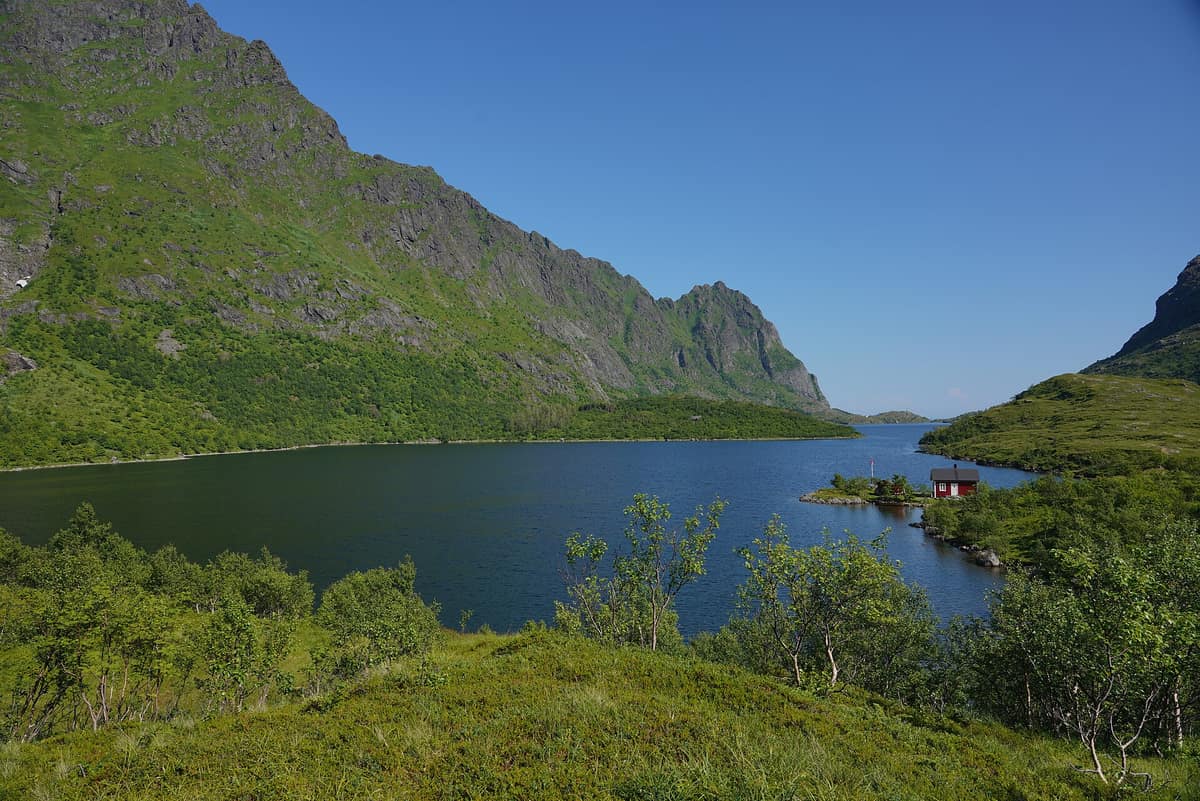
Lofotodden National Park (Lofoten Islands)
Lofotodden National Park
Nordland (Lofoten Islands / Moskenes / Flakstad / Reine) · Norway
Photo: Lukas Beck · CC BY 4.0 · Wikimedia Commons
The national park at the southern tip of the Lofoten archipelago, black granite pyramids rising straight from the Arctic Ocean and secluded white sand beaches like Kvalvika.
Envision a wall of granite summits surging straight out of the Arctic Ocean. Not gentle mountain shoulders, but a knife-edge chain of sheer peaks flanked by open ocean on one side and profound fjords on the other. This is Lofotodden, Norway's fortieth national park, situated entirely on the island of Moskenesøya across the municipalities of Moskenes and Flakstad. It protects the southern anchor of the 160 km mountain wall known as Lofotenveggen ('The Lofoten Wall'), uniting, across 99 km²—86 on land and 13 in marine waters—geological landscapes and habitats found nowhere else in Norway's protected network.
What makes it unique
Here the mountains plunge straight into the sea, with white sand beaches reposing at the foot of ridges soaring up to a thousand metres.
The place
Nature
The landscape
The jagged massif is formed of volcanic rocks and ancient granite, crowned by Hermannsdalstinden at 1029 m, the highest mountain on Moskenesøya; other prominent peaks range from 500 to 940 m. Between these bastions the terrain is deeply fractured and alpine, yet traversable by mountain routes and high passes.
The park encompasses diverse sub-arctic ecosystems: coastal mires, precipitous sea cliffs and sand dunes. The dunes at Kvalvika, Horseidet and Bunes comprise some of the most extensive coastal dune systems in the archipelago. Despite nutrient-poor bedrock, the alpine flora is remarkably diverse: Lofoten was among the earliest areas to emerge from glacial ice, sheltering relict populations of alpine plants. Calcium-loving ferns such as green spleenwort thrive alongside field gentians reaching their extreme north-western European limit.
Wildlife and seasons
The outer oceanic coast hosts thriving wildlife, where bustling seabird cliffs welcome black guillemots, the European shag and the Black-legged kittiwake, alongside resident golden eagles and White-tailed eagles. The Lofotodden nature reserve, on the southwestern tip of Moskenesøya including the islet of Sørholmen, forms a protected maritime bird haven nested within the national park.
Visitor traffic on trails tracks the seasonal cycle. Highest foot traffic occurs in July, showing a clear mid-month peak; seasonal usage traces a bell curve rising steeply in late spring and tapering off as autumn approaches.
Species
With a page in the atlas
Being mentioned in a source doesn't guarantee sightings: check with the people who manage the area.
Memory and protection
History and conservation
Prehistoric remnants and recent coastal settlements along the outer shores of Moskenesøya lend deep cultural antiquity to the landscape, with dwelling traces extending back to the Stone Age. The secluded valley of Stokkvika, spanning around 2 km, was inhabited continuously from at least 1634, served as a supply depot during the Second World War and operated as a military firing range from 1952 to 1963, explaining its exclusion from the park.
Lofotodden was designated on 22 June 2018 and officially opened on 9 June 2019 by Norway's Minister of Climate and Environment. Guided commercial excursions are subject to regulation to safeguard fragile alpine vegetation and avoid disturbing wildlife, especially nesting raptors and seabirds.
Before you set off
Visiting
How to visit
The most sought-after destinations are Kvalvika, Ryten, Bunessanden and Horseid, where the park and the regional outdoor council maintain four automated visitor counters; Kvalvika and Ryten record the highest footfall. Classic treks include the boat-assisted hike from Vinstad to the sandy strand of Bunesstrand, and the demanding route from Å along the southern shore of Lake Ågvatnet, crossing a steep ridge to Lake Stokkvikvatnet and Stokkvika bay.
If heading to Kvalvika, note that parking space at Torsfjorden is limited. To curb trail erosion: cycling is confined strictly to established roads and paths, and is prohibited on two specific routes: from Bunesfjorden to Bunes, and from Torsfjorden to Kvalvika.
Before you go
Flying recreational or commercial drones is prohibited, and electric mountain bikes are barred even with the motor switched off. Motorized transport is forbidden on land, water and in the air below 300 m. Wilderness camping is permitted more than 150 m from the nearest inhabited house or cabin and up to 2 nights in the same spot. Open campfires are allowed from 16 September to 14 April; from 15 April to 15 September, only where fire danger is demonstrably absent. Dogs must be kept on a leash from 1 April to 20 August. Organized or commercial group events require formal approval from the management board.
Check access, rules and visiting conditions in the official information from the managing body before you set off.
Location
Where it is and how far it reaches
Boundary of Lofotodden · IUCN II · © EEA, CDDA (CC-BY) The coordinate is estimated; it isn't a verified access point.
Transparency
Sources
The research data with its sources, and the official links for this place, are in the Spanish version of this page. See the Spanish version
Around it
Lofotodden has no immediate neighbouring sites in the atlas, yet shares seabird ecosystems with other oceanic coastlines: Reserva Ornitológica de Marwick Head shares the black-legged kittiwake, and Parque Nacional de las Islas Atlánticas de Galicia the European shag.
If you like this place, elsewhere in Europe
Distant places with uncommon wildlife and habitats in common. The most widespread species don't count. Sharing species doesn't imply a corridor or guaranteed presence.
- Atlantic Islands of Galicia National Park
Galicia (Cíes / Ons / Sálvora / Cortegada)
In common: European shag — wild coast, marine
Four granitic archipelagos guarding the mouth of the Rías Baixas, with seabird nesting cliffs facing west and sheltered sand dunes facing east.
JFMAMJJASONDApril – June · September – October · Crowding high
- St Kilda Archipelago - Hirta and Dùn
Scotland (Outer Hebrides / Hirta)
In common: Grey seal — wild coast, marine, high mountain
The only Dual (Cultural and Natural) UNESCO World Heritage Site in the UK, with sheer sea cliffs and sea stacks hosting the world's largest gannet colony (Stac an Armin 196 m).
JFMAMJJASONDJune – August · Crowding very low
- Curonian Spit National Park
Klaipėda (Neringa — Nida / Juodkrantė)
In common: Grey seal · White-tailed eagle — wild coast
A sandy spit nearly a hundred kilometres long between the Baltic and the Curonian Lagoon, boasting some of Europe's highest dunes.
JFMAMJJASONDMay – June · September – October · Crowding moderate
Entry #570 of the original atlas.