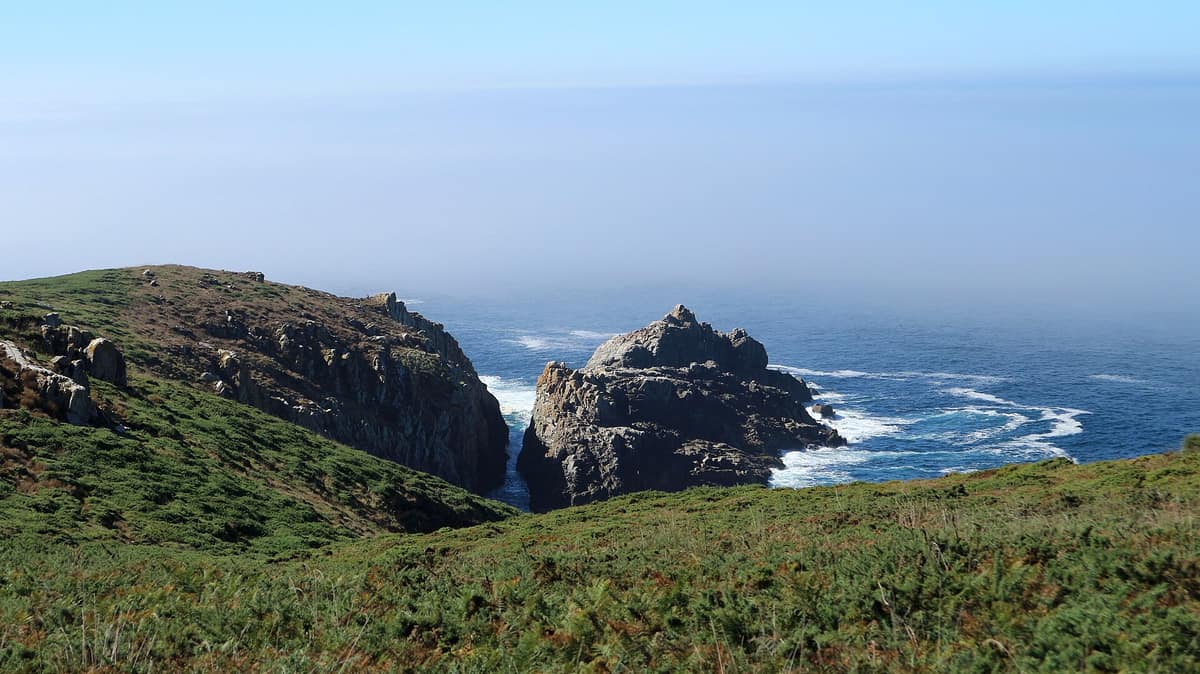
Atlantic Islands of Galicia National Park
Parque Nacional Marítimo-Terrestre das Illas Atlánticas de Galicia
Galicia (Cíes / Ons / Sálvora / Cortegada) · Spain
Photo: Miguel Branco · CC BY-SA 4.0 · Wikimedia Commons
Four granitic archipelagos guarding the mouth of the Rías Baixas, with seabird nesting cliffs facing west and sheltered sand dunes facing east.
Six months after its designation as a national park, on 1 July 2002, the oil tanker Prestige foundered and its black tide fouled the shores of every archipelago except Cortegada. A decade later, comprehensive ecological monitoring revealed that most negative impacts had been overcome; the lingering footprint is a decline in the European shag, currently supported by an active species recovery plan. These granite archipelagos—Cíes, Ons, Sálvora and Cortegada—constitute Galicia’s only national park, accessible exclusively by sea.
What makes it unique
A maritime park where laurel woodlands, over 200 seaweed species and vast seabird colonies thrive just a short boat crossing from the rías.
The place
Nature
The landscape
The Cíes form an archipelago across the mouth of the Ría de Vigo, while Ons guards the entrance to the Ría de Pontevedra. Sálvora stands at the outer portal of the Ría de Arousa, with Cortegada nestled deep within its sheltered waters. Between ocean waves and granite reefs lies a rich mosaic of habitats: underwater kelp forests and maërl beds flourish alongside shallow sandbanks and reefs; onshore, coastal dune systems, dramatic cliffs, gorse and heather heaths, grey dunes and wet Atlantic heathlands shape the terrain. Marine ecosystems are broadly healthy, though vulnerable to oil discharges from shipping lanes and historic overfishing.
Human pressure has altered island vegetation. On Cíes in particular, twentieth-century plantations of eucalyptus, maritime pine and acacia displaced native scrub, and ongoing eradication remains a long-term undertaking. Foot traffic threatens fragile foredunes, prompting fenced conservation boardwalks.
Wildlife and seasons
Seabirds dominate the islands. The yellow-legged gull and the European shag are the two most abundant breeding species, congregating in dense colonies at Punta Centolo on Ons; the headland viewpoint is closed to visitors from 15 February to 31 July during the peak breeding season. On Cíes, the bird observatory along the Monte Faro trail offers panoramic views of thousands of nesting gulls, with groups of shags building seaweed nests on ocean shelves. On Viños islet, shags spread their wings to dry in the sea breeze.
Along the Monte Faro route, the sheltered Lago de Cíes lagoon reveals fish, crabs and marine algae when the tide is still.
Species
With a page in the atlas
Being mentioned in a source doesn't guarantee sightings: check with the people who manage the area.
Memory and protection
History and conservation
Human settlement traces back to the Palaeolithic on Cíes, with Bronze Age fortified castros on Cíes and Ons. On Ons, winter isolation when stormy seas cut all boat connections fostered an autonomous island culture steeped in ethnobotany, folklore of the Santa Compaña and protective broom rituals against the evil eye on fishing skiffs. The dorna is the traditional wooden boat, propelled by oars or lateen sail. The Cíes were originally declared a natural park in 1980.
Before you set off
Visiting
How to visit
The archipelagos are explored entirely on foot along marked nature trails. On Cíes, the Monte Faro route covers 7 km round trip with 175 m of climb, taking about two and a half hours to reach the lighthouse perched above dizzying cliffs. Halfway up sits the Pedra da Campá, a granite tor hollowed out by salty Atlantic gales. The Faro da Porta trail spans 5 km of easy walking in an hour and a half, while the gentle Alto do Príncipe path covers 3 km in one hour.
On Ons, the Northern Route is a circular walk of 8.1 km taking about three hours of moderate hiking. The Southern Route, also circular, covers 6.5 km in two and a half hours, passing the Fedorentos viewpoint overlooking Onza island and the distant Cíes, alongside the Buraco do Inferno, a sea chasm carved into the granite.
For cultural context, visit the Cambón visitor centre in historic Vigo and island interpretation centres on Cíes and Ons, the former built over the medieval monastery of San Estevo.
Before you go
Visiting Cíes and Ons requires an official advance permit from the Xunta de Galicia; secure it before booking ferry crossings. Check ferry schedules and weather forecasts carefully, especially during off-peak months. Authorized campsites have strict capacity limits. Keep well back from unfenced cliff edges and never swim in rough ocean waters.
Check access, rules and visiting conditions in the official information from the managing body before you set off.
Location
Where it is and how far it reaches
Boundary of Islas Atlánticas de Galicia · IUCN II · © EEA, CDDA (CC-BY) The coordinate is estimated; it isn't a verified access point.
Transparency
Sources
The research data with its sources, and the official links for this place, are in the Spanish version of this page. See the Spanish version
Around it
Kornati National Park shares yellow-legged gulls and European shags, as does Cap de Creus Natural Park; both represent celebrated seabird coastlines across southern Europe.
If you like this place, elsewhere in Europe
Distant places with uncommon wildlife and habitats in common. The most widespread species don't count. Sharing species doesn't imply a corridor or guaranteed presence.
- Kornati National Park
Šibenik-Knin (Kornati Archipelago — Murter)
In common: Yellow-legged gull · European shag · Common bottlenose dolphin — wild coast, marine
A labyrinth of nearly ninety barren limestone islands, featuring sheer sea cliffs ("crowns") plunging into the open Adriatic.
JFMAMJJASONDMay – June · September – October · Crowding moderate
- Selvagens Islands Nature Reserve
Autonomous Region of Madeira (Selvagem Grande / Selvagem Pequena)
In common: Yellow-legged gull · Common bottlenose dolphin — wild coast, marine
Portugal's southernmost territory and one of Europe's oldest strict marine reserves (1971), harbouring the world's densest colony of Cory's shearwater (Calonectris diomedea).
JFMAMJJASONDMay – September · Crowding none
- Cap de Creus Natural Park
Catalonia (Girona / Cadaqués / El Port de la Selva / Roses)
In common: European shag · Common bottlenose dolphin — wild coast, marine
The easternmost point of the Iberian Peninsula, where the Pyrenees plunge into the sea in a labyrinth of metamorphic schists sculpted by the tramontana.
JFMAMJJASONDApril – June · September – October · Crowding moderate
Entry #1022 of the original atlas.