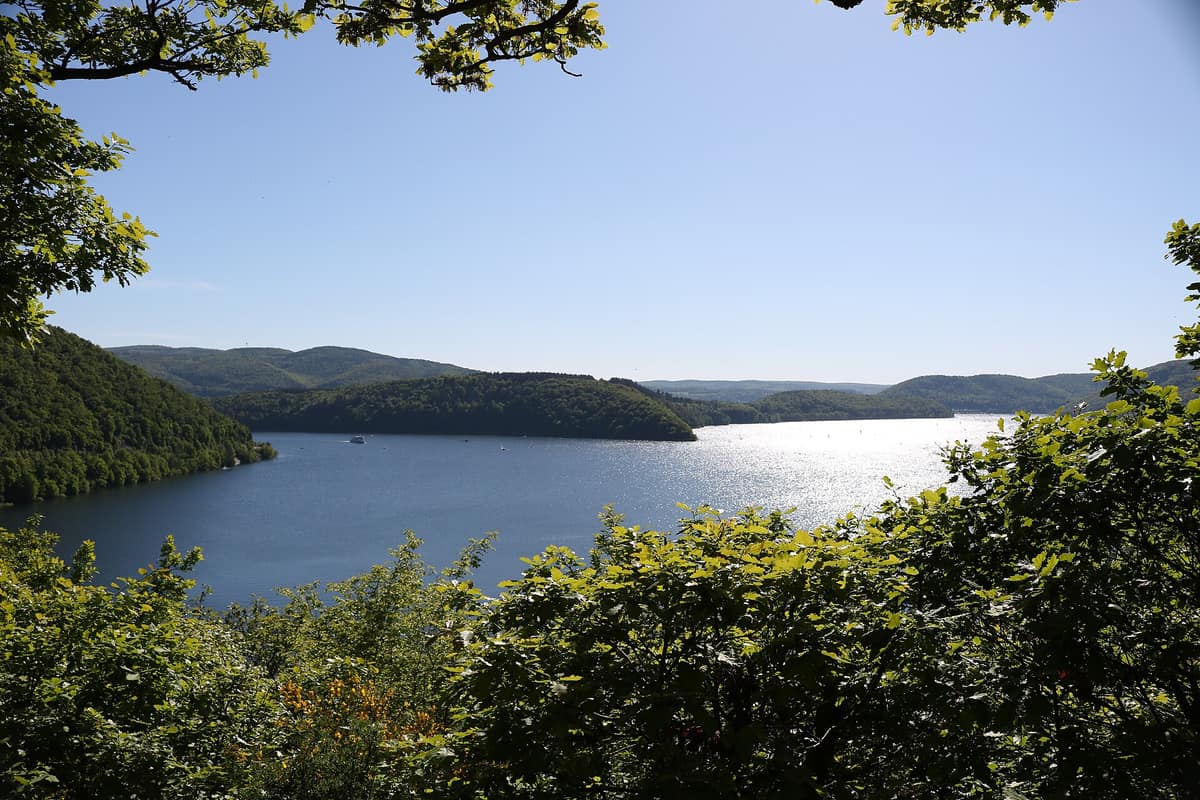
Kellerwald-Edersee National Park - Ancient Beech Forest
Nationalpark Kellerwald-Edersee - Buche Urwald
Hesse (Waldeck-Frankenberg) · Germany
Photo: David Kalhöfer · CC BY-SA 4.0 · Wikimedia Commons
One of Central Europe's last unfragmented montane beech forests on schist soils.
Some forests survive, and some forests return. The one at Kellerwald-Edersee belongs to the second kind, and is still in the middle of that journey. Around Lake Edersee, in northern Hesse, the Ederberge comprise over fifty rolling hills almost entirely blanketed in woodland. Here, very old beech trees coexist with a promise: to let nature be nature, allowing the forest to develop increasingly mature structures. Meanwhile, the park already protects what virgin woodland remnants remained, which is why a section of its beech forests is a UNESCO World Heritage site.
What makes it unique
Its ancient beech forests are a World Heritage site and form part of the territory where the European wildcat returned after decades without records.
The place
Nature
The landscape
The history of this forest begins with the ice. The beech entered Central Europe during the postglacial climatic optimum, expanding at the expense of elm and lime. Because of this, the park's characteristic community is the acidophilous beech forest, thriving on acidic, nutrient-poor soils.
Other slopes tell different stories. Those flanking the Edersee harbour siliceous rock faces hosting the Cheddar pink, the Pfingstnelke, highly endangered in Europe; along the valleys lie meadows and ancient pastures, the Driesche, covering over 200 ha where arnica flourishes. More than one thousand natural springs and streams, together with rocky escarpments and scree slopes, complete this mosaic. In total, there are more than 600 species of vascular plants.
The most ancient pocket lies in the Wooghölle, the northern slope descending toward the Edersee. As far as historical records reach, it never experienced human exploitation and remained continuously forested; it preserves about 10 hectares regarded as a remnant of primary forest. The rest continues to mature: more than 20% of the park's beech forests are already over 160 years old (2009 figure), and the recovery of old-growth structures unfolds across multiple tree generations.
Wildlife and seasons
Among its most secretive inhabitants is the European wildcat. In 2007 its presence was confirmed in a region where it had been presumed extinct for 60 years, and today the park monitors its return through tracking and genetic analysis. Large herbivores include red deer, roe deer and wild boar; mouflon and fallow deer were released in 1935. In total, 44 mammal species occur here.
Among birds, the park records 75 breeding species. The largest is the black stork, while the Eurasian eagle-owl nests on the cliffs. Six of Central Europe's seven woodpecker species live here, and since 1989 the raven has nested again.
Among nocturnal mammals, 15 of Germany's 24 bat species inhabit the park, including Bechstein's bat and the greater mouse-eared bat. Old and decaying timber supports saproxylic beetles, including seven primeval-forest relicts such as the hermit beetle.
Species
With a page in the atlas
Being mentioned in a source doesn't guarantee sightings: check with the people who manage the area.
Memory and protection
History and conservation
Settlers once attempted to claim land from the forest, but it did not last: hamlets across the nutrient-poor Ederberge were abandoned by 1470 at the latest. Systematic reforestation began around 1800 and, unlike elsewhere, relied predominantly on beech with almost no conifers. In the heart of the forest stand the ruins of the Quernstkirche, probably erected in the eleventh or twelfth century and first documented in 1236.
The national park was established on 1 January 2004. On 10 March 2011 it became Germany's first large protected area certified under IUCN Category II, and on 25 June 2011 its ancient beechwoods and primary forest remnants were inscribed onto the World Heritage list. Following the 2020 expansion across three separate parcels, the park encompasses 76,88 km². Since 2016, non-native Douglas fir and Norway spruce monocultures are being systematically removed.
Before you set off
Visiting
How to visit
Begin at the NationalparkZentrum Kellerwald, the main visitor centre in the west of the park at Vöhl-Herzhausen, beside the Edersee. It offers an exhibition and activities, while the outdoor grounds are left unmanaged to illustrate plant community succession.
For hiking, you have more than 25 well-marked circular trails that can be linked into longer outings. Loops starting from car parks typically measure around ten kilometres and bear animal or plant names, such as the Fledermausweg and the Ebereschenweg. Those seeking greater adventure can tackle the Urwaldsteig Edersee, encircling the lake for some 66 km: it can be completed entirely across eight stages or within three days. It often follows narrow, steep paths, offering intimate encounters with the forested slopes of the Edersee. The Hagenstein, known as the Loreley of the Eder Valley, is another prominent rocky outcrop. The 164 km Kellerwaldsteig, a regional trail crossing the nature park and national park, also passes through here. If you prefer company, the park organizes guided walks along the Urwaldsteig Edersee and the Hagenstein route.
Alongside regional trails, the park maintains its own cycling network marked with a bicycle symbol. Narrow footpaths are strictly reserved for walkers; bicycles and horse riders must keep to designated tracks.
Before you go
Smoking and lighting fires are prohibited throughout the year, and narrow footpaths are reserved exclusively for hikers. Do not enter the woodland during storms, high winds, heavy rain or snowfall due to falling branches and trees. The Peterskopf road is closed for roadworks, with signed diversions in place for affected routes. Check trail maps before setting out. Wooden marker posts along trails display location numbers to assist emergency services via telephone 112.
Check access, rules and visiting conditions in the official information from the managing body before you set off.
Location
Where it is and how far it reaches
Boundary of Kellerwald Edersee · IUCN II · © EEA, CDDA (CC-BY) The coordinate is estimated; it isn't a verified access point.
Transparency
Sources
The research data with its sources, and the official links for this place, are in the Spanish version of this page. See the Spanish version
If you like this place, elsewhere in Europe
Distant places with uncommon wildlife and habitats in common. The most widespread species don't count. Sharing species doesn't imply a corridor or guaranteed presence.
- Hainich National Park
Thuringia (Unstrut-Hainich-Kreis)
In common: Fagus sylvatica · European wildcat — old-growth forest, primary forest
Ancient beechwoods rich in deadwood and former military training grounds where woodland regenerates, in Thuringia.
JFMAMJJASONDApril – October · Crowding low
- Fuentes del Narcea, Degaña and Ibias Natural Park and Muniellos Reserve
Asturias (Cangas del Narcea / Degaña / San Antolín de Ibias)
In common: Fagus sylvatica · European wildcat — old-growth forest, primary forest
The largest sessile oak (Quercus petraea) forest in Spain and one of the best preserved in Europe (Muniellos).
JFMAMJJASONDMay – November · Crowding very low
- Strâmbu-Băiuț Primeval Forest
Maramureș County
In common: Fagus sylvatica · European wildcat — primary forest
Continuous virgin beech forest of the Northern Carpathians designated as a UNESCO World Heritage site.
JFMAMJJASONDMay – October · Crowding very low
- Bukovské Vrchy Primeval Forest Complex - NP Poloniny
Prešov Region (Snina District)
In common: Fagus sylvatica · European wildcat — primary forest
Slovakia’s largest tract of virgin primeval beech forests contiguous with subalpine ridge meadows (poloniny).
JFMAMJJASONDMay – October · Crowding very low
Entry #119 of the original atlas.