Škocjan Caves
Park Škocjanske jame
Littoral-Karst (Divača / Matavun) · Slovenia
Photo: Jakub Hałun · CC BY 4.0 · Wikimedia Commons
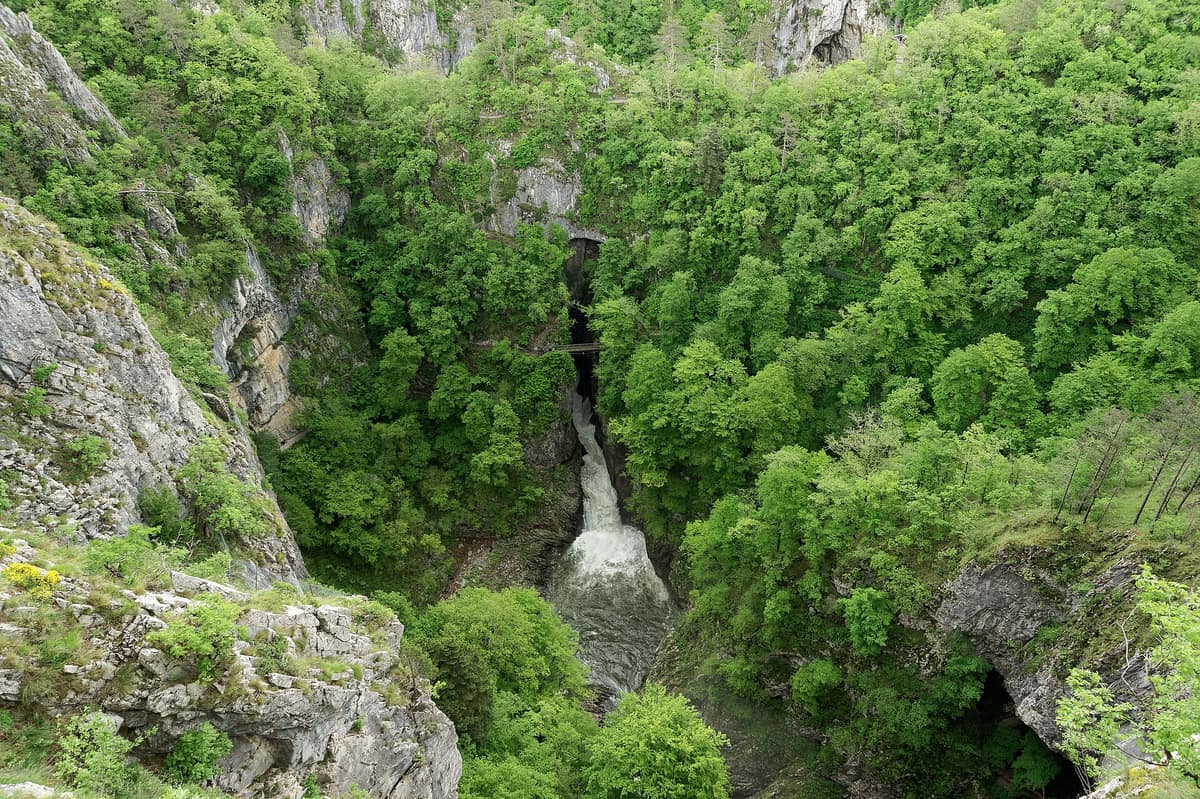
The Reka River vanishes underground into a subterranean canyon over a hundred metres high, among the grandest on Earth.
An entire river plunges into the mountain and stays hidden for kilometres. At Škocjan, the Reka enters through a canyon of some four kilometres, strikes a precipitous wall, and vanishes underground at the base of an immense collapse doline. What follows is a subterranean canyon of extraordinary proportions, placing the Škocjan Caves among the most renowned speleological wonders on Earth. Inscribed as a UNESCO World Heritage site in 1986 and designated a Ramsar wetland, the surrounding regional park safeguards them alongside a classic karst landscape that is, in itself, an open-air museum.
What makes it unique
An underground canyon whose river, having traversed vast caverns, disappears towards the sea beneath a sheer wall of rock.
The place
Nature
The landscape
The Reka sculpted everything. Rising beneath the Snežnik plateau, it flows for some fifty-five kilometres across impermeable flysch, gathering water before meeting Cretaceous and Paleocene limestone where it sinks beneath the surface. From that threshold onward, the river does not merely carve its bed through mechanical erosion; it dissolves the soluble rock. Before disappearing, it cuts through a gorge of about four kilometres terminating at a sheer cliff face: the largest blind valley in Slovenia.
Catastrophic collapse of the cave ceiling left two gaping sinkholes: Velika dolina, plunging to a depth of 165 m, and Mala dolina at 120 m, separated by a natural bridge representing a remnant of the original cavern roof. The cave entrances open here. Underground, the canyon continues through Hanke's Channel and opens into immense chambers, notably Martel's Chamber, boasting 2.2 million m³. The bottle-neck lies at the exit: a canyon of such massive proportions terminates in a narrow siphon, unable to absorb extreme spates after heavy rainfall. The Reka surges inside the cave, typically rising by up to 30 metres; the highest flood ever recorded reached a staggering 132 metres.
The microclimate within the collapse dolines forms an extraordinary ecological refuge. Alpine species such as bear's ear (Primula auricula) grow side by side with Mediterranean elements like maidenhair fern (Adiantum capillus-veneris), a co-occurrence of exceptional biogeographical rarity. Glacial relicts thrive at the bottom, directly above the Reka's ponor; some 40 metres higher, around the roof of the Schmidl Cave entrance, warmth-loving relicts such as wild asparagus and prickly juniper find purchase.
Wildlife and seasons
Above ground, the first creatures you notice are wild rock doves circling in flocks and roosting beneath entrance arches, while an alpine swift colony nests in rock fissures. The sheer crags offer nesting ledges for the Eurasian eagle-owl and peregrine falcon, while in winter the overhanging cliffs welcome the wallcreeper, an alpine bird searching crevices for spiders and tiny invertebrates. Fat dormice inhabit the caves and surrounding canopy, while red fox and badger roam the slopes of the Reka gorge.
Subterranean ecology obeys entirely different rules: lacking seasonal variation, temperature remains constant and terrestrial cave animals are minute, rarely exceeding one centimetre. In the subterranean waters, the uncontested sovereign is the olm, an aquatic giant among cave fauna growing beyond 20 centimetres in length. It was scientifically described in 1758, followed by the blind cave beetle Leptodirus hochenwartii in 1832, making these the very first troglobites recognized by modern science. Among bats, the most abundant is Schreiber's bent-winged bat, whose roosting colonies migrate between Škocjan and Predjama.
Species
With a page in the atlas
Being mentioned in a source doesn't guarantee sightings: check with the people who manage the area.
Memory and protection
History and conservation
Human veneration of the chasm spans millennia. In the abyss of Mušja jama, sacrificial rites honouring chthonic deities took place during the Late Bronze Age: excavations unearthed deliberately broken weapons and charred animal bones. Archaeological evidence shows pilgrims journeyed to this sacred sanctuary across hundreds of kilometres, travelling from northern Italy, the Alps, Pannonia, the Balkans, and even Greece. Skeletna Cave yielded an early Venetic inscription, the oldest written text ever discovered within Slovenia.
In 1689, Johann Weikhard von Valvasor published the first detailed description of the Reka's ponor and subterranean course; systematic exploration began with an organized expedition in 1884, while the visitor registry book opened on 1 January 1819. Local inhabitants from Škocjan and Matavun chiselled almost 12,000 metres of paths into the living rock of the caves, twice the length of the natural cave system. The scientific terms 'karst' and 'doline' were born right here.
The caves are the only natural monument in Slovenia and the Classical Karst inscribed on the UNESCO World Heritage list. The regional park was established by law in 1996, and the caves were designated a Ramsar wetland on 18 May 1999 on account of their specialized, often endemic subterranean fauna.
Before you set off
Visiting
How to visit
Guided tours depart from the visitor reception centre, with rangers leading groups on foot to Globočak doline where the tour enters. An artificial tunnel leads into Tiha jama (Silent Cave), a dry fossil gallery rich in dripstone formations; its Velika dvorana holds the colossal stalagmite known as Orjak (the Giant). From there, the path enters Šumeča jama (Murmuring Cave), where the roar of the Reka fills one of the largest subterranean river canyons in Europe, crossed via the daring Cerkvenik Bridge. Re-emerging into daylight, you continue independently around Velika dolina. The full guided route covers 5 km with roughly a thousand steps; the shorter exit at Velika dolina spans 3 km with between 500 and 800 steps. From January to April and from October to December the tour finishes via Velika dolina. Inside the cave, photography and domestic pets are strictly prohibited.
Above ground, an educational trail encircles both dolines over approximately two kilometres, taking under an hour while offering panoramic vistas of the cliffs, sinkholes, and the vanishing Reka. It begins and ends at the Matavun Information Centre, where tickets are issued. The ethnographic collections at Delez homestead cover the geology and biodiversity of the Classical Karst and are open only during peak season from June to September.
Arriving by rail, a waymarked walking path of some 4 kilometres leads from Divača railway station in approximately 50 minutes.
Before you go
Visits inside the caves are conducted exclusively on guided tours with set departure times; check schedules and advance availability beforehand. The caves are closed on 1 January and 25 December. Wear comfortable footwear and warm clothing, and bring a hat, drinking water, and an umbrella in case of rain, as part of the trail traverses the surface.
Check access, rules and visiting conditions in the official information from the managing body before you set off.
Location
Where it is and how far it reaches
Boundary of Regijski park Škocjanske jame · © EEA, CDDA (CC-BY) The coordinate is estimated; it isn't a verified access point.
Transparency
Sources
The research data with its sources, and the official links for this place, are in the Spanish version of this page. See the Spanish version
Around it
Immediately adjacent to Škocjan, at 0 km, lie the Postojna and Classical Karst Caves (Postojna-Planina Cave System). Approximately 12 km away rises the Nanos Karst Plateau; at sixteen kilometres, the Javorniki Forests and Karst Plateau; at nineteen, the Snežnik Forest Massif, birthplace of the Reka; at twenty-seven, Lake Cerknica; and at twenty-eight, the Trnovo Forest Plateau.
Further afield, Prosiecka and Kvačianska Karst Valleys share with Škocjan karst geomorphology, canyons, river corridors, and the greater mouse-eared bat.
What else to explore nearby
Approximate straight-line distance between the edges of each area. It doesn't indicate access, routes or driving times.
- Javorniki Forests and Karst Plateau
Inner Carniola (Postojna / Cerknica)
About 16 km away
Forested karst plateau without continuous human settlements adjoining the intermittent lake of Cerknica.
JFMAMJJASONDMay – October · Crowding very low
- Lake Cerknica
Inner Carniola (Cerknica)
About 27 km away
Europe's largest intermittent lake, which fills and empties completely through underground karst sinkholes.
JFMAMJJASONDApril – June · September – October · Crowding low
If you like this place, elsewhere in Europe
Distant places with uncommon wildlife and habitats in common. The most widespread species don't count. Sharing species doesn't imply a corridor or guaranteed presence.
- Vârghiș Gorge
Harghita and Covasna Counties (Baraolt / Vârghiș)
In common: Miniopterus schreibersii · Greater mouse-eared bat — karst and caves, gorge and canyon
Limestone gorge reserve with over 120 caves of major chiropterological importance (Peștera Merești).
JFMAMJJASONDMay – October · Crowding low
- Bükk National Park
Heves / Borsod-Abaúj-Zemplén (Eger / Miskolc / Szilvásvárad)
In common: Miniopterus schreibersii · Eurasian eagle-owl — karst and caves
Hungary's most extensive karst plateau, clothed in beech forests, featuring prehistoric caves and imperial eagles soaring along its cliff edges.
JFMAMJJASONDApril – June · September – October · Crowding low
Entry #1052 of the original atlas.