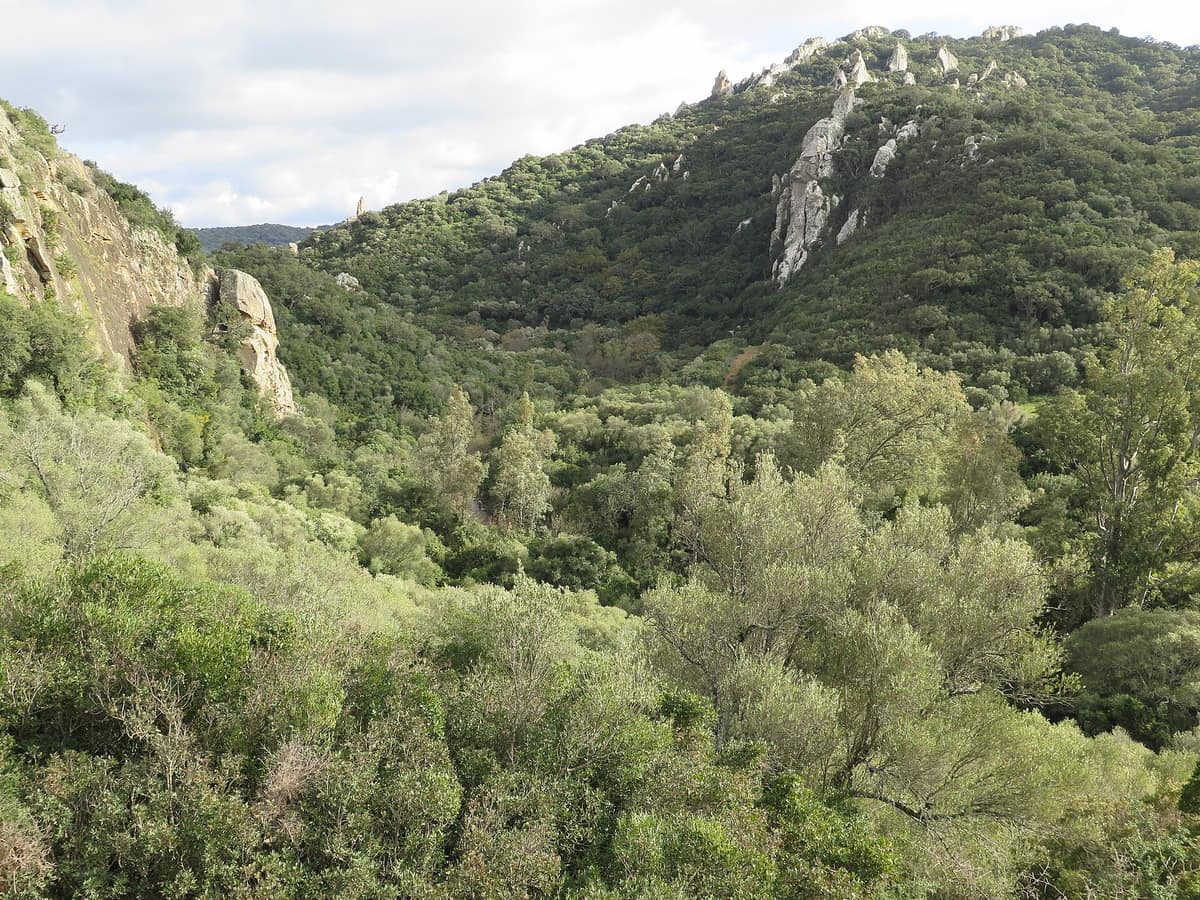
Los Alcornocales Natural Park
Parque Natural Los Alcornocales
Andalusia (Cádiz / Málaga / Alcalá de los Gazules / Jimena de la Frontera) · Spain
Photo: Jesús Pinilla · CC BY-SA 4.0 · Wikimedia Commons
The largest continuous cork oak forest on the Iberian Peninsula (170,000 ha) and humid ravines (canutos) preserving relict Tertiary laurel forest flora.
There is a hidden valley in southern Europe where you walk among laurels, rhododendrons and giant ferns as if geography had slipped into the subtropics. This is no greenhouse: it is a canuto, a deep sandstone gorge in Los Alcornocales Natural Park, spanning the province of Cádiz and northern Málaga. Here, maritime moisture sweeping off the Atlantic condenses into persistent fog, sheltering a relict laurel forest dating from the Tertiary Period. Surrounding these gorges, majestic cork oak woodlands stretch across the mountains as the largest and best-preserved cork forest on the Iberian Peninsula.
What makes it unique
A short distance from the Strait of Gibraltar, mainland Europe’s grandest cork oak woodland shelters a Tertiary rainforest valley found nowhere else on the continent.
The place
Nature
The landscape
Over 90 % of the park rests upon the Aljibe Sandstone Formation: marine sands and clays creating rugged ridges and sheer slopes culminating at Pico del Aljibe (1092 m). This acidic, nutrient-poor sandstone is key, fostering dense cork oak forests alongside Portuguese and Algerian oaks in moisture-rich swales.
Abundant rainfall shapes the environment. Atlantic weather fronts sweep eastward across the sierra from autumn through spring, delivering annual precipitation surpassing 800 litres per square metre and exceeding 1400 litres in summit basins. In southern ranges, summer sea mists known as barbas del levante condense along ridges during the dry season, earning the park its title as Europe's last Mediterranean rainforest.
Moisture concentrates within the steep canutos. In these narrow canyon bottoms, evergreen laurophyllous foliage captures filtered sunlight beneath the canopy: bay laurel, pontic rhododendron (ojaranzo), alder buckthorn, viburnum, alder and holly thrive alongside rare flowering shrubs. It is a subtropical gallery forest unique in continental Europe.
Climbing higher, the landscape transforms. Windswept rocky crests support nutrient-poor soils rich in aluminum, dominated by low ericaceous heathland known locally as herriza. Mid-slopes feature classic Mediterranean scrub of cistus, tree heather and lavender.
Wildlife and seasons
Occupying the southernmost tip of continental Europe, the park forms a crucial bottleneck for millions of migratory birds travelling between Europe and Africa. Autumn and spring bring vast thermals of gliding migrants: white and black storks, black kites, honey buzzards, booted eagles, short-toed snake eagles, griffon vultures and Egyptian vultures resting before the sea crossing.
Resident raptors breed extensively in oak woodlands, including booted eagles, short-toed eagles, common buzzards, goshawks, sparrowhawks and tawny owls. Towering crags host the griffon vulture, Egyptian vulture, Bonelli's eagle, Eurasian eagle-owl and peregrine falcon. Along rushing canuto streams, the white-throated dipper and common kingfisher hunt amongst royal ferns.
Mammals include noteworthy southern specialities. The park harbours Europe’s densest populations of the Egyptian mongoose (meloncillo), alongside common genets, Eurasian otters, European badgers and stone martens. The surrounding sierras preserve the last indigenous herd of the Moorish roe deer, marking the southwestern global limit of the species. Clean headwaters sustain endangered dragonflies and the endemic Alcornocales funnel-web spider.
Species
With a page in the atlas
Being mentioned in a source doesn't guarantee sightings: check with the people who manage the area.
Memory and protection
History and conservation
Los Alcornocales was declared a natural park in 1989. Its fortified white villages flourished under the Nasrid Kingdom of Granada as frontier outposts, retaining their Moorish architectural character. Prehistoric communities settled these mountains millennia earlier, leaving rock art in over fifty sandstone caves. The cave of Tajo de las Figuras is hailed as the prehistoric Sistine Chapel of schematic art; Bacinete preserves over a hundred well-conserved pictographs, and Laja Alta depicts some of the earliest maritime sailing vessels known in the Mediterranean.
Cork extraction remains the economic backbone of the territory. However, oak decline syndrome (la seca) threatens forest health, prompting a comprehensive management plan approved in 2017 to reconcile traditional forestry with conservation. Modern pressures include high-voltage power lines, wind farms, transport corridors, reservoirs and climate shifts.
Before you set off
Visiting
How to visit
Begin at El Aljibe Visitor Centre on the outskirts of Alcalá de los Gazules. Its ethnobotanical garden showcases endemic flora including the rare ojaranzo. An interpretive trail guides visitors through canuto galleries, cork oak groves and cloud forest ecosystems linked to diverse geological beds.
For hiking, the Garganta del Capitán trail leads through ancient cork oaks to Bronze Age rock tombs; the Laguna del Moral path winds through rich bird habitats, and the Río Hozgarganta trail traces polished river rocks past the historic ruins of an eighteenth-century royal artillery foundry. Mountaineers can ascend Pico del Aljibe. Complete your visit exploring historic white hill towns such as Jimena de la Frontera, Alcalá de los Gazules and Castellar de la Frontera.
Before you go
Exercise extreme care with fire hazards; never discard matches, lit objects or smoking materials. Carry all waste out to the nearest municipal container, respect wildlife and local tranquil atmospheres, and heed private property boundaries.
Check access, rules and visiting conditions in the official information from the managing body before you set off.
Location
Where it is and how far it reaches
Boundary of Los Alcornocales · IUCN IV · © EEA, CDDA (CC-BY) The coordinate is estimated; it isn't a verified access point.
Transparency
Sources
The research data with its sources, and the official links for this place, are in the Spanish version of this page. See the Spanish version
Around it
Twenty-nine kilometres away lies Sierra de las Nieves National Park. Further afield, mature Mediterranean woodlands and rare raptors are shared with Cabañeros National Park, Monfragüe National Park and Serra da Malcata Nature Reserve.
What else to explore nearby
Approximate straight-line distance between the edges of each area. It doesn't indicate access, routes or driving times.
- Sierra de las Nieves National Park
Andalusia (Málaga — Ronda / Tolox / Yunquera)
About 29 km away
Spanish fir forests (pinsapares), a relict conifer growing only in these ranges, over deep karst harboring some of the deepest chasms in Spain.
JFMAMJJASONDMarch – May · October – December · Crowding low
If you like this place, elsewhere in Europe
Distant places with uncommon wildlife and habitats in common. The most widespread species don't count. Sharing species doesn't imply a corridor or guaranteed presence.
- Cabañeros National Park
Castilla-La Mancha (Ciudad Real / Toledo / Navas de Estena / Retuerta del Bullaque)
In common: Spanish imperial eagle · Cinereous vulture · Black stork — old-growth forest, river corridor
Open rañas, Mediterranean forested mountain ranges, and riverbanks where you can discover the habitats of the red deer, cinereous vulture, and Spanish imperial eagle.
JFMAMJJASONDApril – May · September – November · Crowding low
- Monfragüe National Park
Extremadura (Cáceres / Villarreal de San Carlos / Torrejón el Rubio)
In common: Spanish imperial eagle · Cinereous vulture · Black stork — old-growth forest, river corridor
The European mecca for raptor watching, holding the largest cinereous vulture (Aegypius monachus) colony in the world and the dramatic Tagus breach at Salto del Gitano.
JFMAMJJASONDMarch – May · October – November · Crowding low
Entry #510 of the original atlas.