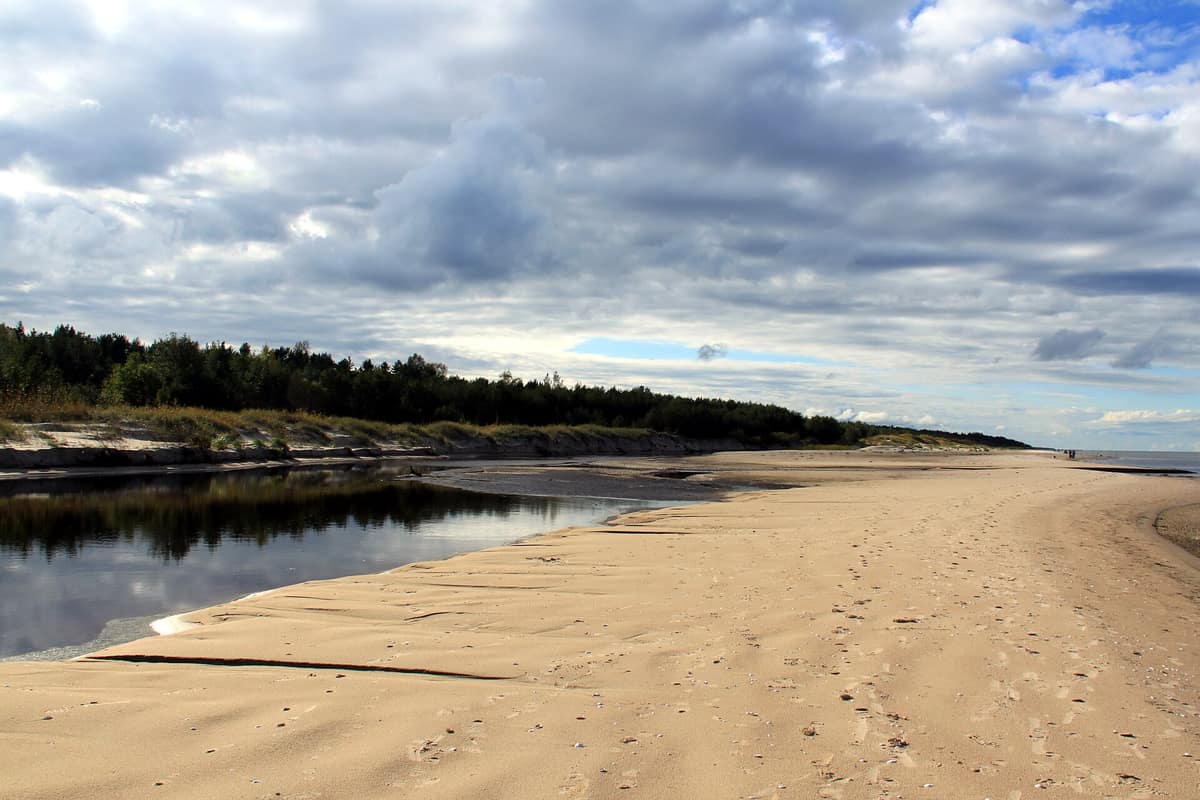
Slītere National Park and Irbe Strait Coast
Slīteres nacionālais parks
Courland / Kurzeme (Dundaga / Cape Kolka) · Latvia
Photo: Sirujs Enobs · CC BY-SA 3.0 · Wikimedia Commons
Cape Kolka where the currents of the Baltic Sea and the Gulf of Riga collide, ancient Livonian wooded dunes (Kangari), and clay coastal bluffs.
At Cape Kolka, the open Baltic and the Gulf of Riga collide, and directly above that clash runs a major avian migratory flyway. On peak migration days, tens of thousands of birds sweep across the cape in a single hour. Inland stretches a forest naturalists term the Northern Rainforest, a maze of ancient dune ridges separated by marshy troughs alongside a scattering of traditional Livonian fishing hamlets. This is Slītere National Park, protecting 16.365 hectares in northwestern Latvia across the parishes of Dundaga and Kolka.
What makes it unique
A complex of ancient dune ridges and swales, the kangari and vigas, whose vast geographic extent is unique in the world.
The place
Nature
The landscape
The Baltic's post-glacial geological past can be read here on foot. The ancient cliffline of the Baltic Ice Lake, rising thirty to fifty meters high, forms the Zilie kalni (Blue Hills). Below lies the unique dune-and-swale complex: kilometer-long ancient dune ridges, known as kangari, alternating with narrow, waterlogged peat troughs called vigas. In the vigas of Lake Pēterezers, a boardwalk trail lets you experience these undulating crests and bog hollows.
At the foot of the ancient bluff, the slope's deciduous woodland has grown untouched by human timber cutting for almost a century. The humid microclimate nurtured by bottomland forests and mires provides sanctuary for an immense variety of plant and animal life, earning it the rainforest moniker. The park hosts all forest types found in Latvia, half the country's plant species, and 60 % of its mosses. Forest blankets roughly 70 % of the park territory, while peat bogs account for 20 %, most prominently the Bažu Mire.
Around Kolka, conservationists actively restore grey dune habitats to protect the meadow pasqueflower and sand pink, which require open, sunny clearings.
Wildlife and seasons
Migration season is the highlight. The park has recorded more than 260 bird species, and spring witnesses a massive migration front; in 2007 and 2008 surveys counted 135 nesting species. Spring passage lasts several weeks, allowing birdwatchers at Kolkasrags to spot almost every species on the Latvian national list. In autumn, the sand spit serves as a refueling stopover for bar-tailed godwits, while winter brings great grey owls wandering from boreal Russia.
In the spring of 2010, the Bažu Mire hosted Europe's largest recorded capercaillie lek, with 66 displaying cocks. At the Šlītere Lighthouse, a permanent exhibition details the flyway crossing Kolka and highlights the broad-billed sandpiper.
Slītere harbors grey wolf, Eurasian lynx, and moose. In the autumn of 2006, a brown bear roamed through the park after an absence of more than 20 years. In winter, Baltic grey seals breed on coastal sea ice. Seven amphibian species occur, including the northern crested newt and natterjack toad, while the smooth snake, on the verge of extirpation in Latvia, maintains one of only two national populations here. Forest streams provide spawning gravels for river lamprey and sea trout. Among rare Latvian invertebrates, the park supports half the nation's beetle species, two-thirds of its molluscs, and one-third of its butterflies.
Species
With a page in the atlas
Being mentioned in a source doesn't guarantee sightings: check with the people who manage the area.
Memory and protection
History and conservation
Livonian communities lived here along the shore for generations, creating historic fishing settlements at Sīkrags, Mazirbe, Košrags, Pitrags, Saunags, Vaide, Kolka, and Uši; Livonian culture remains alive today as an integral part of northern European heritage. Historic pastures at Dāvids, Tamnīte, and Zvejnieki preserve traces of centuries-old coastal grazing.
The core area was initially protected as a natural monument, operating as the Slītere State Nature Reserve until 1999 before being designated a national park in 2000. In the reserve core, fallen timber felled by storms in the sixties was deliberately left untouched, allowing natural forest regeneration across roughly 100 ha; similarly, following a wildfire in 1992 in the Bažu Mire, charred snags were left standing for ecological succession. Slītere belongs to the European Natura 2000 network and the Latvian Important Bird Areas inventory.
Before you set off
Visiting
How to visit
The park offers four established nature trails and several signposted cycling itineraries. The most popular destinations are Kolkasrags and the seacoast, along with the Šlītere Lighthouse complex, which doubles as an observation viewpoint and environmental education hub. For an easy start, the 3 km Kolkasrags circuit loops past sea, sandy beach, and wooded dunes, while the 1,2 km Kolkasrags Pine Trail weaves through white and grey coastal dunes to the shore. Carry warm layers and binoculars in spring and autumn.
The Ēvaži Trail leads to coastal bluffs rising between 8 and 15 meters above the beach. The shoreline is seeped with freshwater runoff from the Bažu Mire, sustaining rare Latvian populations of the natterjack toad. The Pēterezers Nature Trail lets hikers traverse the alternating sequence of dune crests and peat depressions.
Before you go
The Zilie kalni escarpment, its forested ravines, and the base woodlands constitute a strict nature reserve zone. If you plan to hike a specific trail, check in advance with park administration to verify whether it is currently open.
Check access, rules and visiting conditions in the official information from the managing body before you set off.
Location
Where it is and how far it reaches
Boundary of Slīteres Nacionālais parks · IUCN II · © EEA, CDDA (CC-BY) The coordinate is estimated; it isn't a verified access point.
Transparency
Sources
The research data with its sources, and the official links for this place, are in the Spanish version of this page. See the Spanish version
Around it
Sharing coastal marine ecosystems, grey seals, and moose are Kuršių Nerija National Park in Lithuania and Vilsandi National Park in Estonia; sharing moose and Eurasian lynx is Lahemaa National Park.
If you like this place, elsewhere in Europe
Distant places with uncommon wildlife and habitats in common. The most widespread species don't count. Sharing species doesn't imply a corridor or guaranteed presence.
- Vilsandi National Park and Coastal Cliffs of Saaremaa
Saare County (Saaremaa Island / Kihelkonna / Tagamõisa)
In common: Lampetra fluviatilis · Grey seal · Moose — wild coast, wetland
The oldest marine bird sanctuary in the Baltic (1910), encompassing some 160 limestone islets and reefs off Saaremaa.
JFMAMJJASONDMay – October · Crowding very low
- Skuleskogen National Park (High Coast of Sweden)
Västernorrland (Höga Kusten / Örnsköldsvik / Kramfors)
In common: Grey seal · Moose · Eurasian lynx — wild coast, old-growth forest
The heart of Sweden's High Coast (Höga Kusten), the site of the world's greatest post-glacial isostatic rebound (286 m of land uplift after the ice), featuring the Slåttdalssvackan canyon.
JFMAMJJASONDMay – October · Crowding low
- Curonian Spit National Park
Klaipėda (Neringa — Nida / Juodkrantė)
In common: Grey seal · Moose — wild coast, old-growth forest
A sandy spit nearly a hundred kilometres long between the Baltic and the Curonian Lagoon, boasting some of Europe's highest dunes.
JFMAMJJASONDMay – June · September – October · Crowding moderate
Entry #448 of the original atlas.