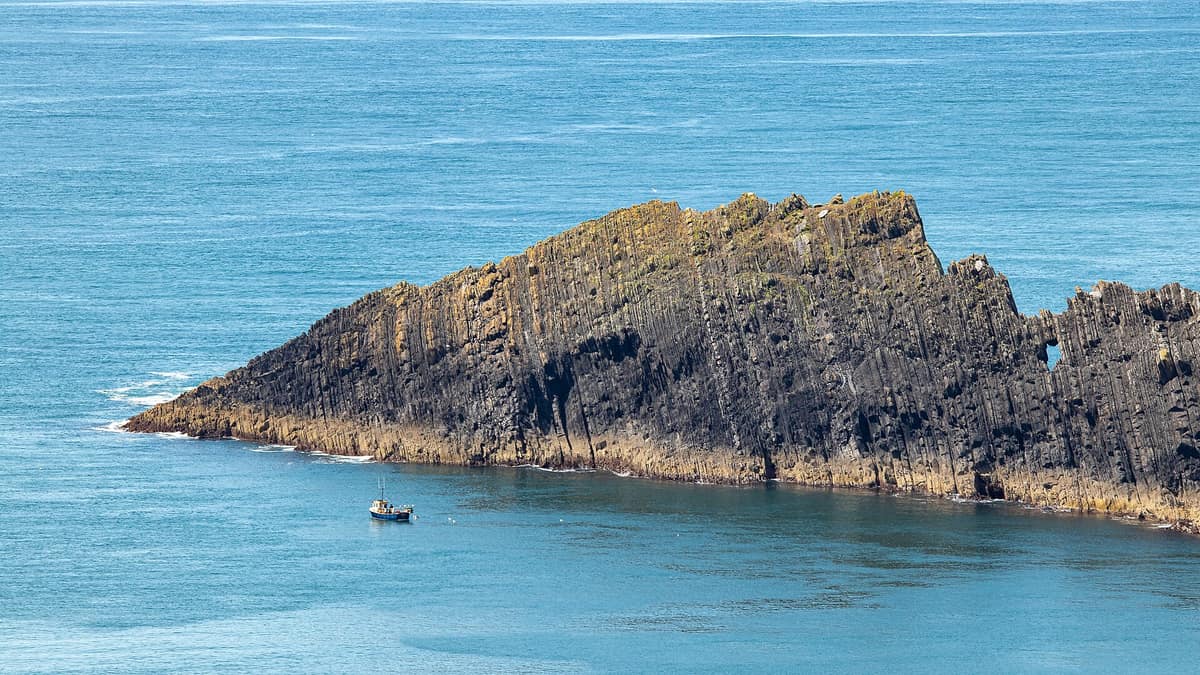
Cape Clear Island
Cape Clear Island / Cléire
County Cork (Southernmost point / Wild Atlantic Way) · Ireland
Photo: Superbass · CC BY-SA 4.0 · Wikimedia Commons
Ireland's southernmost inhabited Atlantic island, home to a legendary bird observatory tracking pelagic migration, cetaceans, and basking sharks.
A Eurasian blue tit crossed the Irish Sea, and we know this because someone had ringed it nine days earlier in Wales. That remains the only recorded live crossing of its kind, and it concluded here on Cape Clear. That singular feat captures the essence of this outpost: a sentinel station at the southern extremity of Ireland, receiving wind-drifted migrants and rare vagrants far displaced from normal flyways. Oileán Chléire, its official Irish name, is the southernmost inhabited territory in Ireland, lying off the southwest coast of County Cork; since 1959 it has hosted an acclaimed bird observatory at North Harbour.
What makes it unique
An island bird observatory that has been ringing birds continuously since 1959 at Ireland's southernmost inhabited outpost, where vagrants from North America and Siberia regularly appear.
The place
Nature
The landscape
The island is neatly partitioned into eastern and western halves by a narrow sandy isthmus locally termed the Waist. On the sheltered landward side lies North Harbour; on the open oceanic side opens South Harbour. Its highest elevation, Cnoicín an tSeabhaic, ascends to 160 m. Some 6.5 km to the southwest looms the isolated Fastnet Rock lighthouse, Ireland's southern sentinel.
Despite its compact scale, ancient heritage marks the terrain: a prehistoric cup-marked boulder, a Bronze Age fulacht fiadh cooking trough, a Neolithic passage tomb, standing stones, an Iron Age promontory fort at Dún an Óir, and a Napoleonic signal tower. Adjacent to the main North Harbour pier stand the ruins of a twelfth-century church, a protected national monument. The island is an official Gaeltacht enclave where the Irish language is spoken daily.
Wildlife and seasons
According to BirdWatch Ireland, Cape Clear ranks among the preeminent seawatching locations in Europe, especially during late summer. This is prime time to scan offshore waters. Breeding and pelagic species include the common murre, European storm petrel, and cormorants, while grey seals, basking sharks, and common dolphins regularly patrol the bays. On dry land, thrift and honeysuckle cascade over stone walls.
Spring and autumn usher in weary songbirds pausing on their journeys between breeding grounds and winter quarters, frequently mingled with transatlantic or Siberian vagrants. Autumn migrants such as willow warblers, common whitethroats, sedge warblers, common chiffchaffs, and northern wheatears make landfall en route to tropical Africa. September reliably brings Eurasian wrynecks, European pied flycatchers, common redstarts, wood warblers, and Eurasian reed warblers. Constant ringing uncovers extraordinary ornithological records: 125 coal tits ringed in autumn 2008 where only 91 had been banded previously; a red-eyed vireo trapped in September 2004 representing the earliest autumn record for Europe; alongside thrush nightingales and little buntings.
Species
With a page in the atlas
Being mentioned in a source doesn't guarantee sightings: check with the people who manage the area.
Memory and protection
History and conservation
Systematic bird ringing has been carried out on Cape Clear since 1959. Because overall numbers of grounded passerines are relatively modest, ringing over one hundred birds in a single day is exceptional, limiting recovery rates of banded individuals. Ring recoveries were the foundational justification for early ringing schemes to unravel migration routes. Today, monitoring resident and breeding populations holds equal value: annual totals reveal population fluctuations compared against national trends. The observatory ringing list stood at 128 species by late 2016.
Before you set off
Visiting
How to visit
Access is by passenger ferry departing from Baltimore or Schull. At Baltimore, public parking is located beside the ferry pier, though spaces often fill on sunny days, so allow extra time.
The observatory stands right beside North Harbour with straightforward access to island amenities and easy walking routes to renowned seawatching headlands. BirdWatch Ireland hosts guided wildlife weekends led by the observatory warden alongside the popular «Seabirds to Songbirds» course, introducing pelagic observation techniques and migration ecology.
Before you go
The island is reachable exclusively by ferry: check sailing schedules and weather forecasts before confirming travel arrangements.
Check access, rules and visiting conditions in the official information from the managing body before you set off.
Location
Where it is and how far it reaches
Boundary of Cléire · © OpenStreetMap contributors (ODbL) The coordinate is estimated; it isn't a verified access point.
Transparency
Sources
The research data with its sources, and the official links for this place, are in the Spanish version of this page. See the Spanish version
Around it
Cape Clear shares marine and coastal biotas with several atlas sites. With Great Blasket it shares the harbour porpoise; with Park prirode Lastovsko otočje and Islas Selvajes, the short-beaked common dolphin; and with Nationalpark Schleswig-Holsteinisches Wattenmeer, the harbour porpoise.
If you like this place, elsewhere in Europe
Distant places with uncommon wildlife and habitats in common. The most widespread species don't count. Sharing species doesn't imply a corridor or guaranteed presence.
- Lastovo Archipelago Nature Park
Dubrovnik-Neretva (Lastovo Island)
In common: Short-beaked common dolphin · Yelkouan shearwater — wild coast, marine
One of Croatia's most remote inhabited islands and dozens of islets, with pristine night skies and largely undisturbed seabed ecosystems.
JFMAMJJASONDMay – June · September – October · Crowding very low
- Great Blasket Island / An Blascaod Mór
Ireland (County Kerry / Dingle Peninsula / Dunquin)
In common: Common porpoise — wild coast, marine
The largest of the Blasket archipelago islands (evacuated in 1953), famed for rich Gaelic literature, wild sea cliffs, and beaches with hundreds of grey seals.
JFMAMJJASONDMay – September · Crowding low
- Selvagens Islands Nature Reserve
Autonomous Region of Madeira (Selvagem Grande / Selvagem Pequena)
In common: Short-beaked common dolphin — wild coast, marine
Portugal's southernmost territory and one of Europe's oldest strict marine reserves (1971), harbouring the world's densest colony of Cory's shearwater (Calonectris diomedea).
JFMAMJJASONDMay – September · Crowding none
- Schleswig-Holstein Wadden Sea National Park
Schleswig-Holstein (Sylt / Halligen / Husum / Tönning)
In common: Common porpoise — wild coast, marine
Central Europe's largest national park: intertidal mudflats, dyked islets (Halligen) and millions of migratory waders on passage.
JFMAMJJASONDApril – May · August – October · Crowding moderate
Entry #626 of the original atlas.