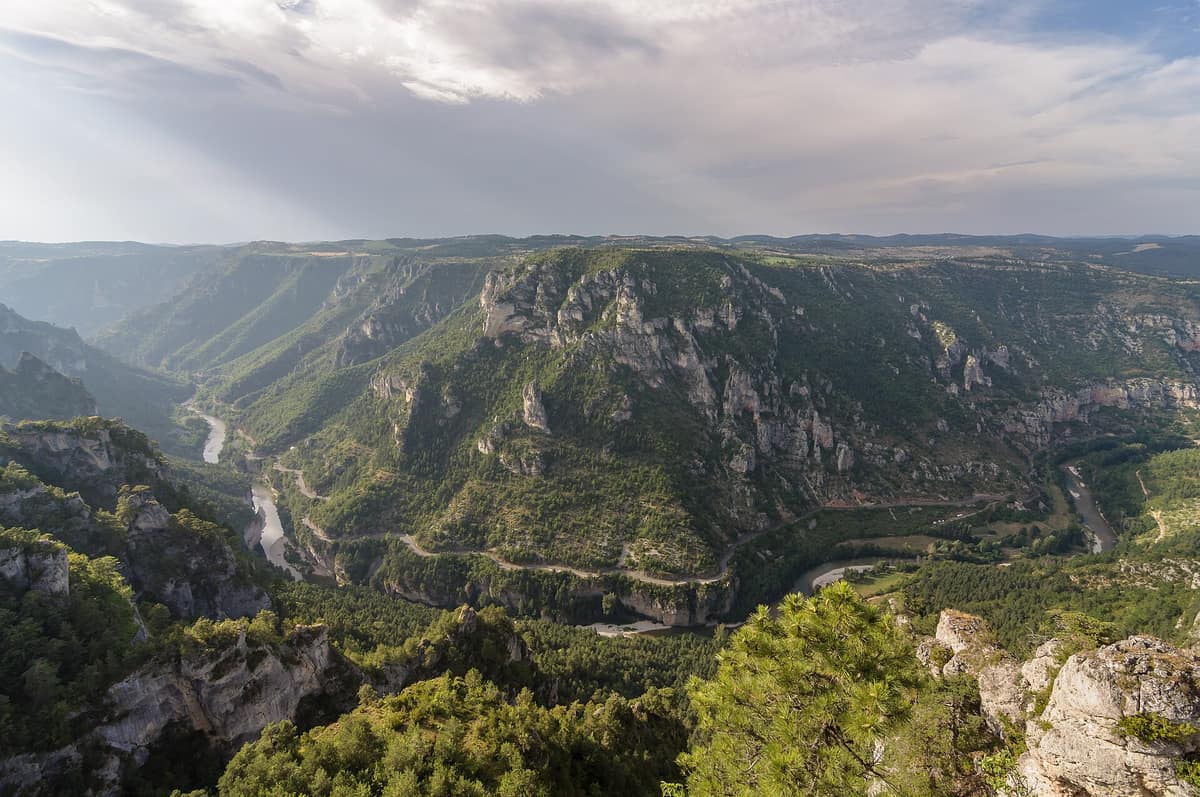
Tarn Gorges
Gorges du Tarn
Occitania (Lozère / Aveyron) · France
Photo: Myrabella · CC BY-SA 3.0 · Wikimedia Commons
Spectacular limestone canyon 500 m deep carved by the Tarn between the karstic plateaus of the Causses.
A river with no surface tributaries for 52 kilometres that nonetheless swells with every bend. Between Quézac and Le Rozier, the Tarn receives subterranean surges from some 170 karstic resurgences, having carved out over 53 km an imposing gorge 400 to 600 m deep between the vast limestone plateaus of the Grands Causses. These are the Gorges du Tarn: a sheer vertical rift with dolomite cliffs, vultures circling high overhead, a surprisingly Mediterranean microclimate along the valley floor, and a continuous trail threading from Florac to Le Rozier.
What makes it unique
It is a canyon where water wells up from deep within the mountain, the sky belongs to vultures, and beech forests thrive in a near-Mediterranean climate.
The place
Nature
The landscape
To grasp the origin of the gorges, one must look back to the Miocene, when the tectonic uplift of the Alpine orogeny hoisted the Massif Central, elevating the Causses to an average altitude of 800 m in the north and 1000 m in the south. Relentless fluvial erosion subsequently incised the valleys. The canyons of the Tarn, Jonte, Dourbie, and Vis slice through these sprawling, steppe-like limestone tablelands. Between Les Vignes and Le Rozier the geological architecture is stark: Mesozoic limestones capped by precipitous dolomite palisades.
Water carves the canyon from within. Around forty resurgences have been inventoried along the Tarn; the spring at Cénaret feeds a small subterranean lake 30 m across and eight metres deep inside the cave of the same name. Fault zones near Sainte-Énimie produce two powerful springs—the Fontaine de Burle and Coussac, which cascades straight into the Tarn. At the Fontaine de Salce, iron oxide stains the water deep red along the boundary between schist and limestone. At Pas de Soucy, a colossal rock collapse has choked the chasm, forcing the Tarn entirely underground before it emerges downstream.
Volcanic vestiges also endure: a twin basalt neck in Sauveterre, crowned by the village itself, and basalt intrusions at Eglazines within the gorge.
The canyon climate is far milder than that of the surrounding windswept highlands, bathed in intense sunlight. Emerging from Capluc, southern-facing terraces sheltered by cliffs nurture the northernmost Mediterranean vegetation in the region: narrow-leaved ash, wild jasmine, Montpellier maple, and holm oak. Along the riverbanks grow beeches, occupying an unusual niche in this warm microclimate because the Tarn waters their roots continuously. High up the crags, in nearly inaccessible breaches, cling relic groves of Salzmann pine.
Wildlife and seasons
Cast your gaze skyward. Soaring on thermals are the Egyptian vulture, which recolonized naturally after a prolonged absence, the reintroduced griffon vulture, and the cinereous vulture. Griffon vulture reintroduction began in 1982 in these gorges, followed by cinereous vultures (1992) and the bearded vulture (2012), while only the Egyptian vulture returned unassisted in 1986. Sharing these skies are the black kite, osprey, short-toed snake eagle, peregrine falcon, and golden eagle.
The seasons dictate wildlife activity. During the colder months, the wallcreeper and alpine accentor overwinter on the vertical rock faces; as days lengthen, the white-throated dipper bobs vigorously along mountain currents. In the river itself, the Eurasian beaver, reintroduced along the Tarn, maintains a rapidly growing population, active primarily at night, dawn, and dusk. River currents also support brown trout, gudgeon, and Mediterranean barbel.
The cliffs and riparian habitats nurture numerous Causses endemics, such as Pinguicula caussensis on dripping limestone walls, Arenaria hispida, Aquilegia viscosa, and Armeria girardii. The gorges are exceptionally rich in wild orchids: green-winged orchid, military orchid, monkey orchid, lady orchid, and the endemic Ophrys aymoninii. Underground caverns shelter scarce bats including greater mouse-eared bats and horseshoe bats, while the Castelbouc cave harbors two endemic aquatic snails: Bythinella bouloti and Bythinella galerae.
Species
With a page in the atlas
Being mentioned in a source doesn't guarantee sightings: check with the people who manage the area.
Memory and protection
History and conservation
The Causses and Cévennes were collectively inscribed in 2011 on the UNESCO World Heritage list as an outstanding agro-pastoral cultural landscape. The highland plains of the Causses have been shaped by three millennia of grazing traditions, and from the ninth century monastic orders managed sheep rearing and seasonal transhumance, their abbeys eventually controlling extensive summer rangelands across Causse Noir and Causse Méjean.
A practical architectural landmark: the bridge at Sainte-Énimie, replacing an ancient river ford, was erected in the thirteenth century. It remains the sole bridge across the Tarn gorges accessing Causse Méjean that accommodates buses and trucks exceeding 19 tonnes.
Before you set off
Visiting
How to visit
The gorges can be experienced on foot and, along several reaches, by canoe or kayak. The long-distance foot trail traverses the entire canyon from Florac to Le Rozier across five walking stages: it totals 66,9 km and is rated moderate. Several sections are ideally suited to canoeing. The stage between Les Vignes and Le Rozier spans 12 km with 435 m of ascent, passing beneath crags where raptors nest; on its final approach, the trail reaches Le Rozier along an easier gradient after passing above La Sablière.
For an accessible initial excursion, the Birds of the Causses and Gorges interpretive trail is an easy loop of 2,8 km taking about an hour and a half, with 91 m of ascent and 92 m of descent: it offers wonderful birdwatching amid the rim scrub of Causse Méjean above the Tarn. For a longer challenge, the Corniches du Méjean circuit from Le Rozier spans 11,5 km, taking around four and a half hours with 954 m of positive elevation gain and breathtaking vantage points over soaring vultures. It takes in the Balcon du Vertige, Pas du Loup, Vase de Chine, and Vase de Sèvres; the Balcon du Vertige overhangs the Jonte canyon by nearly 400 m, with the Belvédère des vautours below, open to visitors since 1998. It is not recommended for those prone to vertigo; be sure to close all livestock gates.
The Causse Méjean cliff line between Le Rozier and Les Vignes features sculpted dolomite towers and natural arches, including the Baousso del Biel, a 40 m stone arch. The Point Sublime is the premier panoramic lookout over the canyon, named after its Colorado counterpart. Les Détroits form the narrowest gorge section: the canyon here plunges 500 m deep while barely 1200 m separate the opposing rim edges; it can be explored by boat or canoe.
For practical guidance, the Maison du tourisme et du Parc national in Florac provides interactive exhibits and park regulations, open year-round. Near Le Rozier, the Maison des vautours offers direct spotting scopes and chronicles the reintroduction programme led since 1980 by Cévennes National Park.
Before you go
During spring and autumn spates, park officials urge visitors to monitor the flow conditions of the Tarn and adapt equipment accordingly. Visitation peaks heavily in Sainte-Enimie throughout July and August, while remaining peaceful in spring and autumn; the recommended hiking season runs from May to October.
Check access, rules and visiting conditions in the official information from the managing body before you set off.
Location
Where it is and how far it reaches
Boundary of Gorges Du Tarn Et De La Jonte · © EEA, CDDA (CC-BY) The coordinate is estimated; it isn't a verified access point.
Transparency
Sources
The research data with its sources, and the official links for this place, are in the Spanish version of this page. See the Spanish version
Around it
Cévennes National Park lies directly adjacent to the gorges, and the Jonte Gorges are an integral part of the same canyon system.
Further afield, Verdon Regional Natural Park - Grand Canyon shares red-billed choughs and breeding vultures, while Monfragüe National Park and Els Ports Natural Park share cinereous and griffon vultures.
What else to explore nearby
Approximate straight-line distance between the edges of each area. It doesn't indicate access, routes or driving times.
- Cévennes National Park
Occitania (Lozère / Gard — Florac / Mont Lozère / Mont Aigoual)
Borders this area
Limestone plateaus (causses), granite uplands and chestnut valleys with reintroduced vultures: a pastoral landscape protected as an inhabited national park.
JFMAMJJASONDMay – June · September – October · Crowding low
If you like this place, elsewhere in Europe
Distant places with uncommon wildlife and habitats in common. The most widespread species don't count. Sharing species doesn't imply a corridor or guaranteed presence.
- Verdon Regional Natural Park - Grand Canyon
Alpes-de-Haute-Provence / Var (Castellane / Moustiers-Sainte-Marie)
In common: Red-billed chough · Cinereous vulture · Griffon vulture — gorge and canyon, karst and caves, river corridor
The 'Grand Canyon of Europe', sheer limestone cliffs plunging 700 m carved out by the turquoise waters of the Verdon River.
JFMAMJJASONDApril – June · September – October · Crowding moderate
- Monfragüe National Park
Extremadura (Cáceres / Villarreal de San Carlos / Torrejón el Rubio)
In common: Cinereous vulture · Griffon vulture — gorge and canyon, river corridor
The European mecca for raptor watching, holding the largest cinereous vulture (Aegypius monachus) colony in the world and the dramatic Tagus breach at Salto del Gitano.
JFMAMJJASONDMarch – May · October – November · Crowding low
- Els Ports Natural Park
Catalonia / Aragon / Valencian Community (Tarragona / Teruel / Castellón / Roquetes / Tortosa)
In common: Cinereous vulture · Griffon vulture — gorge and canyon, karst and caves
A rugged karst massif between Catalonia, Aragon, and the Valencian Community featuring limestone cliffs, southern beech groves, and the Iberian ibex.
JFMAMJJASONDApril – June · September – November · Crowding low
Entry #238 of the original atlas.