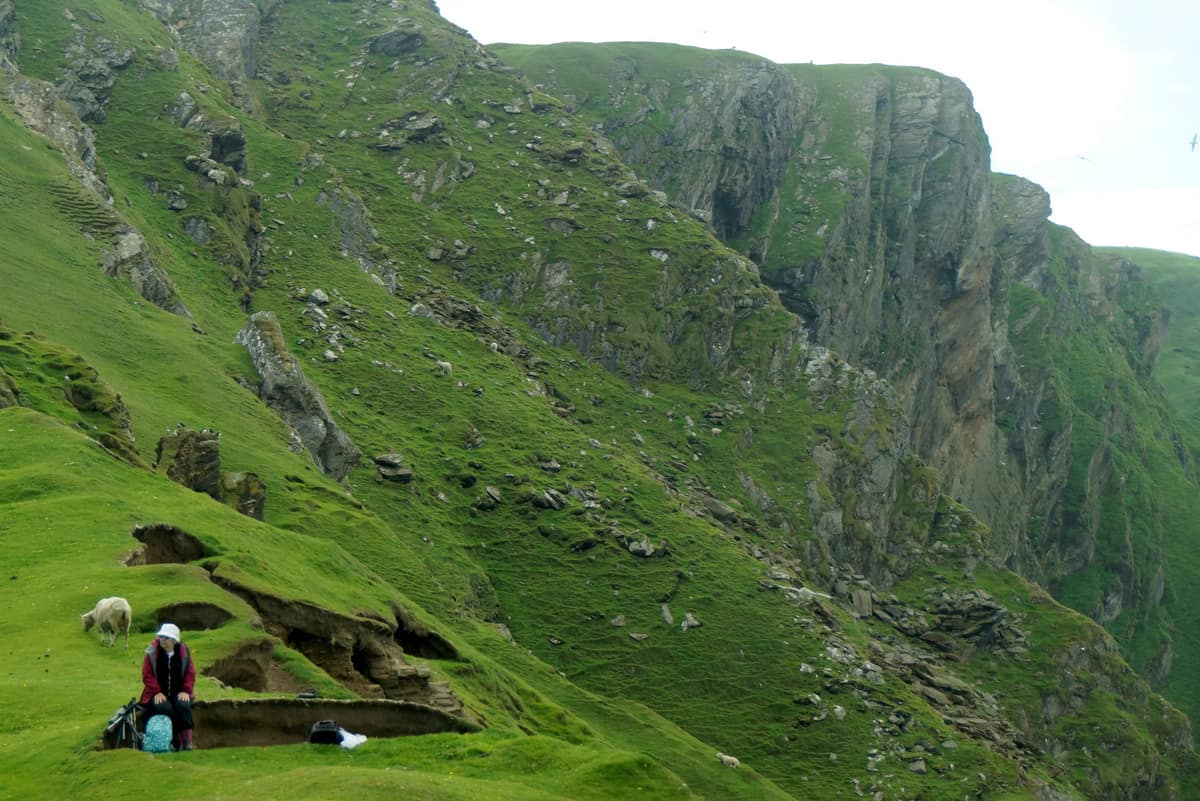
Hermaness National Nature Reserve
Scotland (Shetland Islands / Isle of Unst) · United Kingdom
Photo: Mike Pennington · CC BY-SA 2.0 · Wikimedia Commons
The northernmost headland of the United Kingdom (facing the Muckle Flugga lighthouse), hosting the world's third largest great skua colony.
North of Hermaness, only barren skerries remain. This is the northern tip of Unst, Shetland's northernmost inhabited isle: soaring sea cliffs to the west, an expanse of rolling moorland in the centre, and offshore, the rocky stacks of Muckle Flugga and Out Stack crowned by the lighthouse. Across some 965 hectares thrive more than 100,000 pairs of seabirds across 15 species, accessible via a timber boardwalk traversing the blanket bog all the way to the ocean edge.
What makes it unique
In May, spring squill blankets the coastal maritime grassland in vivid blue, while just paces away northern gannets cling to precipitous sea stacks.
The place
Nature
The landscape
Hermaness is cliffs and blanket bog, and virtually everything else flows from that pairing. The reserve encompasses the entire peninsula along with the offshore islets of Muckle Flugga and Out Stack. In the centre, the moor shelters extensive peatlands; in summer the heath becomes a rich tapestry of heather, crowberry, bog bilberry, and mosses, while coastal grasslands fill with spring squill and sea pink. The wooden boardwalk serves a vital purpose: it shields fragile peat moss from erosion and avoids disturbing ground-nesting birds.
Muckle Flugga is a jagged rocky islet off Unst, often described as the northernmost point of the British Isles, though Out Stack reef lies further north. Its lighthouse was automated in 1995 when the last keepers departed.
Local lore explains the landscape differently: two giants, Herman and Saxa, hurled boulders at each other over a mermaid, forging the rugged sea stacks guarding the headland.
Wildlife and seasons
Hermaness reveals itself in layers. Up on the moorland, nearly 1,000 great skuas, Shetland's fierce bonxies, defend their territory, while 3 to 9 pairs of red-throated divers breed on peat pools. The interior peatland also provides breeding habitat for waders such as golden plover, dunlin, and snipe.
Down on the cliffs, the spectacle shifts. Northern gannets nest crowded on narrow ledges and stacks: in 2018 there were around 26,000 breeding pairs. Between 20,000 and 30,000 pairs of puffins burrow into turf slopes. Observers recorded some 3,700 pairs of common murres and 416 pairs of black-legged kittiwakes in 2015, while European shags colonise boulder-strewn beaches on the west shore.
Spring welcomes northern fulmars, gulls, shags, gannets, puffins, and kittiwakes. The peak window for breeding birds extends from mid-May to mid-July. By late summer, haul-outs of grey seals appear along rocky shores. In the offshore waves, harbour porpoises, minke whales, and killer whales are regularly spotted, alongside occasional otters hunting the shoreline.
Between 1972 and 1995, except for 1988 and 1989, Hermaness hosted an extraordinary vagrant: a black-browed albatross, exceptionally rare in the northern hemisphere, nicknamed Albert.
Species
With a page in the atlas
Being mentioned in a source doesn't guarantee sightings: check with the people who manage the area.
Memory and protection
History and conservation
Conservation began in 1831, when landowner Lawrence Edmondston stepped in to guard great skua nests against egg collectors after numbers collapsed to just 3 pairs. In 1891 his family employed a dedicated watcher, sparking a remarkable recovery for the bonxies; in 1906 the RSPB took over protection. The reserve was formally declared in 1955. Systematic seabird censuses have taken place since the eighties, with a comprehensive all-reserve count conducted every six years.
The land remains privately held, primarily by the Buness Estate, and is managed by NatureScot. Hermaness is also designated a SSSI and forms part of the Hermaness, Saxa Vord and Valla Field SPA, as well as the Shetland National Scenic Area.
Before you set off
Visiting
How to visit
There are two principal hiking routes. The Saito Trail covers seven kilometres to the western clifftops overlooking the gannetry; returning takes around three hours. The Muckle Flugga Trail is a 7.7 km circular loop across heathland, cliff edges, and Hermaness Hill. Walking the complete circuit through the reserve requires between three and four hours.
Keep dogs on a short leash, stick to marked paths, and maintain a safe distance from cliff edges.
Before you go
This is an exposed maritime environment of precipitous cliffs and fragile peat bog. Stay on the boardwalk and designated trails, never approach cliff edges, and consult NatureScot for path updates before setting out.
Check access, rules and visiting conditions in the official information from the managing body before you set off.
Location
Where it is and how far it reaches
Boundary of Hermaness National Nature Reserve · © OpenStreetMap contributors (ODbL) The coordinate is estimated; it isn't a verified access point.
Transparency
Sources
The research data with its sources, and the official links for this place, are in the Spanish version of this page. See the Spanish version
Around it
Hermaness shares great skua and puffin colonies with Handa Island Nature Reserve and with Fair Isle. It is linked by northern gannets and puffins to Mykines Island (Faroe Islands) and Sept-Îles Nature Reserve.
If you like this place, elsewhere in Europe
Distant places with uncommon wildlife and habitats in common. The most widespread species don't count. Sharing species doesn't imply a corridor or guaranteed presence.
- Fair Isle Bird Sanctuary
Scotland (Shetland Islands)
In common: Great skua · Northern gannet · Atlantic puffin — wild coast, marine
The isolated island midway between Orkney and Shetland, historic mecca for migratory vagrant birds and traditional knitwear.
JFMAMJJASONDMay – October · Crowding very low
- Handa Island Nature Reserve
Scotland (Sutherland / Scourie / Tarbet)
In common: Great skua · Atlantic puffin — wild coast, marine
Torridonian sandstone Scottish Wildlife Trust island sanctuary with the sheer ramparts of The Stack of Handa sheltering 100,000 seabirds.
JFMAMJJASONDMay – August · Crowding low
- Isle of Mykines (Faroe Islands)
Faroe Islands (Vágar Region / Mykines)
In common: Northern gannet · Atlantic puffin — wild coast, marine
The "Puffin Island", the westernmost outpost of the Faroe Islands, with sheer basalt sea cliffs where hundreds of thousands of Atlantic puffins (Fratercula arctica) nest.
JFMAMJJASONDJune – August · Crowding moderate
- Sept-Îles Nature Reserve
Brittany (Côtes-d'Armor — Perros-Guirec)
In common: Northern gannet · Atlantic puffin — wild coast, marine
France's largest colony of northern gannets and the puffin's last refuge on the French coast.
JFMAMJJASONDApril – July · Crowding low
Entry #611 of the original atlas.